In Munich, Europe tries to strike a balance: “We need a more European NATO.”
By François Diaz-Maurin | Analysis | February 12, 2026
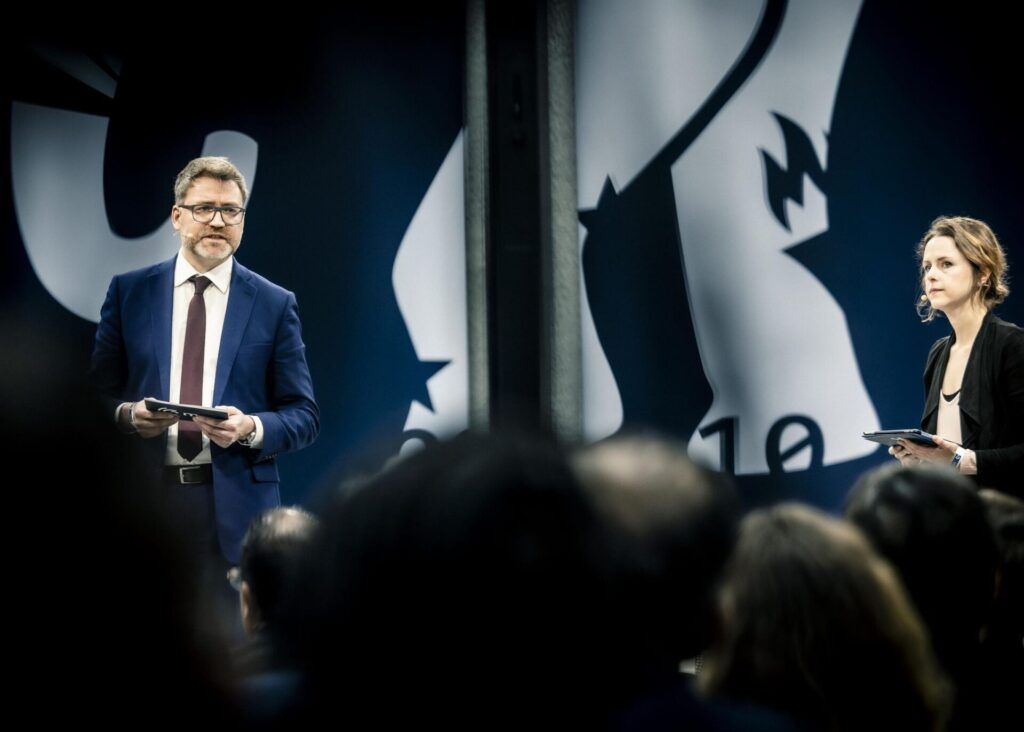 Tobias Bunde and Sophie Eisentraut present the Munich Security Report at the kick-off event of the Munich Security Conference on February 9 in Berlin. Bunde co-chairs the European Nuclear Study Group. (Credit: MSC/Kuhlmann)
MUNICH — The Munich Security Conference, the world’s most prominent forum for international security, started on Friday. Over 50 heads of state and hundreds of government officials and experts are expected to attend the annual conference, held inside the Hotel Bayerischer Hof in downtown Munich.
Last year’s edition is remembered for US Vice President JD Vance’s speech, during which he forcefully criticized Europeans for allegedly not defending the democratic values of free speech and fair elections. He added that, “the threat that I worry the most about vis-à-vis Europe is not Russia, it’s not China, it’s not any other external actor. And what I worry about is the threat from within, the retreat of Europe from some of its most fundamental values.” To drive the point home, Vance added that “it’s important in the coming years for Europe to step up in a big way to provide for its own defense.”
Many in Europe saw this speech as a turning point in transatlantic relations.
The tone will be different this year.
Vance is not on the guest list; the US administration preferred to send its Secretary of State, Marco Rubio, instead. (Under Secretary of Defense for Policy, Elbridge Colby, will take US Defense Secretary Pete Hegseth’s place; and US Ambassador to the United Nations and former National Security Advisor Michael Waltz is also announced to speak in Munich.) For its part, France is scheduled to also send an important delegation, including President Emmanuel Macron and several government officials.
The conference officially kicked off on Monday, with the release of the Munich Security Report titled “Under Destruction.” In it, the organizers argue that a period of “wrecking-ball politics” is gravely eroding the international security environment. The report goes on by calling out the rise of “demolition men” in politics—Donald Trump being only one prominent example of a global trend—who prefer moving fast and breaking things over deliberation and reform. And that destruction includes the transatlantic alliance. The report, which traditionally serves as a conversation starter for the conference, set the stage: “It is time for frank debates.”
The main theme this year will be how Europe can step up to its own security at a time when, in the words of the vice chair of the conference, Benedikt Franke, “many, if not most, Americans are no longer convinced by the intrinsic value of the transatlantic relationship.”
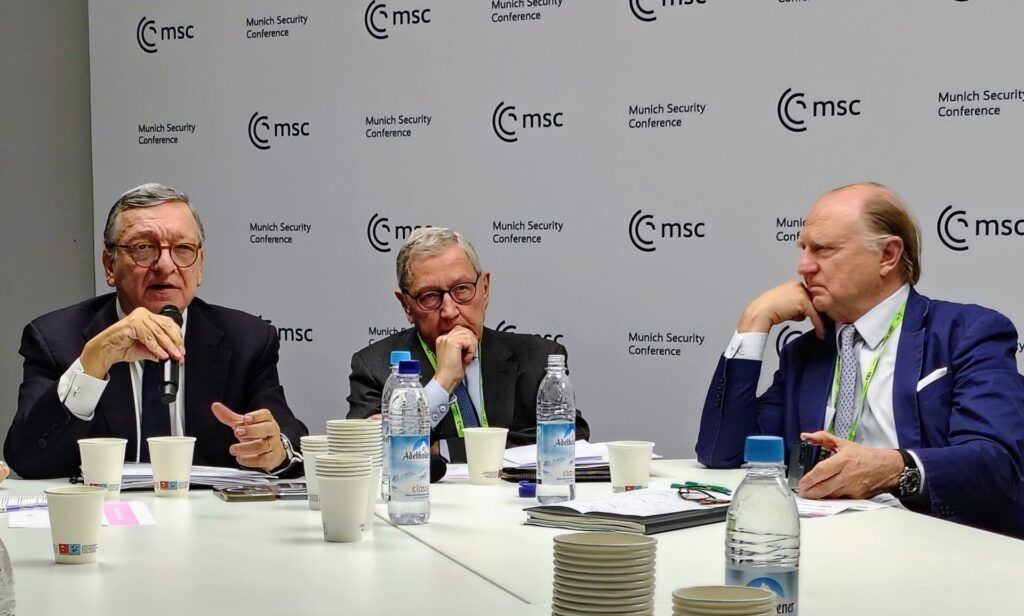
At a press briefing on Thursday, the Sovereign Europe Forum presented its recommendations to increase Europe’s defense and strategic capacity to react to external threats. Asked by the Bulletin about how Europe can overcome the different strategic visions on whether Europe should rely on nuclear weapons or conventional forces, José Manuel Barroso, former Prime Minister of Portugal and former President of the European Commission, answered, “I urge the leaders of Germany and France to get together and to solve their differences.” Barroso added that “the solution for these difficulties is to enlarge the problem, to find a big trade-off on very important issues. And this is perfectly possible.” Martin Schoeller, a co-founder of the Sovereign Europe Forum, added that if Germany is not going to own nuclear weapons, “France can build mid-range [nuclear-capable weapon] systems in Germany and agree that these can be used for the whole of Europe.”
On Wednesday, the European Nuclear Study Group, a joint European initiative co-led by the Munich Security Conference and established in 2024, published a report calling for urgent action to maintain nuclear deterrence in Europe. With the evocative title of “Mind the Deterrence Gap,” the report explores five possible nuclear options for Europe to deter President Putin’s revisionist Russia and counter President Trump’s undermining of the US security commitment to Europe. The nuclear options for Europe are all “bad options” according to the authors of the report. They range from continuing to rely on US extended nuclear deterrence, strengthening the role of French and UK nuclear forces, developing a common European deterrent, pursuing new, independent national nuclear deterrents, to investing in conventional deterrence without a nuclear component. The report, which relies heavily on Bulletin publications, will be officially presented during a round table at the conference on Friday.
Asked whether strengthening European deterrence was going to further undermine NATO’s credibility, Héloïse Fayet, a research fellow at the French Institute of International Relations (Ifri) and co-author of the report, explained that the credibility of NATO doesn’t rely only on its nuclear components. “The credibility of NATO might already be undermined by what Trump does, so what the Europeans can do together to strengthen European deterrence might not damage it further, because it will mean strengthening the European pillar of NATO.”
Former prime minister Barroso agrees: “My last point is this one: We should remain Atlanticists but Europeanize NATO.”
Together, we make the world safer.
The Bulletin elevates expert voices above the noise. But as an independent nonprofit organization, our operations depend on the support of readers like you. Help us continue to deliver quality journalism that holds leaders accountable. Your support of our work at any level is important. In return, we promise our coverage will be understandable, influential, vigilant, solution-oriented, and fair-minded. Together we can make a difference.
Get alerts about this thread
0 Comments
Oldest

François Diaz-Maurin
François Diaz-Maurin is the editor for nuclear affairs at the Bulletin of the Atomic Scientists. Previously, Diaz-Maurin was a MacArthur ... Read More