Editor’s note: This is part of an “experts comment” series on the expiration of New START.
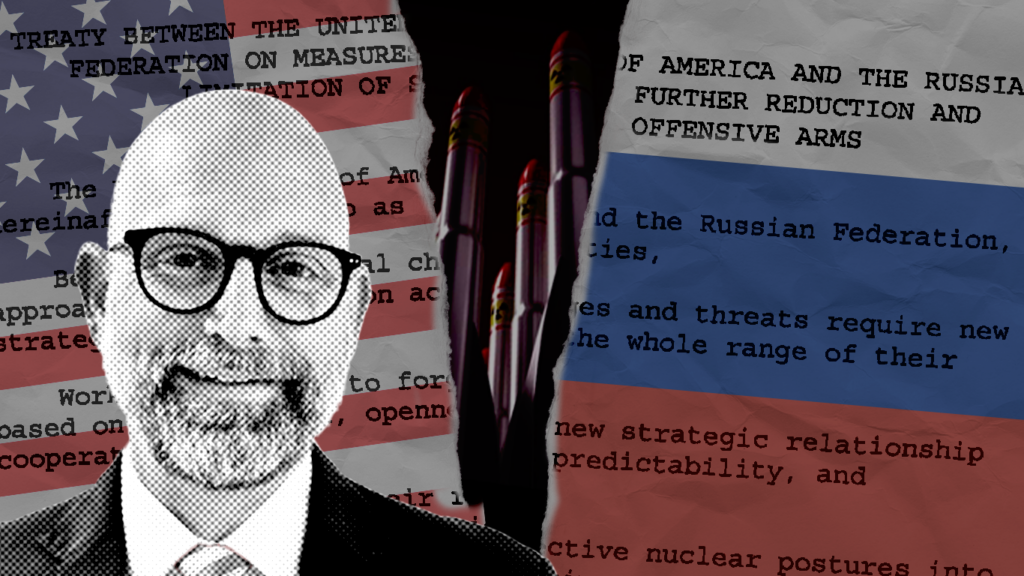
After the New Strategic Arms Reduction Treaty (New START) expires this week, it will leave no legally binding restraints on the nuclear arsenals of the United States and Russia. For the first time since 1973, there will be no arms control guardrails to help prevent an unconstrained nuclear arms race.
What do we lose? New START was the latest in a half-century-long string of agreements that helped contain and then curtail the US-Soviet arms race and ultimately continued a post-Cold-War trend of progressively deeper strategic nuclear arms reductions between the United States and Russia, the two largest nuclear weapons states. While the two countries still have a combined nuclear arsenal of over 10,000 deployed and non-deployed nuclear weapons, that represents a dramatic reduction from the more than 70,000 they possessed in the mid-1980s.
Now that the treaty expires, so do its legally binding limits on US and Russian strategic nuclear forces. Under the treaty, each side was limited to 1,550 deployed strategic nuclear warheads, 700 deployed nuclear weapon delivery systems (comprised of intercontinental ballistic missiles, submarine-launched ballistic missiles, and heavy bombers), and 800 deployed and non-deployed launchers for these delivery vehicles (missile launchers, submarine launchers, and heavy bombers such as the B-2 and B-52).
New START required the sides to notify one another of specific strategic activities such as missile test launches and heavy bomber movements, provide data about the numbers of missiles and delivery systems, and permit on-site inspections. This allowed each side to monitor and verify the data it was provided about the other’s nuclear arsenals and associated delivery systems and launchers.
More broadly, the treaty provided a critical guardrail against nuclear competition between the United States and Russia. The combination of limits, data, and monitoring and verification provided each side with predictability for strategic forces planning, makeup, and deployments. It also helped with funding predictability, transparency between nuclear-armed governments, and reducing the risk of miscalculation or misperception between the world’s two largest nuclear powers.
The practice of implementing the treaty also provided valuable opportunities for dialogue and engagement between US and Russian officials at multiple levels—from senior military and diplomatic leaders down to on-site inspectors and technical experts confirming (or disproving) the data and declarations of the other side. With the expiration of New START, both sides also lose—possibly for good—critical connections at the senior and working levels. With strategic challenges mounting at unprecedented speed and complexity, US and Russian officials and lawmakers must roll up their sleeves and revitalize dialogue and cooperation. They should remember that, in the past, cooperation has led to successful outcomes and provided a baseline stability and predictability that has benefited both sides’ security.
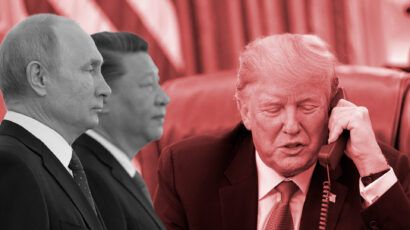
What comes next? Diplomatic efforts between the United States and Russia regarding a New START follow-on have been essentially non-existent beyond soundbites from the two presidents. Two days into his current term, President Donald Trump noted the possibility of talking to Russia and China about future arms control: “Tremendous amounts of money are being spent on nuclear, and the destructive capability is something that we don’t even want to talk about,” adding, “we want to see if we can denuclearize, and I think that’s very possible.” In September, Russian President Vladimir Putin stated that Russia was “prepared to continue observing the central quantitative restrictions” for one year after New START expires, but only if the United States “acts in a similar spirit.” There is no public indication that the Trump administration responded to Putin’s offer already, and the president has sent mixed messages in his public remarks. In October, Trump said of Putin’s offer, “Sounds like a good idea to me.” Then, in a January interview with the New York Times in the Oval Office, Trump said of New START, “If it expires, it expires. We’ll do a better agreement.”
The good news is that it’s not too late. And President Trump has the right idea.
Preserving limits on Russian and US nuclear weapons is indeed a good idea, and there are ways by which the current parameters of those limits can be improved to account for new geopolitical and technological realities. There exists a middle ground between accepting Putin’s offer without negotiation and embarking on a nuclear arms race the likes of which the United States has not undertaken since the Cold War.
If Washington and Moscow are serious about preserving any baseline nuclear stability and predictability in a very complex and uncertain world, the sides could agree to adhere to New START’s limits for one year as part of a broader agreement. Such a new agreement should include immediately beginning serious, high-level talks on a follow-on strategic weapons agreement, resuming meetings of the Bilateral Consultative Commission (New START’s implementing body) to foster dialogue and avoid misunderstanding, and placing new strategic systems under New START’s central limits for the one-year period, specifically Russia’s Sarmat heavy intercontinental ballistic missile and the Kinzhal air-launched hypersonic missile.
These stop-gap measures will not be easy to implement; these are complicated issues and challenging times. But letting New START expire without even trying to offer some guardrails for what comes next is sure to add more uncertainty and ambiguity to an already volatile international security environment. That should be the common ground in Washington and Moscow.
Together, we make the world safer.
The Bulletin elevates expert voices above the noise. But as an independent nonprofit organization, our operations depend on the support of readers like you. Help us continue to deliver quality journalism that holds leaders accountable. Your support of our work at any level is important. In return, we promise our coverage will be understandable, influential, vigilant, solution-oriented, and fair-minded. Together we can make a difference.
Keywords: Donald Trump, New START, New START expires, Russia, United States, Vladimir Putin, arms control
Topics: Nuclear Weapons
Get alerts about this thread
0 Comments
Oldest

Greg Dwyer
Greg Dwyer is the principal owner of the consulting firm Guidemark Diplomacy and a former director of the United States Department of Energy’s ... Read More