Senseless obloquy: Benjamin Wilson’s false and incoherent vilification of Hans Bethe and Richard Garwin
By Tom Garwin | Opinion | March 27, 2026
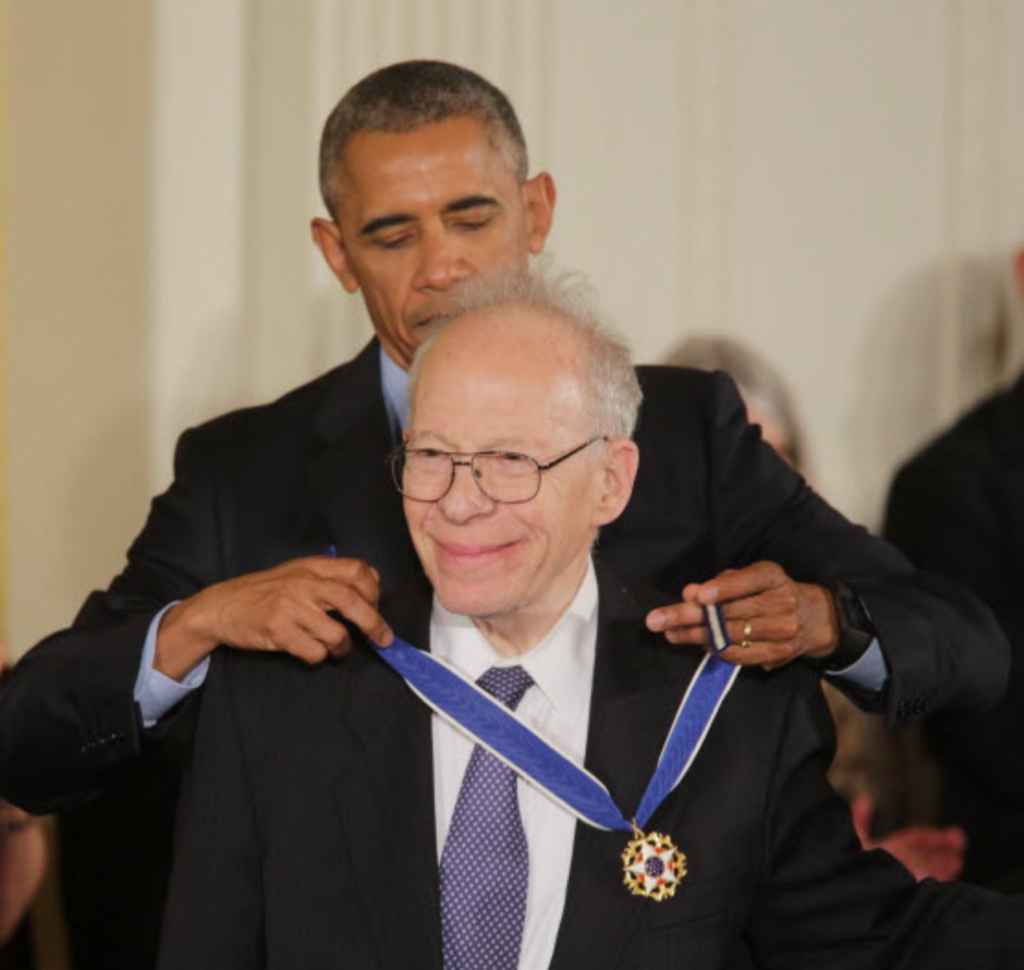 Dick Garwin received the Presidential Medal of Freedom in 2016 (White House photo).
(The following is a rejoinder by Tom Garwin[1] to an article by Benjamin Wilson that the Bulletin published online on January 5, 2026.)
Early this year, without any external review, the Bulletin published an article in which Benjamin Wilson purports to overthrow the common understanding of an important episode in the democratic control of American nuclear weapons policy.[2] Hans Bethe and Richard Garwin were respected atomic scientists who opposed the Sentinel and Safeguard Anti-Ballistic-Missile (ABM) deployments proposed by the Johnson and Nixon administrations. In the March 1968 Scientific American, they published detailed physics and strategic arguments against such systems. Wilson depicts them as hypocrites who opposed the deployments in public while supporting them in private, owing to their roles as “corporate consultants” to defense contractors.
This is all nonsense, as will be demonstrated below. It goes against the judgments contained in many articles previously published by the Bulletin, including one co-authored by Wilson himself.[3] For example, after Bethe’s death in 2005:
Never regretful of his time working on the Manhattan Project, Bethe nonetheless carefully weighed the moral implications of the weapons work that followed. … As close colleague Victor Weisskopf once commented about Bethe, “His sense of duty toward society is so deeply ingrained that he isn’t even aware of its being a sacrifice.” [emphasis added][4]
In addition to relying on the public record, this rejoinder is informed by a lifetime of interaction with Garwin regarding national security issues and otherwise. As with Bethe, most everyone who interacted with Garwin sensed his “exceptional honesty” and his commitment to truth.[5] Garwin did not present different views to different audiences. He would not have tolerated corrupt actions by colleagues.
Wilson was able to render his conclusions plausible only by misrepresenting his sources.
This rejoinder is much longer and more detailed than would be needed to vindicate the reputations of Bethe and Garwin, even for those who may be unaware of their contributions.[6] A comprehensive response is needed to illuminate and combat the intellectual and institutional practices that resulted in the production and publication of Wilson’s meritless work.
Wilson’s willful misrepresentations. Garwin and Bethe’s Scientific American article is generally recognized as providing technical and strategic information and arguments that helped fuel public and congressional opposition to ABM. Wilson has been writing about this article for more than half of his adult life. Versions of many of the misrepresentations that now figure in the Bulletin article appear in his 2014 dissertation and in his 2025 book.[7] Richard Garwin was available to be interviewed by Wilson until his death in May 2025. Wilson chose to ignore this key source that was available for over a decade while he conducted his research.[8]
It is possible to review only a fraction of the source material that Wilson cites in support of his claims. In violation of a basic principle of scientific research, he has refused to provide copies of any of the archival material that he cites.[9] Given the many times Wilson has misrepresented source materials that are available online, no reader should have any confidence in his handling and interpretation of archival material that isn’t.[10]
To limit the length of this rejoinder, many of Wilson’s misinterpretations and misrepresentations are addressed only in endnotes. The endnotes also provide extensive substantiation and documentation of statements in the text.
In just 2000 words, Wilson makes at least seven overlapping false claims about Bethe and Garwin, through explicit statement and innuendo:
(1) They were hypocrites who in private supported deployment of the system they opposed in public.[11]
(2) They misled their readers by denying they used classified information in the Scientific American article.[12]
(3) They “postured” themselves as independent scientists at war with the military-industrial complex, but, actually, they were its creatures.[13]
(4) They acted in the interests of defense contractors they served as paid “corporate consultants.”[14]
(5) Bethe used his membership on the President’s Science Advisory Committee (PSAC) to steer major defense contracts to his corporate client, AVCO.[15]
(6) They were not in charge of their own lives—they only went public in opposition to ABM because of a seemingly chance encounter with a magazine publisher.[16]
(7) Scientific American induced them to publish statements contrary to their beliefs.[17]
The following discussion addresses each of these false charges in turn.
(1) Did Bethe and Garwin ever support deployment of a national missile defense, and did they work in private “on behalf of the administration’s policy” that they opposed in public? Wilson concludes that Bethe and Garwin were “generally in favor of missile defense.” His source for this phrase is from the editor of Scientific American, who was using it as what grammarians call a “condition contrary to fact.” Flanagan knew that the authors were not “generally in favor of missile defense” but was arguing against including certain cases in which missile defense might have value because it might mislead the audience.
Wilson further states that
…if the most famous scientific “opponents” of ABM had gotten their way in the late 1960s, the United States would have deployed a national ballistic missile defense system.
This is false, and Wilson provides no real evidence for it. Wilson goes on to say,
… Bethe and Garwin seem to have calculated that they could become public “opponents” … without abandoning … their private work on behalf of the administration’s policy. [emphasis added]
The notion that they worked “on behalf of the administration’s policy” they opposed in public is also entirely untrue.
Bethe and Garwin each at times made statements that recognized some value in certain kinds of defenses. Some of these statements were rhetorical offerings, made tactically to show reasonableness. Statements finding some value in a thin area deployment were often of this nature, at least in part. Other statements were favorable only to very local defenses of hard points such as missile silos, that would not provide national coverage. During 1966-1972, Bethe and Garwin did not advocate deployment of any actual system either in public or in advice to the government, or in any way support missile defense “in general.”
Wilson believes that support for missile defense research was inconsistent with opposition to deployment; this is an element in his charge of hypocrisy. Wilson does not accept the obvious arguments that research on missile defense phenomenology and mechanisms was necessary to validate anti-ABM judgments and to evaluate techniques to ensure that American offensive missiles could penetrate potential Soviet defenses.[18]
Looking at the evidence Wilson provides for the inconsistencies he alleges:
The PSAC study from 1960 did not recommend deployment. PSAC opposed deployment every year.[19] The 1965 study mentioned by Wilson recommended against deployment. Bethe’s 1967 comments, even as reported by Wilson, do not advocate deployment of a national population defense that would threaten the Soviet offensive capability.[20] Whatever the attractions of a light defense to deal with small accidental launches and crazy leaders with small ICBM forces, both Bethe and Garwin recognized that, without credible limits on such a deployment, the Soviets would likely respond by deploying many additional ICBMs, impairing our security and stimulating a costly US procurement response. So they opposed any such deployment.
Both Bethe and Garwin believed that local defense of hard points such as missile silos could be useful, but only so long as it could not be seen by the Russians as a first phase of a population defense.[21] They never advocated deployment of such a system, in part because no components had been developed and in part because it was not yet needed. Detailed PSAC evaluations of options for hard-site defense that they participated in were negative throughout the period, and by 1970 the PSAC Strategic Military Panel on which they served judged that novel ICBM basing modes would be a better way to protect the deterrent than missile defense.[22]
This was consistency, not hypocrisy.
The Johnson administration’s policy was the deployment of the Sentinel system that used all the major components of the Nike-X thick population defense system for a “thin” anti-Chinese defense. The Nixon administration’s policy was the deployment of the Safeguard system that used the same Nike-X components ostensibly for silo defense. Bethe and Garwin opposed both deployments, in private as well as in public.[23] So there is no sense in which they acted “on behalf of the administration’s policy” during 1967-1972.
In 1991 Bethe recalled:
At first, I supported ABM and worked on it for several years. In the course of my work, however, I became convinced of the effectiveness of countermeasures—and penetration aids, especially. I concluded that ABM is likely to lead to an increase of offensive weapons by both sides. Defense of a hard point—such as a missile silo—is possible.[24]
This concise first-person account of Bethe’s views going back to before 1960 is entirely supported by the historical record.[25] Bethe opposed ABM in public as early as January 1962. Walter Sullivan of the New York Times reported on a public meeting:
The development of an effective defense against missile attack is, [Dr. Bethe] said, “virtually hopeless.” An attacker can fill the skies with decoys and thus launch, at one time, more missiles than any defense system could cope with, he explained.[26]
Later in 1962, Bethe published an article in the Bulletin that described effective missile defense as “impossible”:
The offense has always many more possibilities than the defense. The offense can choose its target, it can concentrate a lot of fire on one target while the defense has to defend 20, 50, 100 different targets. The offense can always bring in enough missiles to use up all the defensive missiles which may exist near one target. The offense can fire a salvo of many missiles simultaneously which will saturate the radars. And most important, the offense can send, with the actual missiles, decoys, gadgets which look to the radars just like missiles. In spite of intensive work on this problem it remains extremely difficult to find any way to tell them apart. For these reasons I believe there is no effective AICBM system.[emphasis added][27]
I was involved in preparing Garwin’s letters to United States senators regarding ballistic missile defense in 1969. Thereafter Garwin and I talked about missile defense whenever it was in the news, and sometimes when it wasn’t.
Garwin’s approach to analyzing missile defense systems remained the same from 1967 until his death. Technical, strategic, and economic considerations including cost-exchange ratios and total cost, counter-measures and circumventions, crisis stability, and arms-race stability all figured into his assessments. He consistently regarded population defenses—even thin ones—as destabilizing if they were not credibly limited to a very small scale or very low performance. Usually he concluded that the offense would prevail over the defense, but not always—viz. his 1976 article in the Harvard journal International Security that presented low-tech defenses for hardened silos that did not involve interceptor missiles, and his later work with Ted Postol on boost-phase interception of North Korean ICBMs.[28] This devotion to case-by-case analysis explains many of the episodes that Wilson sees as apostasy based on his silly expectation that Bethe and Garwin should have “oppose[d] missile defense per se.”
(2) Did Garwin and Bethe mislead their readers about what information they used in Scientific American?
No. There is a kernel of truth in Wilson’s exegesis. Everything Bethe and Garwin wrote was “informed” by all the information they had available to them, including classified studies. How could it be otherwise? Wilson presumably would not want them to advance arguments they knew to be wrong. They took care that the article did not inadvertently disclose classified information. Garwin’s respect for classification and ability to keep secrets is legendary.[29] The authors each submitted their work to the Defense Department for review.[30] So it would be extremely odd if the article contained anything other than public information.
Garwin and Bethe showed their work in detail in the published article. While the equations may be obscure to Wilson, to a physics professor they are straight out of a classical electrodynamics textbook. The article’s bibliography includes the 1962 edition of The Effects of Nuclear Weapons, the standard compendium of unclassified information on weapons effects published by the Atomic Energy Commission and the Defense Department. Chapter Ten of this book comprises forty-five pages packed with equations and data concerning “Radio and Radar Effects,” including information from high-altitude nuclear explosions. Wilson performed no analysis to show that Garwin and Bethe published anything that went beyond what physics could derive from this public information. He seems not to be aware that The Effects of Nuclear Weapons existed or that Bethe and Garwin were relying on it.[31]
Wilson suggests that the Scientific American article’s stated reliance on public information and basic physics calculations somehow tricked younger scientists into falsely believing that they could analyze defense programs without inside information.[32] He doesn’t identify one scientist who complains of such deception—because there aren’t any.
Sometimes detailed information about weapons configurations, internal defense department studies, and even from classified experiments may be needed for fine-grained determinations.[33] This should prompt a discussion of how our polity should ensure that outside analysts can be assured access to needed information.[34] Such useful questioning doesn’t interest Wilson; he’s just out to bust myths.
Wilson is wrong to suggest that inside information is always needed; often physics calculations based on unclassified information can be determinative. Wilson mentions one of these examples in his chapter on SDI, though he seems not to grasp its significance.[35] It was largely basic physics calculations and the public’s lack of concern about the Soviet “threat” that prevented SDI deployment. Basic physics calculations and data from The Effects of Nuclear Weapons were also sufficient to reduce concerns about the vulnerability of Minuteman ICBM silos to attacks by multiple warheads.[36] More recently, basic physics alone served to refute Pentagon hype about air-breathing hypersonic weapons.[37]
So Wilson failed to understand or engage with the scientific basis for the article’s discussion of radar blackout, ignored available evidence that contradicted his claims, and misled his readers about Bethe and Garwin’s use of classified information.
(3) Did Bethe and Garwin “posture” or “perform” or otherwise present themselves as whistleblowers or independent scientists at war with the military-industrial complex, when they were its creatures?
So far as one can tell, neither Bethe nor Garwin ever presented himself as being against the “military-industrial complex,” or against “the military.” The Bulletin article presents no evidence that either of them did so. Wilson’s book includes an extended discussion demonstrating that Bethe and Garwin (also Jerry Wiesner) were not “whistleblowers.” They didn’t think of themselves as revealing secret wrongdoing; so the term didn’t apply to them. Wilson’s use of the term is anachronistic; it only came into common use six years or more after the publication of the Scientific American article.[38] To argue that they were not true to this “posture” is an absurd distraction.
Bethe and Garwin presented themselves not as “independent scientists” or “whistleblowers” or “opponents of the military-industrial complex” (as Wilson claims at various points), but as informed physicists who provided the public and Congress information and analysis needed to decide an important national security issue. The “AUTHORS” section of the March 1968 Scientific American disclosed their roles as nuclear weapons scientists and government
advisors.[39] Their inside knowledge formed part of their authority.
The positions they took demonstrate that they were not creatures of the military-industrial complex and did not do its bidding. Bethe and Garwin favored reductions in nuclear forces. Garwin hoped his efforts would reduce the defense budget. He also had a reputation for being rough on military briefers and showing no deference to generals or admirals.[40] Bethe and Garwin were for good policy decisions based on good technical and strategic analysis, cost concerns, data, physics calculations, and moral considerations.
(4) Did Bethe and Garwin act against the public interest owing to their roles as “corporate consultants” to defense contractors?
Wilson offers no evidence that Bethe put the interests of AVCO (the corporate client Wilson mentions in the Bulletin) ahead of the national interest, or that his work for AVCO unduly colored his perception of the national interest. It is reasonable for Wilson to raise questions about the AVCO connection.[41] But while his book provides a lot of detail, casts many aspersions, and makes Bethe sound bad, it doesn’t land the punch. Wilson doesn’t consider whether Bethe’s work at AVCO was important to American national security.
There is strong evidence that Bethe’s science advice to the government was not determined by AVCO’s interests. Both Bethe and Garwin consistently argued for much lower missile and warhead numbers than demanded by the military services, and Bethe later supported the “nuclear freeze” that would have stopped missile procurement. They thus repeatedly opposed the interests of AVCO, a leading developer and manufacturer of missile warhead reentry vehicles.[42]
This is adequate to refute the substance of Wilson’s insinuation that Bethe and Garwin were corrupt. But it is important to understand that this is not a close call based on a preponderance of evidence. Much of Wilson’s supposed evidence disappears on inspection.
In supporting his disparagement of Garwin as a “corporate consultant,” Wilson identified Garwin as a “consultant to AVCO and other defense contractors.”[43] This is a gross misrepresentation. Garwin’s employment relationship with IBM meant that from 1952 forward he did no consulting for defense contractors. Over the course of at most a year (1951-2), in addition to his teaching and research at the University of Chicago, he did a small amount of consulting for AVCO and served “for a couple of days” on an advisory committee for Convair (General Dynamics). These brief consulting relationships ended 15 years before Defense Secretary Robert S. McNamara’s San Francisco speech announcing the Sentinel deployment.[44] It’s thus ridiculous for Wilson to identify Garwin as a corporate consultant and to insinuate that AVCO and General Dynamics somehow influenced his advice on ABM.
Garwin’s employment with IBM also did not influence his advice to the government, and his work for the government did not affect his income. There was a firewall between his work for IBM and his work for the government, to the extent that no one at IBM knew about the substance of his government activities.[45] When asked what IBM got out of the third of his time that IBM made available to the government, Garwin said that he hoped his work reduced defense spending and so saved IBM money in taxes.[46]
While Bethe had a relationship with AVCO that supplemented his nine-month salary from Cornell, his positions on ABM were essentially the same as Garwin’s, who had no conflict of interest. An unbiased observer would conclude that serving as a consultant did not cloud Bethe’s judgment or affect his advice.
(5) Did Bethe use his position on PSAC to steer major defense contracts to AVCO?
Wilson claims that:
As a government advisor, Bethe helped Avco win major contracts, primarily as a member of the White House’s President’s Science Advisory Committee (PSAC).
This irresponsible and reckless accusation is extremely serious. Wilson doesn’t even pretend to provide evidence for it in the Bulletin.
Garwin would have been outraged had he suspected that Bethe was shilling for AVCO. Garwin knew Bethe for 55 years. His judgment of Bethe’s character was opposite to Wilson’s:
For Hans, integrity was the word that came most often to my mind.[47]
The Pentagon was not in the habit of doing things PSAC wanted. PSAC had no role in contract definition or source selection, the two steps that would be crucial to direct a major contract to AVCO.
Wilson’s book is filled with innuendo on this subject as well as others. The best he can do in the book to show that Bethe might have steered a contract to AVCO is to allege that AVCO got a research contract soon after a PSAC discussion of the subject area. Wilson appears not to understand that much of PSAC’s work consisted of reviewing on-going government activity, including research on reentry. Contracts are not let overnight; there is a long lag between the decision to grant a contract and the final contract action. So, if AVCO got a contract shortly after a PSAC meeting, then that PSAC meeting had nothing to do with AVCO winning the contract.[48]
Finally, contrary to Wilson’s statement in the Bulletin, this was not a “major” contract. All the circumstantial innuendo that Wilson can muster in his book does not come close to justifying the accusation in the Bulletin.
(6) Did Bethe and Garwin only oppose ABM in public because of a seemingly chance encounter with a magazine publisher?
This is false, and laughable.[49]
Bethe worked to get key information declassified well before the encounter with the publisher of Scientific American—why would he have done so except as a step in preparing to go public?[50] Garwin and Kurt Gottfried, a colleague of Bethe’s at Cornell, reported after Bethe’s death that:
Hans, a longtime member of the PSAC Strategic Military Panel, had decided before McNamara’s announcement that he would make public his opposition to such a decision.[51]
Similarly, Garwin explained that he had begun thinking about how to approach Congress and the public starting before the 1967 Sentinel announcement, as soon as the Republicans began attacking the Johnson administration for inaction on missile defense in the run-up to the 1968 election.[52]
Wilson’s basic premise that making public statements on defense policy was new for scientists— “that they were drawn into a new kind of public performance by outsiders”—is flat-out wrong.[53] According to one scholar who has worked in the Bethe archives,
Commenting publicly on nuclear policy issues was an established practice for Bethe, going back to his postwar support for the international control of atomic energy and his brief public opposition to the H-bomb. During the late 1950s, Bethe had urged a nuclear test ban and studied the feasibility of systems to monitor an agreement. Throughout the postwar era, he appeared on television and radio programs and wrote wide-circulation articles.[54]
Who is this scholar who contradicts Benjamin Wilson? Why, it’s Benjamin Wilson. Even in this passage, Wilson leaves out Bethe’s public advocacy for banning nuclear tests. He ignores Bethe’s August 1960 Atlantic Monthly article, “The Case for Ending Nuclear Tests,” that was widely circulated in schools, along with a rebuttal by Edward Teller.[55] Wilson’s claim that public opposition to ABM by science advisors was novel in 1968 is also undercut by Bethe’s public opposition to ABM in 1962—opposition that Wilson had written about. In 2015 Wilson co-authored an article for the Bulletin that noted:
… as early as 1962 Bethe offered in the Bulletin his judgment that effective missile defense was technically “impossible.” But at that early date, the case was not easily made in public, “largely because much of the argument is classified,” he wrote. Thanks to his and others’ efforts, vigorous discussion of missile defense would become far more open by the end of the decade.[56]
If the contention that Bethe and Garwin went public because Scientific American tricked them into it were the only laughable falsehood in the article, one might think it an accident. But it is part of a pattern.
(7) Did Scientific American lead Bethe and Garwin to publish statements opposite to their own beliefs?
Wilson is mystified about “why the two physicists agreed to … changes” to the draft of the Scientific American article … “that reversed arguments that Bethe and Garwin had made for years.”[57] The obvious, and correct, reason is that supposed editorial changes by Scientific American did not contradict their previous positions or their beliefs.
Wilson likely misrepresents the process by which the article came together. He certainly goes well beyond the evidence he presents. He suggests that the Scientific American editors on their own revised and changed the meaning of drafts provided by the authors. They manipulated the authors into accepting statements contrary to their own beliefs. In addition to misrepresenting his sources, Wilson more than once vividly describes the state of mind of the Scientific American editor and publisher, creating high drama out of nothing.
A brief chronology suggests a more prosaic story than the one Wilson confected.
Bethe and Garwin separately wrote detailed papers to be delivered at the AAAS meeting on December 26, 1967.[58] Bethe’s portion was based on a lecture he delivered at the University of Wisconsin in June 1967 as well as a subsequent talk at Cornell, and included material he managed to get declassified in advance of the talk.[59] A few days after the AAAS session, on December 29, Bethe sent the manuscript of his AAAS talk to Dennis Flanagan, the editor of Scientific American, along with a cover letter mentioning an agreement that had been made by telephone whereby the staff of the magazine would consolidate Bethe’s and Garwin’s AAAS manuscripts and then the authors would edit the combined draft. Bethe suggested that the editors add an introductory section with a summary of the Sentinel system components.[60]
Garwin received a copy of Bethe’s letter and manuscript on January 2,
1968.[61] On January 3 he wrote a letter to Flanagan, saying that he would be glad to work with Bethe to revise the article once Scientific American produced a consolidated draft. This letter also acknowledged a telephone conversation with Flanagan. We don’t know the nature of this conversation, but it seems to have prompted Garwin to muse about the possible value of an area-only ABM system to deal with very small accidental launches or with a very initial phase of a Chinese ICBM deployment. Garwin said that such a system, made up of at most three Perimeter Acquisition Radars (PARs) and a few dozen exo-atmospheric Spartan missiles, with no expensive high-capacity engagement radars or in-atmosphere interceptors, would not pose a problem for the Soviets. While he wrote that this “would make a great deal of sense to me,” it was not quite a deployment endorsement.[62]
Garwin’s prepared AAAS remarks had included a mention of such an area-only system; there he did not advocate deployment of such a system but noted that it would have adequate capability against the very small and unsophisticated Chinese ICBM force (with no penetration aids) that some Sentinel proponents were positing, that it would be much cheaper than Sentinel, and that it might be rolled out in a way that would not provoke the Russians.[63]
On Friday, January 12, Flanagan wrote Bethe and Garwin acknowledging receipt of the written versions of their AAAS talks. He also responded to the Garwin letter, suggesting, as Wilson reports in his book, that the average reader would be confused if the article advanced what he called a “light light” system but opposed the “light” Sentinel system.[64] Flanagan said he looked forward to talking to the authors by telephone the week of January 15. No record of the content of such conversations has surfaced.
Contrary to the intended import of Wilson’s statement in his book that “Bethe’s section” was “uncritical of terminal defense,”[65] Bethe’s December 29 letter promised two typewritten pages that would address “The Disadvantages of a Terminal Defense.” Bethe mailed this promised “Supplement to AAAS talk” to Flanagan on January 19.[66] The text of this supplement was included in the consolidated draft that the editors sent out to the authors, presumably in the last week of January. Garwin completed marking this up by hand on the evening of Friday, February 2.[67] In addition to the supplement on terminal defense, this consolidated draft contains the summary of the Sentinel system that Bethe had requested, preceded by a few introductory paragraphs that may be presumed to have been based on public discussion at the AAAS meeting and subsequent telephone conversations with the authors.
Wilson seems to claim that this draft (that he doesn’t cite and may not have seen), as received from the editors, replaced a favorable discussion of an area-only defense in some other draft (that he also doesn’t quote or cite) with new material showing how China could penetrate Sentinel. This appears to be false based on the chronology. Since Garwin had suggested in the last sentence of his January 3 letter to Flanagan that he would wait until he edited the consolidated draft to expand on his views on what Flanagan called the “thin thin” defense, there seems to have been no previous draft (other than the AAAS manuscripts) for the editors to rewrite. In his book, Wilson doesn’t cite any drafts, only the published article.[68] Moreover, the China argument that Wilson says was added by the editors was present in Garwin’s AAAS manuscript.[69] Garwin’s handwritten edits on the consolidated draft do not mention the area-only (“thin-thin”) defense.
In the AAAS, talk, Garwin had provided arguments against the value of an area-only system, highlighting how China could attack the United States without missiles, and how even an initial Chinese ICBM deployment could penetrate ABM, and emphasizing that one could rely on deterrence against China. It’s reasonable to see Garwin’s discussion of arguments for an area-only defense as a search for the most politically effective rhetoric rather than actual advocacy. He seems to have thought better of it after receiving Flanagan’s letter, or maybe Bethe talked him out of it, or perhaps he changed his mind after a good night’s sleep. Contrary to Wilson’s account, there is no evidence of high drama associated with this change of mind, and no evidence that “the editors were horrified.”[70]
By February 2, in his letter transmitting his handwritten changes to Bethe, Garwin had returned to the formulation of his AAAS talk, writing that “a deterrent policy is adequate against China.” He still wanted to address an area-only defense in the article, but only as a cheaper and possibly less harmful alternative to Sentinel, that showed the wastefulness of Sentinel, not as something he supported.[71]
Thus, contrary to Wilson’s highly imaginative drama, the record shows no major substantive changes to the authors’ manuscripts.
Turning from editorial process to the substance of the published article, the next paragraphs review all the ways in which Wilson claims that it reversed Bethe’s and Garwin’s previous positions.
Projected ABM effectiveness against China was highly dependent on the time frame of the projection and assumptions about China’s rate of technical advance, but no one doubted that China would ultimately be able to deploy penetration aids and other countermeasures—or just to overwhelm a light system with multiple nuclear warheads. The key word in the section of the Scientific American article that Wilson quotes is “indefinitely.” Defense planners could argue about the value of a thin defense against China for a period of uncertain length before China could develop countermeasures. But, looking far into the future, as meant by “indefinitely,” China would certainly be technically capable of penetrating a thin defense as well as the Soviets could in 1968. So the language in Scientific American does not reverse previous acknowledgements that a light defense might stop some Chinese missiles for some period after an initial ABM deployment. Moreover, Garwin had argued in his December 1967 AAAS talk, as in the Scientific American article, that even an initial Chinese ICBM deployment could easily be designed to penetrate Sentinel.
Some defense planners and advisers were concerned not to waste money and opportunity for technical improvement by deploying an anti-Chinese system that would reach operational capability before any Chinese ICBMs. China’s first ICBM (the DF-5) entered service in 1981; the 1968 announcement of an anti-China deployment was premature by half a decade.
Bethe and Garwin both worried that any light system would be seen as the initial phase of a heavy population defense, leading the Soviets to deploy many additional warheads that could explode in the United States, killing more Americans. The United States would no doubt respond with its own additional ICBMs, in an offensive arms race spiral, leading to even greater potential death and destruction. They judged that the negative effect on our security of this Soviet response would outweigh by far any possible temporary value of a thin defense. So they could recognize theoretical value in a light area defense but still oppose deployment of the system that the Pentagon was calling “light.”[72]
Bethe and Garwin elaborated on this argument in a letter published in the May issue of Scientific American, written without any help from the editors. They argued that “the existence of a light ABM will make it more difficult to resist pressure for its expansion,” and that “The elements of the Sentinel system and the production capacity we build to produce it, together with the avowed possibility of technical upgrading of the system, may lead the U.S.S.R to consider it as directed against themselves.”[73]
The final alleged reversal is more dramatic. Wilson claims that the authors were now against defense of hardened missile silos, though they had previously said favorable things about this mission and even described types of components that should be explored for implementing it. But this reversal is a mirage. Wilson made it seem factual by interpolating a false equivalence into a quotation from the Scientific American article: he put the words “protecting missile silos” in brackets to explain the meaning of “terminal defense.” It is plain from the next paragraph of the Scientific American article that “terminal defense” meant protecting populations with high-acceleration interceptors exploding nuclear weapons high in the atmosphere, not close-in defense of missile silos.[74]
That Wilson could make this false equivalence shows his lack of technical understanding, as well as an apparent failure to read the article. The Sprint missile only provided “terminal” defense in a relative sense; it was designed to reach up to 22 miles in altitude before exploding, and each Sprint battery would protect an area of 500 square miles.
Since neither Bethe nor Garwin had supported such a “terminal” defense of populations against ballistic missiles in the decade before 1968, this was not a reversal.
There were no reversals. Wilson misrepresented the editing process, took statements out of context and falsified what the Scientific American article said in trying to support his untenable theory that Scientific American led Garwin and Bethe to publish statements contrary to their beliefs.
Setting the record straight. Bethe and Garwin did not mislead their audiences, they weren’t hypocrites, and they didn’t act corruptly in their roles as government advisors. Neither physicist publicly or privately advocated any actual deployment in the period Wilson addresses, and they certainly didn’t favor a “national” missile defense.
They sometimes recognized value in a thin defense, at least for purposes of argument, but concluded that any such system would easily and rapidly be overcome, penetrated, or circumvented by Chinese countermeasures. Any value against China or accidental launch would be outweighed by additional Soviet missile procurement, if the size and capability of the defense and even its industrial base were not strictly and credibly limited.
They advanced arguments for point defenses of missile silos that would be demonstrably incapable of defending the population, but no such system was proposed by the government, the components for such a system did not exist, and the strategic situation in 1968 did not require a defense of missile silos. So neither Bethe nor Garwin advocated deployment of such a system.
By the time defense of Minuteman silos became a pressing issue inside the government in 1969-70, the PSAC Strategic Military Panel on which they served opposed all the silo defense options proposed by the Pentagon and expressed skepticism toward additional variants explored by the scientists, suggesting that the missile force would be better protected by enhanced hardening and novel basing modes.[75] These were fine-grained judgments based on well-developed analytic perspectives derived from grappling with technical, strategic, economic, and moral issues, over many years.
Wilson thinks Bethe’s and Garwin’s overall goal was or should have been to oppose missile defense in general, when in fact they aimed to protect the world from nuclear war and millions of deaths, to improve American security, and to economize on defense spending.
The value of the President’s Science Advisory Committee. Wilson thinks it is damning that the inside arguments of Bethe and Garwin (and others) were reflected in McNamara’s launch speech for Sentinel.[76] His image of a monolithic “military-industrial complex” prevented him from understanding that, on nuclear policy and matters of force structure, McNamara had mostly opposed the Joint Chiefs and especially the Air Force for his entire tenure. The congruence between the arguments of the science advisors and McNamara’s San Francisco speech actually meant that (1) they and McNamara had succeeded in preventing a heavier defense and (2) ABM was much easier to oppose in public, because, as was widely noted at the time, the Defense Secretary’s speech read as a powerful argument against missile defense with a politically motivated deployment announcement tacked on at the end.[77]
As Morton Halperin pointed out in 1974, while McNamara was forced by politics (and the failure of arms control negotiations with the Soviet government) to announce deployment, the arguments of McNamara and the PSAC scientists seem to have convinced the Nixon administration to forego nuclear superiority and accept nuclear parity with the Soviet Union, to try not to deploy a missile defense that would look like a destabilizing population defense, and to agree to only one Safeguard site in the SALT negotiations.[78] In the end the lone Safeguard site was operational for less than a year before it was deactivated. Inside science advice and outside political agitation informed by insiders was important in reaching this beneficial result.
One can give Wilson the last word—from his Bulletin article with David Kaiser in 2015:
During the 1960s, scientists increasingly attacked ABM’s technical limitations, framing their arguments with the tools of their disciplinary expertise …
By the late 1960s, arms controllers like Bethe were ferrying information and arguments from classified contexts—in which many scientists worked as consultants and advisers to the government—out into a growing public debate about nuclear policy. Scientists had earlier chafed against the restraints of government secrecy, but the arms controllers relied heavily on their insider status and their access to secret information in fashioning critiques of government programs.
Thanks to his and others’ efforts, vigorous discussion of missile defense would become far more open by the end of the decade.
The destabilizing potential of missile defense was recognized in the landmark US-Soviet ABM Treaty in 1972, which put firm limits on allowed ABM deployments.[79]
There are many other examples where science advisors tried to make the world safer and more than a few where they succeeded:
Permissive Action Links (PALs) on nuclear weapons.[80] During the 1950s the United States deployed thousands of nuclear weapons that could be detonated without authorization, including in Europe where it was feared they could be overrun or stolen. Early in the Kennedy administration, the president’s science advisor, Jerry Wiesner, together with Harold Agnew and others including Garwin, succeeded in requiring that PALs be installed on American weapons, starting immediately with those deployed in Europe. American PAL ideas and technology were later shared with other nuclear powers. Although it took years for all American weapons to be protected, it is entirely possible that this one action saved hundreds of thousands of lives in the ensuing six decades.[81] Had unauthorized detonation of a weapon initiated a “catalytic” nuclear war (another aspect of instability), hundreds of millions of people could have been killed, and civilization could have collapsed in much of the Northern hemisphere.[82]
Elimination of America’s offensive biological weapons. PSAC played a key role both in the inter-agency argument and directly with President Nixon, leading to his decisions to eliminate America’s offensive biological weapons programs, including toxins.[83] Nixon’s unilateral U.S. action led directly to the 1972 international Biological Weapons Convention. This has likely saved countless lives.
Ban on DDT. PSAC, at Richard Garwin’s instigation, had played a key role in validating Rachel Carson’s critique of pesticides published in Silent Spring, offsetting the role of other advisory bodies that hewed close to chemical industry perspectives and beginning a process that led eventually to regulation of persistent pesticides and a ban on DDT.[84]
Nuclear Test Ban. As Wilson probably knows, Hans Bethe used his position on the President’s Science Advisory Committee to advocate for a full nuclear test ban. With his involvement, negotiations with the Soviet Union came close to succeeding during the Eisenhower Administration. The eventual limited nuclear test ban cooled the arms race and prevented much sickness and many deaths from fallout.
Wilson does not mention any of these examples. He does not provide a true or useful history of any of the people, topics, or institutions he visits for his drive-by attacks.
A final howler. Wilson concludes his Bulletin piece:
Nuclear thinkers and historians should avoid the complacent thought that rational expertise can transcend politics in the field of strategic weapons.
Wilson does not cite one person who believed that expertise would “transcend” politics. Does Wilson think expertise is a bad thing? One can’t tell.
I have been privileged to know many of the people that Wilson derides in his book. I have reviewed a thousand or more grant proposals from researchers and writers in the areas of peace, international security, and arms control. And I have interacted professionally with many hundreds of security professionals and participants in university programs on peace and security.[85] Not one of these people ever expressed the “complacent” thought that Wilson suggests was prevalent. At most they thought that expertise could nudge outcomes in the right direction, whether inside the executive and legislative branches of government or by informing the broader political debate.
This absurd howler with no basis in fact is typical of Wilson’s interpretive approach and should warn readers not to credit any of his other conclusions.
Wilson’s incoherence. What can account for Wilson’s incoherent history and cavalier approach to facts?[86] Wilson’s primary narrative device is to set up a strawman—sometimes a version of an established interpretation and sometimes a hypothesis of his own invention—and then tear it down.[87] He also tries on various trendy interpretive frameworks—like whether the scientists were “performing dramaturgy”—and only looks at facts for confirmation. If scientists often supported R&D on systems whose eventual deployment they opposed, he assumes this is evidence of venality, rather than grappling with more sophisticated explanations.
Harvard University Press promotes Wilson’s book as countering myth, not presenting a history.[88] Any historical account that frames itself this way should be treated with great caution. Never does he tell a story of an event and explain how participants understood their actions and their significance, before turning to the significance for us today, as a mature historian would know to do. He has no theory of how government should work or understanding of how government and politics do work.
Under Wilson’s microscope, people like Bethe and Garwin are not human beings striving to make the world better; they are just objects that can be shown to be different from what some made-up “myth” says they should be. He demands that “liberals” or “arms controllers” oppose all missile defense all the time. When they fail to conform to his casting, he suggests falsely that they are under the corrupt influence of money, rather than acknowledging that he doesn’t understand the real world.
To Wilson, as is clear from his book, there is no moral difference between Bethe and Garwin on the one hand and Donald Brennan on the other—or maybe Brennan is superior. Wilson reports, without judgment, that Brennan became a racist as he drifted into right wing circles after he embraced right-wing attitudes toward missile defense.[89] It seems that Wilson thinks this is the fault of the “arms controllers” who rejected his arguments.
He laments that “strategic stability” has no fixed meaning, implying that no one took it seriously and that it was just a mask for machinations of the faceless military-industrial complex. But strategic stability is not a substance or thing—it’s a cluster of concepts in strategic analysis, and, contrary to Wilson, not the only concern of either those who saw arms control as a valuable policy tool or of defense intellectuals and planners more generally.
If he had understood the policy debates he has mined for his revisionist myth-busting, he would have realized that there are multiple aspects of stability that may be important in analyzing different aspects of the strategic situation.
I have already referred to “crisis instability”—involving incentives to strike first in a period where war has become likely, and to escalate once a war has begun—and “arms race instability”—the effect of a development by one side on procurement plans of the other, leading to an action-reaction cycle. These concepts (or their opposites) are each mentioned just once in Wilson’s 488 page book—and each reference is to a late usage by a right-wing figure rather than the more mainline analysts that put these concepts in play, in each case at least seven years earlier.[90] This is yet another indication that Wilson’s book is not an actual intellectual or social history but just a screed with footnotes.
Wilson’s book goes wrong at the outset, thinking that there was a unified group of “arms controllers” who came to dominate American security people. There never was a unified group, and they never were dominant, even when Bill Perry and Ash Carter led the Pentagon. It is absurd to think general and complete disarmament and a complete reorientation of foreign policy toward peace would have come to fruition but for the contrary efforts of a few “arms controllers” in academia and government and at foundations.[91]
The people he derides were conscientious human beings who thought international arms agreements limiting weapons could enhance prospects for peace and security. Advisers tried to make America and the world safer. Funders tried to strengthen cross-disciplinary training, research, and writing and to build a cadre of people conversant with these issues, and to make these more sophisticated analysts available for hiring into government.[92]
Things didn’t work out perfectly (though they could have gone much worse), but it wasn’t because “arms controllers” got the world they wanted.
Wilson’s methods of busting “myths,” trying out trendy interpretive frameworks and only interrogating the record to seek confirmation, and tracking multiple statements to find verbal contradictions, without understanding their context and significance, led him to make interpretive misjudgments. He bent the evidence to suit his revisionism, often to the breaking point.
Editorial failures of process and perspective. On the eve of the fifth anniversary of the attempted coup against American democracy, John Mecklin’s focus as chief editor of the Bulletin of the Atomic Scientists was not on fighting fascism or on any other threat to humanity—it was on publishing an incoherent confection of misrepresentations and innuendo, attacking two of the atomic scientists who previously had been treated as heroes in the pages of the Bulletin. The Bulletin’s editor has refused to retract Wilson’s article, although it is now labeled “opinion.” The Bulletin has insisted on his independence from Bulletin leadership and its Science and Security Board.
Before publishing an attempted takedown of these respected atomic scientists, Mecklin had a responsibility to investigate whether there was any basis for its wild claims. Based on multiple conversations with Mecklin and Bulletin leaders, it appears that no fact-checking was done, and there was no review by anyone with any relevant expertise.[93] But it shouldn’t have required fact checking to notice that Wilson’s article was incoherent. Accusing Bethe of using his membership on the President’s Science Advisory Committee to steer major contracts to AVCO—without explanation or footnote—should have been a red flag even to an editor without any knowledge of nuclear matters.[94]
Mecklin defended his decision to publish by saying the article was a provocative piece by a Harvard professor who had published a book in a subject area of interest to Bulletin readers.[95] In other words, he relied on the Harvard brand name as a cover for reckless disregard for the facts and the truth, just to generate controversy.
Even if there were some factual basis for any of Wilson’s lurid claims, how would stirring up a controversy over events from 1968 advance the Bulletin’s mission of reducing nuclear and other existential dangers? Even if there was some interesting facet of science advising or public discussion of weapons programs hidden in Wilson’s screed, would that really be important today, when the US government has no respect for science?
Wilson’s article should have been retracted once it was shown to be based on misrepresentations. Acting otherwise has damaged the credibility of the Bulletin and of the research process as a whole.[96]
Lessons for editors. Scientists have grappled increasingly with scientific fraud. Vaccine skepticism has killed children, and it stems from a fraudulent study that was ultimately withdrawn by the Lancet.[97] One response has been to insist on full data transparency. While Wilson’s false claims will not cause that degree of harm, they shouldn’t have been published without examination of his sources. Exceptional claims should require exceptional attention to evidence.
Many are still too ready to accept any academic study with footnotes at face value. One scientist wrote that he had approached Wilson’s article with a favorable presumption:
I was surprised at some of the statements but assumed Wilson must have evidence to back up his claims. All of the historians I know are meticulous in that regard, spending years piecing together memos and meeting summaries from government archives, private letters, etc.[98]
Editors and consumers of policy-relevant history need to become more sophisticated in how they read. They need to check whether statements are indeed supported by substantive footnotes. They need to check sources to see if they are reported accurately. They need to check facts. They should read more than one account of any historical episode and compare them against each other. They should prime their minds to ask the right questions by reading David Hackett Fischer.[99]
Finally, they should ask what is motivating the history, and what expertise the author brings to the story. What axe is being ground? If the overall motive is to debunk some prior idea, or to gain prominence at the expense of others, or if the author looks down on his subjects, the history is unlikely to be reliable. A good history bridges to the standpoint of the present but only after it reconstructs the perspectives of the past.
Editors must keep their eyes—and those of their readers—on what’s important for human freedom and survival today and not be distracted by insignificant provocations.
No editor has the expertise to assess the value of the wide range of articles submitted for publication or time to do the needed fact checking. An external review process is thus necessary for potentially controversial or important articles, though it can be informal.
Editors should look to Ruth Adams as a model. She edited the Bulletin for 13 years in two different stints but never became isolated or arrogant. While not a scientist, she was a member of the community that the Bulletin
represented.[100] She cultivated a wide network of brilliant people whom she could and did rely on for timely advice. A competent and confident editor of the Bulletin could adopt a similar approach. Such an editor should also take advantage of the Bulletin’s Science and Security Board. This board has abundant and diverse expertise and, according to the Bulletin’s website, is available to advise the editorial staff.
The Bulletin should now take appropriate steps to reclaim its proud heritage.
NOTES
↑ 1. The author is a son of Richard (Dick) Garwin and the executor of his estate. He was the founding director of the Nuclear History Program at the University of Maryland. He was professionally engaged with issues of arms control, peace, and international security through employment at Harvard University, the Pentagon, the Brookings Institution, the United States House of Representatives Committee on Armed Services, the John D. and Catherine T. MacArthur Foundation Program on Peace and International Security, Hicks and Associates, and Science Applications International Corporation. His publications include (with John Steinbruner) “Strategic Vulnerability: The Balance Between Prudence and Paranoia,” International Security 1:1 (Summer 1976), and (with Steve Fetter), “Using Tags to Monitor Numerical Limits in Arms Control Agreements,” in Barry Blechman, ed., Technology and the Limitation of International Conflict (Johns Hopkins Foreign Policy Institute, School of International Studies, 1989). He is grateful to Frank von Hippel for his (post-publication) line-by-line comments on Wilson’s article that were largely cast aside by the editor-in-chief of the Bulletin.
↑ 2. https://thebulletin.org/2026/01/how-hans-bethe-and-richard-garwin-served-the-missile-defense-system-they-publicly-criticized/. Wilson, a Harvard associate professor with no apparent policy background and a thin publication record, addresses the March 1968 Scientific American article by Richard Garwin and Hans Bethe that opposed deployment of the SENTINEL Anti-Ballistic Missile (ABM) announced by the Johnson administration and provided detailed scientific and strategic arguments to inform public and Congressional debates over missile defense. Richard L. Garwin and Hans A. Bethe, “Anti-Ballistic-Missile Systems,” Scientific American 218, no. 3 (March 1968): 21–31.
↑ 3. Within days of Garwin’s unexpected death, the Bulletin published nine separate admiring memorials by Matt Bunn, Rose Gottemoeller, Rita Guenther, John Holdren, Raymond Jeanloz, Herb Lin, Eryn MacDonald, Mike Murphy, and Frank von Hippel. See https://thebulletin.org/2025/05/experts-and-former-colleagues-share-their-appreciations-of-dick-garwin-h-bomb-designer-and-government-advisor/. David Kaiser and Benjamin Wilson. 2015. “American Scientists as Public Citizens: 70 Years of the Bulletin of the Atomic Scientists.” Bulletin of the Atomic Scientists 71 (1): 13–25. doi:10.1177/0096340214563679. https://doi.org/10.1177/0096340214563679.
↑ 4. “Passings” (2005). Bulletin of the Atomic Scientists, 61(6): 14–15. https://doi.org/10.1080/00963402.2005.11460928.
↑ 5. According to the journalist Dan Ford, agreeing with Murray Gell-Man on January 15, 2007, “Various people have told me about his level of honesty which they just found exceptional.” Oral History Interview, American Institute of Physics, https://repository.aip.org/node/129283, p. 9. According to Ralph Gomory, IBM Director of Research, on September 12, 2004, “Dick always tries to give an honest opinion. A lot of situations, people don’t want an honest opinion. So, what the hell? But that never deterred him, and frankly I think that’s just great.” https://repository.aip.org/node/129286 p. 10. From Wilson’s book bibliography it is evident that he accessed this oral history repository, and so he ignored or suppressed evidence that went against his thesis. The book is Benjamin Wilson, Strange Stability: How Cold War Scientists Set Out to Control the Arms Race and Ended Up Serving the Military-Industrial Complex (Harvard University Press, 2025). Page references are to the Kindle edition. Wolfgang (Pief) Panofsky, who had interacted with Garwin since 1959, and who sometimes criticized Garwin’s judgment ,said more than once to interviewer Dan Ford that Garwin was “absolutely honest” in providing technical analyses independent of his policy views. (December 7, 2004 Panofsky interview session 1. Garwin collection at the American Philosophical Society.)
↑ 6. The Bulletin has published two valuable short responses to Wilson’s article, by Frank von Hippel, and by Herb Lin. See https://thebulletin.org/2026/02/who-were-richard-garwin-and-hans-bethe-a-response-to-the-recent-attack-on-their-integrity-in-the-bulletin-by-benjamin-wilson/ and https://thebulletin.org/2026/03/facts-and-physics-still-matter-a-response-to-wilsons-historiography/
↑ 7. Benjamin Tyler Wilson, Insiders and Outsiders: Nuclear Arms Control Experts in Cold War America. MIT PhD Dissertation, available online at https://dspace.mit.edu/handle/1721.1/93810. Strange Stability, previously cited. The article is also discussed in Kaiser and Wilson (2015), previously cited.
↑ 8. First-person accounts can be inaccurate owing to faulty memory. They can be self-serving and even deliberately deceptive. Nevertheless, historians have a duty to engage with such sources if available, even if ultimately there are grounds to rely more on other evidence that conflicts with first-person accounts. Wilson also did not make use of Garwin’s papers. They are at the American Philosophical Society in Philadelphia. https://as.amphilsoc.org/repositories/2/resources/3388.
↑ 9. Wilson did not respond to emails and phone calls to his published Harvard email address and phone number, nor to attempts to reach him through the Bulletin.
↑ 10. The Bulletin has been an accessory to Wilson’s lack of data transparency, withholding supporting material the Bulletin says was provided by Wilson.
↑ 11. “…if the most famous scientific “opponents” [Bethe and Garwin] of ABM had gotten their way in the late 1960s, the United States would have deployed a national ballistic missile defense system.” “Bethe and Garwin seem to have calculated that they could become public ‘opponents’ of the Pentagon without abandoning their status as insiders or their private work on behalf of the administration’s policy.” Emphasis added. Unsourced quotations in this paper are from Benjamin Wilson’s 2026 Bulletin article.
↑ 12. “It was that knowledge—not back-of-the-envelope physics calculations—that later informed the relevant passages of his article with Garwin.”
↑ 13. “…Bethe and Garwin had challenged the military-industrial complex and upheld the independence of science—or so it appeared to the public. …Yet for all their posturing, Bethe and Garwin did not oppose missile defense per se, and they were not entirely independent scientists.” Five weeks after publication, the Bulletin deleted the phrase “Yet for all their posturing,” without otherwise changing the substance or tone of the article. Strange Stability contains the same sort of derisive rhetoric, saying that Bethe and Garwin were “performing opposition.” “Performing Opposition” is the title of the chapter that discusses the Garwin and Bethe article. The vilification could not be cured by removing an introductory phrase.
↑ 14. “As corporate consultants” …. “as a paid consultant to the AVCO corporation.” … “Richard Garwin, like Bethe, had also consulted for the AVCO Corporation and other defense contractors, and he too supported a light area defense.”
↑ 15. “As a government advisor, Bethe helped Avco win major contracts, primarily as a member of the White House’s President’s Science Advisory Committee (PSAC).”
↑ 16. “How, then, did Bethe and Garwin come to publish an article openly criticizing a defensive system resembling one they had supported for years? In short, they were drawn into a new kind of public performance by outsiders who desired displays of oppositional politics by scientists. And Bethe and Garwin obliged.” … “The [December 26-27, 1967 AAAS] event was attended by Gerard Piel, publisher of Scientific American”. … “He asked the physicists to write a joint article for the magazine, and they agreed.”
↑ 17. “Each of these points reversed arguments Bethe and Garwin had made for years, and in the weeks preceding the article, both in classified settings and in front of various audiences.”
↑ 18. See for example Garwin’s comments on an innovation to protect missile reentry vehicles from exo-atmospheric soft X-rays from high-altitude nuclear explosions. “The Secret Hans.” “…on the Strategic Military Panel, we encountered another surprise, that the greatest vulnerability of our nuclear missile warheads to nuclear-armed interceptors in space could be the influence of soft (but intense!) x-rays on the skin of the vehicle. …The remedy was in fact quite simple. Even assuming that one could not change the momentum contributed by the x-ray induced blow-off, one could eliminate the spall damage that it would produce. …All one really needs to do, however, is to insert a material with a [low] crushing pressure …. In brief, we found a simple technical solution and these techniques were then deployed to protect our reentry vehicles.”
↑ 19. On the PSAC stance see Bethe’s first-hand report in Jeremy Bernstein, Hans Bethe, Prophet of Energy (Perseus Books, 1980), pp. 102-107. See also Edward Randolph [Randy] Jayne. The ABM Debate (PhD Dissertation, MIT, 1969), p. 331. Available at https://dspace.mit.edu/handle/1721.1/14577. Also, Morton Halperin et al., Bureaucratic Politics and Foreign Policy (Brookings, 1974), chapters one and 16.
↑ 20. According to Randy Jane’s dissertation, citing an interview, “Even PSAC’s ABM panel, generally pessimistic of the Army’s approach to ballistic missile defense, did credit a thin area defense—as a finite, non-building block deployment [emphasis added]—as useful in both the accidental launch and anti-Chinese scenarios.” In other words, a thin defense might have value if it could be clearly distinguished from a defense that would impede a Soviet second-strike. p. 376 note 6.
↑ 21. As Garwin later put it in a debate with Richard Perle, “Silo defense equipment could in principle be very different from city defense, but this would require a system completely different from Safeguard. I believe that a system which is both less costly and more effective than Safeguard for this purpose should be developed, although not necessarily deployed.” Richard Garwin oral history interview with Finn Aaserud, American Institute of Physics, 8 June 1987, https://repository.aip.org/node/127936. Wilson knew of this interview, but he either ignored or suppressed this aspect of it.
↑ 22. PSAC’s Strategic Military Panel, on which Bethe and Garwin served, continued to argue that the Safeguard system would not be effective in defending the Minuteman ICBM force, and they also argued against the cost-effectiveness of the Army’s various hardsite defense options for Minuteman. They were somewhat more positive toward a notional one-hardened-radar-per-silo option, but concluded that novel ICBM basing modes were a better way of protecting the ICBM force. The National Security Archive has published the Drell letter of December 1969 and Larry Lynn memo to Kissinger of January 1970. https://nsarchive2.gwu.edu/NSAEBB/NSAEBB36/docs/doc05.pdf This documentary evidence shows that Wilson exaggerated PSAC support for silo defense during 1969. Strange Stability, pp. 261-263. By April 1970, President Nixon’s National Security Advisor, Henry Kissinger, was forced to let the President know that Bell Labs, the principal contractor for the Safeguard system, had decided on technical grounds that the system was not worth building. The Soviets could build an ability to cripple its radars, and the Chinese could produce fully effective balloons and other penetration aids, all before the system would become operational. See memos from Kissinger to Nixon and from Larry Lynn to Kissinger at https://nsarchive2.gwu.edu/NSAEBB/NSAEBB36/docs/doc06.pdf These were not the opinions of scientists blinded by the ideology of strategic stability, as Wilson sometimes seems to believe about “arms controllers.”
↑ 23. Wilson’s claim, even if taken as true, that Bethe assured Nixon’s Science Advisor that he would still be available to advise on how to make the system as effective as possible does not indicate that Bethe favored deployment. In their force planning, the Soviets most likely would assume the system would work, a working system would be better for Americans than a non-working system. Wilson does not cite any statement from either Bethe or Garwin endorsing Sentinel or Safeguard in any of his writings. In addition to the March 1968 Scientific American article, their opposition to Sentinel was reaffirmed in a joint letter to the editor published in the May 1968 Scientific American. Garwin sent a letter dated July 10, 1969 to every United States Senator, calling Safeguard “bad medicine” and arguing that the security of the nation would be enhanced if Safeguard were defeated in the Congress. (copy available from the author). Wilson quotes out of context from this letter a phrase where Garwin said he would support a “reorientation of Phase 1 of Safeguard” toward a tailored defense of Minuteman. In a typical misrepresentation, while Wilson does note that Garwin suggested that Minuteman could be defended with non-nuclear interceptors, he suppresses the introductory phase of the sentence he quotes from, “Although I personally do not see the need to defend Minuteman at this time…” and also the immediately following sentence, “Such an effective system would use none of the large (MSR or PAR) radars of the Safeguard system.” Garwin’s preferred system for defending Minuteman, which he personally thought was unnecessary, would use none of the components of Safeguard or Sentinel.
↑ 24. Hans A. Bethe, The Road from Los Alamos (New York: American Institute of Physics, 1991). Preface, p. xiii.
↑ 25. Bethe dated his belief that offensive penetration aids could render defense useless to his service as Chair of the PSAC subcommittee on missile defense during the Eisenhower Administration. Jeremy Bernstein, p. 105. See also William Broad’s New York Times story from 1984. https://www.nytimes.com/1984/06/12/science/hans-bethe-confronts-the-legacy-of-his-bomb.html, that dates Bethe’s analytic opposition to ABM from early in his 1956-1959 tenure on PSAC.
↑ 26. NYT, January 6, 1962, p.4. Cited at Joel Primack and Frank von Hippel, Advice and Dissent: Scientists in the Political Arena (New York: Basic Books, 1974), p. 73 n. 7. Wilson cites this book.
↑ 27. https://doi.org/10.1080/00963402.1962.11454389, p. 18. Wilson cited this article by Bethe in the Bulletin article he co-authored with David Kaiser in 2015.
↑ 28. Richard L. Garwin, “Effective Military Technology for the 1980s,” International Security 1:2 (Autumn 1976), available at https://rlg.fas.org/100076EeectiveMilitaryTechnologyforthe1980s.pdf. Garwin was prompted to invent the non-interceptor methods for silo protection presented in this article by a breakfast conversation regarding unclassified calculations of damage to hypersonic ICBM warheads encountering dust clouds from previous nuclear explosions in a Minuteman basing area. On boost-phase intercept of North Korean missiles, see https://www.nytimes.com/2022/09/19/science/missile-defense-north-korea.html.
↑ 29. No one knew of his role in designing the first thermonuclear device and the first operational (JUGHEAD “emergency capability”) H-bombs, not even his wife. “A Scientist Fighting Armageddon Hid a 50-Year Secret.” William Broad, https://www.nytimes.com/2025/05/19/science/richard-garwin-hydrogen-bomb.html.
↑ 30. On the steps Garwin and Bethe took to submit their material for review, see Anne Hessing Cahn, Scientists and the ABM (1971), MIT Ph.D. dissertation, pp. 90-91. https://dspace.mit.edu/handle/1721.1/15165.
↑ 31. The bibliography is on page 150 of the March 1968 Scientific American. See Samuel Glasstone, ed., The Effects of Nuclear Weapons (U.S. Government Printing Office, April 1962, Revised Edition, Reprinted February 1964), pp. 502-546 and 50-52. This reference book, known to every analyst of nuclear effects, is not mentioned in Wilson’s book or its bibliography. Readers should ignore Wilson’s suggestion that Garwin’s and Bethe’s supposed use of secret information is demonstrated by the fact that one Atomic Energy Commission official was reportedly surprised at how much information was contained in the article. Strange Stability, p. 247. Insiders rarely have any idea of how much information is public, and Bethe got information declassified in advance of publication. Joel Primack and Frank von Hippel, Advice and Dissent: Scientists in the Political Arena (New York: Basic Books, 1974), p. 181. In his book, Wilson makes a big deal of Bethe’s classified knowledge of high-altitude nuclear effects and ties it to his relationship with AVCO. He incoherently claims that the discussion in Scientific American is based on classified information but cites unclassified letters on the subject from 1960. Strange Stability, footnote 122. In the Bulletin, Wilson says that “Avco provided the reentry vehicles for a series of high-altitude nuclear tests in 1962, leading Bethe into a years-long classified debate with fellow weapon scientists about the complex physics of radar blackout.” … “It was that knowledge—not back-of-the-envelope physics calculations—that later informed the relevant passages of his article with Garwin.” He thus implies that Bethe had unique knowledge from his AVCO relationship. As the book makes clear, one of the key tests was Starfish Prime, in which electrons interacted in unexpected ways with Earth’s magnetic field, incapacitating satellites and disrupting electric systems on the ground through EMP (electro-magnetic pulse). There was concern that the electrons would stick around and cause radiation that could preclude manned space flight for years. This attracted high-level attention. Garwin was called to Washington on an emergency basis and spent two weeks analyzing the errant test for the president’s science advisor, ultimately briefing President Kennedy on the subject. Interview by Dan Ford with Garwin, September 11, 2004. https://repository.aip.org/node/129282. A planned subsequent high-altitude test was canceled as a result, and the analysis gave impetus to negotiations banning nuclear tests above ground. See Broad (2025). So Garwin knew as much as Bethe about the 1962 high-altitude tests, and perhaps more, without any recent association with AVCO. Hence Wilson’s notion that Bethe’s relationship with AVCO was essential to Garwin and Bethe’s knowledge of exo-atmospheric nuclear phenomena is false. Wilson had access to the Garwin interview. Recognizing Garwin’s separate knowledge probably wouldn’t have affected Wilson’s account, but it is another example of his shoddy analysis. Wilson says the explanation of Starfish Prime’s anomalous effects is uncertain even 60 years later. If so, this underlines the fact that the additional test knowledge beyond the 1958 ARGUS series was not conclusive. The 1963 Limited Test Ban treaty precluded further high-altitude nuclear tests. So unclassified data from Effects of Nuclear Weapons (including results from ARGUS), together with basic physics, still provided a fully adequate basis for discussion of radar blackout in 1968. Residual uncertainty about radar blackout to some extent strengthens the case against area ABM defense because it means the radar design can’t be confidently optimized. Wilson is wrong to say the offense is inhibited by radar blackout, compared to a defense without blackout. Finally, most statements by Bethe and Garwin explaining why ABM could be penetrated refer to penetration aids and decoys, not x-ray blackout, and so the policy and historical significance of the many pages Wilson devotes to this subject is minimal.
↑ 32. Strange Stability, pp. 241-2. This is inconsistent with Wilson’s belief that their inside role and information were not valuable to the public.
↑ 33. The degree to which inside information is needed for informed public debate could have been an interesting topic for historical analysis. A proper research design would require an unbiased survey of weapons controversies, together with studies of the role of classified information versus basic physics analysis and unclassified data in each instance. Wilson was either uninterested in or incapable of conducting such a historical analysis.
↑ 34. Often Pentagon studies hinge on small assumptions that bias the results against cheaper solutions. These errors may be deliberate, or analysts may not be motivated to find mistakes once the analysis comes out the way the sponsors want. For example, the Air Force claimed that the B–70 bomber would be much less vulnerable to Soviet air defense than the slower B-52. But this was only because of an unrealistic assumption about the reaction time of the SA-2 air defense batteries that was falsified by experience with the same Russian system in Vietnam. No sensitive information was involved in setting this model parameter. The Kennedy administration canceled the B-70. (Soviet air defenses were also dealt with by flying B-52s at low altitude, stand-off weapons including the hypersonic SRAM, cruise missiles, and by precursor targeting by ICBM warheads.) A similar error first facilitated the procurement of the B-1 and, once recognized, contributed to its termination (together with the prospect of airborne radars and stealth technology). The expensive C-5 was supposedly preferable to the existing C-141 in part because it could in theory land on soft surfaces, owing to its large high-flotation tires that could be deflated in flight. But this feature could be retrofitted to existing aircraft for a small amount of money. Richard L. Garwin, Philip E. Coyle, Theodore A. Postol, and Frank von Hippel, “Comments on the Future of the United Kingdom’s Nuclear Deterrent,” January 10, 2007. https://rlg.fas.org/uknd20070110.pdf. On the C-5/C-141 see also Charles A. (Bert) Fowler interview with Dan Ford, November 30, 2004, https://repository.aip.org/node/129274. Also Garwin oral history interview with Finn Aaserud, American Institute of Physics, October 23, 1986, https://repository.aip.org/node/127934.
↑ 35. Strange Stability, p. 317. In a talk prepared for a memorial for Bethe, Garwin recalled, “Hans and I recognized the simple but devastating fact that the proposed deployment of the non-existent X-ray laser was as a ‘pop-up’ rocket interceptor that would need to reach an altitude of many hundreds of km in order to see over the curve of the Earth to project its X-ray beams at the Soviet missiles while they were still in their boost phase. The consequence was that the interceptors had to have the speed of ICBMs if their x-ray lasers were to counter the existing Soviet missiles with a boost time of 200-300 seconds. But if such a defense were to be built, it would be entirely feasible for the Soviets to build a new ICBM design that, at cost increase of about 5 percent, would reach ICBM speed in 100 seconds. The consequence would be that the US X-ray laser rocket would need to reach its firing point in half the time, and it would need not just ‘fast burn’ of the same amount of rocket fuel but enough fuel to double its SPEED. Instead of a launch weight 50-100 times its payload, the interceptor would have a launch weight of 2500-10,000 times its payload. Hans and I agreed on a chart to be presented at the Panel discussion summarizing this analysis and pointing out that the X-ray laser weapon could not overcome the unfortunate fact that ‘The Earth is round’.” “The Secret Hans,” https://rlg.fas.org/rlg092006.html. Also see Garwin’s AIP oral history interview, June 7, 2001, pp. 35-37. https://repository.aip.org/node/128236. Wilson’s book chapter eight, on SDI, mentions this argument. Wilson doesn’t or can’t say whether this argument was correct or whether the efforts to inform the public about whether SDI would work in the face of Soviet countermeasures were valuable, or even whether SDI was a good idea. The history is clear: There was never a decision to deploy SDI in any of its continually shape-shifting forms, despite President Ronald Reagan’s and Defense Secretary Caspar Weinberger’s desire to do so. Partly this was because the administration was unwilling to fly in the face of congressional and European opposition to “reinterpreting” (violating) the SALT treaty limitations on ABM including testing, and partly it was due to the efforts of scientists including Richard Garwin who convinced Congress that a perfect and even an economical defense was unattainable. Frances Fitzgerald, Way Out There in the Blue: Reagan, Star Wars, and the End of the Cold War (Simon and Schuster, 2000), especially pp. 390-2.
↑ 36. Steinbruner and Garwin (1976). The computer code for the model underlying this paper was shared with the Strategic Air Command (SAC) at SAC’s request. After vetting the model, SAC briefed the article to visiting defense officials and members of Congress, to show the continued survivability of hardened ICBM silos.
↑ 37. https://www.nytimes.com/2021/01/15/science/hypersonic-missile-weapons.html
↑ 38. Strange Stability, p. 211ff. This would be false even if it were not anachronistic nonsense. “Whistleblowers” expose wrongdoing through the publication of internal information. Bethe and Garwin viewed themselves as providing substantive information and arguments for democratic deliberation by the public and the Congress. They did not see themselves as “whistleblowers” in 1968 or later. They did not accuse anyone at the Pentagon of wrongdoing. Garwin told Anne Cahn that he had “never protested the abuse of his advice.” Scientists and the ABM, p.97. According to the Google Ngram viewer, use of the term did not begin to take off until 1974. The first use in the New York Times of “whistleblower” in the sense of someone revealing confidential information for a public purpose was Jan 27, 1971—a report of a new Ralph Nader group “Clearinghouse for Professional Responsibility to encourage ‘responsible whistleblowing by professional employees of companies and governments’.” https://www.nytimes.com/search?dropmab=false&lang=en&query=whistleblower&sort=oldest and https://www.nytimes.com/1971/01/27/archives/new-nader-group-seeking-tipsters-asks-professionals-to-blow-whistle.html. The Government Accountability Project website that identifies whistleblowers throughout American History does not name anyone involved in the ABM debate. https://whistleblower.org/timeline-us-whistleblowers/ Wilson set up an erroneous and anachronistic strawman just to knock it down without producing anything of interpretive significance. Oddly, Wilson acknowledges that the term “whistleblower” was not in use for some years after 1968. Strange Stability, p. 273. One suspects that a reviewer for Harvard University Press pointed out the anachronism and that the Press accepted this minimal acknowledgment. But Wilson nevertheless goes on for pages about how various people performed the dramaturgy of the whistleblower. This is the same response he had when he was forced to recognize some of the factual errors in his Bulletin article. One suspects that a reviewer pointed out the anachronism to the Harvard University Press, and the Press accepted a minimal change from Wilson. This is intellectual defalcation.
↑ 39. Scientific American 218:3, March 1968, p. 19. In his book, Wilson supposes that “many” readers might have recognized Bethe and Garwin as weapons scientists but also implied that most would somehow be deceived. Strange Stability, p. 241.
↑ 40. Oral history interview with Finn Aaserud, American Institute of Physics, October 23, 1986, https://repository.aip.org/node/127934, 23. Ann Finkbeiner discusses how fellow participants in the JASON study organization viewed Garwin’s relations with the military. One said, “he was a gadfly to the military.” The Jasons (Viking, 2006), 176-7. (The idea of a gadfly contains the notion of futility—it’s not clear if that was intended.) His aimed to improve national security, enhance the effectiveness of defense programs, and reduce their cost. It did not occur to him to either be in opposition to the military as a whole or to support it as a whole.
↑ 41. It’s typical of Wilson’s misrepresentations and lack of balance that his book fails to recognize that much of Bethe’s post-World War II consulting was about nuclear electric power generation, not military matters, and that his later work for AVCO focused on commercialization of magneto-hydrodynamic electric power generation. See Gerald E. Brown and Sabine Lee, “Hans Albrecht Bethe,” in National Academy of Sciences, Biographical Memoirs, (National Academies Press, volume 91, 2009) pp. 48-9.
↑ 42. For Bethe’s history of supporting a minimum deterrence force posture and the nuclear freeze, see The Road from Los Alamos, pp. xiii-xv. Garwin’s views are well-known to the author and can be documented from the public record. See for example https://ahf.nuclearmusem.org/voices/oral-histories/richard-garwins-interview/
↑ 43. Five weeks after publication, the Bulletin changed “contractors” to the singular, making the statement true in some limited literal sense but failing to explain that the consultant relationships ended more than 15 years before the events in question. Even if Wilson’s original claims about Garwin being a corporate consultant were just sloppiness, he refused to retract them once he was provided with clear evidence that his statements had no significance. This is not the behavior of someone who has a regard for accuracy. Similar statements in Wilson’s book have not been retracted. Wilson has made no apologies.
↑ 44. This information is available to the public in interviews conducted in 1986/7 that Wilson cites in his book. “I guess Hans Bethe was a consultant with AVCO. He was a long-time consultant, and as a consultant helped to build their laboratory. I told them how I thought about these problems, and Bethe told Kantrowitz I guess, and Kantrowitz hired me as a consultant. General Dynamics, I guess, was a similar thing. Charlie Critchfield who was at Los Alamos, had gone to General Dynamics. They had an advisory committee, and so they wanted help, and so put me on it, and I suppose they wanted ideas or analyses or whatever. So those were the ones I had early on, and those were really the only commercial consulting arrangements I ever had.” Oral history interview with Finn Aaserud, American Institute of Physics, October 23, 1986, p. 36. Elsewhere, in another document available to Wilson, Garwin said that his consulting for Convair (General Dynamics) amounted to “a couple of days,” and suggested he did not contribute much to AVCO. “The Secret Hans.” Wilson’s dissertation is even more outrageous in its false statements on this point. There Wilson says that as of 1968 Garwin had worked with Bethe “for years … especially for the research lab of the AVCO Corporation.” (p.223) and then he claims that Bethe had recruited Garwin to work at AVCO in the 1960’s. (p. 224). In his book, Wilson makes other false claims about Garwin consulting for industry. He says Garwin consulted for Westinghouse and TRW and cites a Robert J. Kohler interview as his source. Kohler had been director of the CIA’s Office of Development and Engineering and played key roles at the National Reconnaissance Office. But, although Kohler recounts discussions between Garwin and members of those firms, he said nothing that could be construed as meaning that Garwin was ever paid by Westinghouse or TRW. Oral history interview with Dan Ford, American Institute of Physics, July 2004, https://repository.aip.org/node/129290. In his book, Wilson claims that Garwin consulted on “missile defense” for AVCO and General Dynamics. Strange Stability, p. 238. This is also false. Missile defense would not have been a concern for either company in 1951-2; according to Garwin’s account that Wilson has read, his work for AVCO and General Dynamics (Convair) focused on “ballistic missiles and ballistic missile reentry technology.” Oral history interview with Finn Aaserud, American Institute of Physics, February 4, 1987, https://repository.aip.org/node/127935, p. 48. Since Wilson gets simple facts like this wrong, we should doubt all of his putative facts that we haven’t checked (or can’t). Garwin recalled he first suggested that missile defense should be studied as Project Lamp Light was finishing, so in early 1955. Dan Ford interview with Garwin, June 24, 2004, p. 37. https://repository.aip.org/node/129279. In another interview Garwin placed this story in 1953, but still in the context of Project Lamp Light. Oral history interview with Finn Aaserud, American Institute of Physics, October 23, 1986, p. 43. Project Lamp Light’s briefings began September 27, 1954; meetings continued through 18 February 1955. So, it could not have been 1953. See Chapter 16 of Volume 4 of the Project Lamp Light report, March 15, 1955. https://apps.dtic.mil/sti/tr/pdf/AD0311321.pdf It is not surprising that Garwin was unable to accurately place dates from thirty to fifty years before, especially since the period in question involved moving to a new city with a young child, starting a new job, and having a second child.
↑ 45. In his book, Wilson suggests that Garwin should have been precluded from work on PSAC because “IBM held maintenance contracts for the SAGE air defense system.” He suggests that Jerry Wiesner acted corruptly in allowing Garwin to continue. This was a small part of IBM’s business. Neither Garwin nor IBM viewed Garwin’s role in his government work as promoting IBM’s interests. In the interview that Wilson cites falsely about Garwin’s consulting, Robert Kohler went out of his way to say that though the National Reconnaissance Office NRO had IBM equipment everywhere, IBM systems never came up in his conversations with Garwin. He also says Garwin was motivated by patriotism, not money. Oral history interview with Dan Ford, American Institute of Physics, July 2004, pp. 23-24 and 10. For a perspective from IBM on Garwin’s value to the company, see the interview with Ralph Gomory, IBM Director of Research, previously cited. Gomory said Garwin’s value was from the time he spent working directly for IBM, due to his inventiveness and ability to solve problems. He did not mention Garwin’s government work as having value for IBM.
↑ 46. Garwin’s account of the relationship with IBM is in an oral history interview with Finn Aaserud, American Institute of Physics, October 23, 1986, pp. 22-3. Also see oral history interview with Finn Aaserud, American Institute of Physics, June 8, 1987, p. 84.
↑ 47. “The Secret Hans.”
↑ 48. Strange Stability, p. 175.
↑ 49. “The [December 26, 1967 AAAS] event was attended by Gerard Piel, publisher of Scientific American”. … “He asked the physicists to write a joint article for the magazine, and they agreed.” The right column of page 238 of Strange Stability contains a similar story. But the left column says that the Scientific American editor, Dennis Flanagan, had already been in touch with Bethe about writing an article in the Fall of 1967, and that they had formed a plan where Bethe’s AAAS talk would form the basis for an article. So the presence of Gerard Piel was not an accident.
↑ 50. Primack and von Hippel, p. 181. Wilson knew this when he wrote his dissertation. See p. 224 and footnote 113. His source was Anne Hessing Cahn, Eggheads and Warheads, MIT Center for International Studies Report 71-7 (1971), based on her 1971 MIT Ph.D. dissertation, previously cited. See pp. 90-1 of the dissertation.
↑ 51. https://physicstoday.aip.org/features/hans-in-war-and-peace. Wilson read this article; it’s in his book bibliography and cited in the text.
↑ 52. “The Secret Hans.” This is available on the public “Garwin Archive,” maintained by the Federation of the American Scientists at https://rlg.fas.org. During his life Garwin republished much of his work on this website. Wilson’s book cites other documents from this source, but he ignored or suppressed this one. Political pressure had been building for ABM deployment for over a year before the Sentinel announcement. See Randy Jane, The ABM Debate, pp. 312-371, and Morton Halperin, Chapters 1 and 16.
↑ 53. Though the Scientific American article by Garwin and Bethe contained more detailed physics than most analyses, and Anne Cahn’s dissertation cites evidence that it activated some scientists, Wilson is unfair to the many other scientists who testified to Congress and published anti-ABM articles. Other insider scientists who did so included Sidney (Sid) Drell, Marvin (Murph) Goldberger, Wolfgang (Pief) Panofsky, and Jerome (Jerry) Wiesner. See for example, Joel Primack and Frank von Hippel, Advice and Dissent: Scientists in the Political Arena (New York: Basic Books, 1974), chapters five and thirteen. Anne Cahn counted 26 insider scientists who opposed ABM during 1967-1969. Scientists and the ABM, Table 5, p. 40. On the influence of the Scientific American article on scientists, see Cahn, p. 91. Wilson’s book contains a perverse discussion of a Look magazine article against ABM that Jerry Wiesner wrote in 1967, months before the March 1968 Scientific American article. Wilson argues that Wiesner’s article couldn’t have been prompted by the Sentinel announcement because it was prepared before the speech. But Wiesner had been aware of the building political pressure for ABM deployment for nine months or more. (Jayne, p. 332.) Wilson oddly focuses on the fee Wiesner got. Strange Stability, p. 232. Similarly, Panofsky wrote a letter to two liberal Democratic members of Congress in November 1967, a month before the AAAS session that Wilson says was the origin of public opposition to ABM by insider scientists. Panofsky argued strongly against an anti-China deployment but found some value in a possible defense of Minuteman ICBMs or a thin area system to deal with accidental launches or to protect command and control—but he regarded these as low-priority rationales at best. On balance he opposed deployment as a hindrance to arms control. Panofsky to Representatives Ryan and Fraser, November 28, 1967, available in the Garwin Papers at the American Philosophical Society, Microfiche Frame Location 1055A10.
↑ 54. Strange Stability, p. 233.
↑ 55. Jeremy Bernstein, pp. 107-12.
↑ 56. Kaiser and Wilson (2015). Bethe, H. A. (1962). Disarmament and Strategy. Bulletin of the Atomic Scientists, 18(7), 14–22. https://doi.org/10.1080/00963402.1962.11454389 Also reprinted in Bethe, The Road from Los Alamos.
↑ 57. Five weeks after publication, reportedly at Wilson’s request, the Bulletin removed “and Garwin” from the sentence Wilson wrote. But the next sentence still refers to “two physicists.” Removing Garwin from a single sentence doesn’t change the substance of Wilson’s errors and misrepresentations. It’s like Wilson admitting he stole a car but insisting on keeping it. If Bethe’s section of the Scientific American article was edited in a way that did not represent his views, why would he have allowed his portion of the article to be reprinted in the anti-ABM book sponsored by Senator Ted Kennedy and edited by Abram Chayes and Jerome Wiesner? ABM: An evaluation of the decision to deploy an anti-ballistic missile system (Harper and Row, 1969).
↑ 58. Both talks are in the American Philosophical Society Garwin Collection. Garwin’s manuscript is “ABM and the Nuclear Arms Race,” AAAS Symposium on ABM, Document ID: 122667.RLG, Microfiche Frame Location 1055A15. Bethe’s is “SOME CONSIDERATIONS ON ABM: Talk Planned for AAAS, December 26, 1967.” Document ID: 122667.HAB, Microfiche Frame Location 1055B07
↑ 59. Bethe’s steps to his AAAS talk are discussed in Cahn, Scientists and the ABM, p. 90.
↑ 60. Bethe’s December 29, 1967 letters to Flanagan and Garwin are available at the Am. Philosophical Society Garwin collection, DocIDs 122967.HAB and 122967.HAB1, Frame Locations 1055C10 and 1055C11
↑ 61. The January 2 received date is established by an IBM stamp on the incoming letter.
↑ 62. Oddly, Garwin’s letter did not transmit the text of Garwin’s prepared AAAS remarks; perhaps he had already given them to the Publisher, Gerard Piel, at the AAAS meeting. This might have been addressed on the phone. The letter is DocID 010368..DF and Frame Location 1055C12 in the Am. Phil. Society Garwin Collection.
↑ 63. Garwin AAAS talk.
↑ 64. The Flanagan January 12 letter is DocID 010368..DF and Frame Location 1055C13 in the Am. Phil. Society Garwin Collection. Wilson goes very far beyond any evidence he presents to say, “The editors were horrified. They assumed they were commissioning an article explaining why the United States should not field any MSRs, PARs, Sprints, or Spartans—anywhere!” Strange Stability, p. 239.
↑ 65. Strange Stability, p. 239.
↑ 66. Bethe’s January 19 letter signed by his assistant conveying the Supplement to the AAAS talk and the Supplement are in the Am. Phil. Society Garwin Collection. Probably on Fiche Card 1055.
↑ 67. Garwin’s cover letter to Bethe was written (most likely dictated) on Friday evening February 2 and sent in his absence by his assistant on February 6. Am. Phil. Society Garwin Collection. Probably on Fiche Card 1055, possibly 1056.
↑ 68. See Strange Stability, p. 240 and footnote 100.
↑ 69. Wilson claims the editors added the idea that, since China’s program was “still in the early research and development stage, it can and will be designed to deal with the Sentinel system,” and it was “well within China’s capabilities to do a good job” at designing countermeasures against Sentinel. Strange Stability, p. 240. Compare to the AAAS text: “…the Sentinel light ABM Deployment, to be built now and to be operational in the early to middle 1970’s against the Chinese ICBM threat, will have to reckon with an ICBM force unlike either the Soviet or the U.S. force, which were … built when there was no ballistic missile defense. The Chinese will no doubt build their ICBMs so that they will penetrate, and I will show you it is well within their capabilities to do so, without extensive testing, tremendous sacrifice in payload, etc.” Garwin’s AAAS talk “ABM and the Nuclear Arms Race” (December 26, 1967 as prepared), p.6. It is not clear that Wilson has actually seen the drafts he discusses, since one of the words he attributes to the editors was in fact inserted by Garwin in his own handwriting. (Strange Stability, p. 240 says the editors added “the ‘light’ system described by Secretary McNamara will add little, if anything, to the influences [emphasis added] that should restrain China indefinitely from an attack on the U.S.” Garwin had changed “list factors” to “influences” in the draft he received from Scientific American and sent on to Bethe.). The consolidated draft with Garwin’s handwritten changes is in the Garwin collection at the American Philosophical Society, Microfiche card 1055 (or possibly 1056).
↑ 70. Strange Stability, p. 240.
↑ 71. Garwin to Bethe dated February 6, 1968. Garwin suggested that someone should be thinking about whether there were ways to spend $5 billion (the supposed cost of Sentinel) on other ways to reduce the likelihood of a Chinese attack on the United States, for example on inducements that would “bring China more rapidly into the fold of nations.”
↑ 72. The Joint Chiefs and the Army were not concerned to maintain the distinction between a light defense and the first phase of a heavy defense—quite the opposite. In a January 1967 meeting with President Johnson where all the present and past Presidential Science Advisors and Directors of Defense Research and Engineering voiced opposition to ABM deployment, the Joint Chiefs Chairman General Earle Wheeler confirmed that he would only support a thin system as the first stage of a full defense. Cahn, Scientists and the ABM, p. 37. The Army planned to site an engagement radar and Sprint battery within Seattle city limits. Primack and von Hippel, pp. 179-182.
↑ 73. Scientific American 218:5 (May 1968), pp. 7-8
↑ 74. Two sentences after the one that Wilson perverts by his interpolation, Garwin and Bethe wrote, “Suppose that the largest 20 American cities were provided with terminal defense.” (p. 31). As anyone who can read English can see, this was not about protecting missile silos. The false equivalence would have been apparent to any fact checker who read the quote in context. Five weeks after publication, the Bulletin eliminated the interpolation and apologized for it in an editor’s note. Despite the elimination of the interpolation, the argument that depends on this falsehood remains intact in the republished article.
↑ 75. Proposed novel land-based basing modes ultimately included mobile launchers, shell-game multiple silos, and closely spaced super-hard silos to take advantage of interference between warheads attacking adjacent silos (“Densepack”). Various submarine-borne options were proposed, including an economical scheme that Garwin advocated that would have put four containerized ICBMs outside the pressure hull of an inexpensive (small, slow, and quiet) diesel-electric submarine. https://repository.aip.org/garwin-richard-l-2020-april-14
↑ 76. From his Bulletin article: “As government advisors, they helped devise the arguments McNamara would later use to rationalize the system’s deployment.” Also, Strange Stability, pp. 230-1.
↑ 77. Randy Jane, p. 396 and following.
↑ 78. Halperin, p. 310. Halperin was a key adviser to Secretary of Defense McNamara who went on to work for Henry Kissinger at the National Security Council in the Nixon Administration. He drafted the San Francisco speech announcing Sentinel. After the invasion of Cambodia he was bugged by the FBI and placed on Nixon’s enemies’ list. One can argue with his view that the Safeguard system was distinguishable from a population defense, but his argument is at least somewhat directionally correct. However, the hiatus in a search for strategic superiority was politically fraught and did not last. This was not the fault of “arms controllers.”
↑ 79. Kaiser and Wilson (2015). For readability, references have been removed from the quoted text.
↑ 80. Originally “Prohibitive” or “Proscribed” Action Links; the name was changed to make it more palatable to the weaponeers and the military.
↑ 81. https://en.wikipedia.org/wiki/Permissive_action_link For an account by Garwin, see oral history interview with Finn Aaserud, American Institute of Physics, October 23, 1986, pp. 44-5. Agnew was the science advisor to the Supreme Allied Commander, Europe (SACEUR) and a staff member at Los Alamos Scientific Laboratory.
↑ 82 And perhaps globally as well, depending on the extent of the “nuclear winter” that might have ensued, especially with the much larger arsenals and more powerful warheads that the United States and the Soviet Union deployed prior to arms reductions. See for example https://thebulletin.org/2022/10/nowhere-to-hide-how-a-nuclear-war-would-kill-you-and-almost-everyone-else/
↑ 83. https://ndupress.ndu.edu/Portals/68/Documents/casestudies/CSWMD_CaseStudy-1.pdf. For an account by Garwin, see oral history interview with Finn Aaserud, American Institute of Physics, June 8, 1987, pp. 10-11.
↑ 84. Primack and von Hippel, pp. 41-46.
↑ 85. I knew Jerry Wiesner, Paul Doty, George Rathjens, Jack Ruina, Tom Schelling, Herb York, Murray Gell-Mann, Bill Perry, Ash Carter, John Steinbruner, Barry Carter, Jeremy Stone, Sid Drell, Richard Garwin, and Catherine Kelleher. Also, foundation officers Enid Curtis Bok
Schoettle (Ford), David Hamburg (Carnegie), Ruth Adams (MacArthur), and Rebecca Rimel (Pew), who made grants concerning arms control, international security, and international peace.
↑ 86. One explanation is that, if Harvard University Press and the Bulletin are willing to publish baseless innuendo, why should a scholar bother to be rigorous about facts? Another possibility should be rejected. Wilson comes out of the STS (Science, Technology and Society) Program at MIT and is now in a History of Science department. Some believe that Social Studies of Science is a deracinated field, turned against the truth by Wittgenstein, or perhaps by false readings of Wittgenstein. For an extreme statement, see Errol Morris, The Ashtray (Or the Man Who Denied Reality) (Chicago: University of Chicago Press, 2018). Neither Morris’s interpretation of Wittgenstein nor his advocacy of naïve realism is valid. But this is a common view of social studies of science. More discerning authors recognize that a progressive rationality can result from a disciplinary matrix in which contact with reality constrains the evolution of populations of concepts. See especially Stephen Toulmin, Human Understanding, (Chicago, University of Chicago Press,1972); David L. Hull, Science as a Process (Chicago, 1988); Andrew Pickering, The Mangle of Practice (Chicago, 1995); and David Wootton, The Invention of Science (Harper, 2015). See also Ian Hacking, Representing and Intervening (Cambridge University Press, 1973). Disciplinary background does not absolve Wilson of responsibility.
↑ 87. One of the more comical passages in the book is Wilson’s derision of Tom Schelling and other academics who grappled with nuclear strategy, because they were not trained in nuclear strategy and instead (illegitimately?) imported concepts (which in some instances he derides as “jargon”) from other disciplines. As Wilson knows, there was no discipline of nuclear strategy to be trained in at the time, it being less than a decade after the first nuclear explosion.
↑ 88. Harvard University Press calls it a “counterhistory” rather than a history. https://www.hup.harvard.edu/books/9780674976085 A “counterhistory,” to the extent the neologism has a meaning, is a history told from the perspective of a marginalized group. Possibly Wilson is claiming to speak on behalf of peace activists, who he claims in the book blurb the “arms-controllers” actively sought to marginalize. Never does Wilson present evidence on what peace activists thought of the “arms controllers.” Randall Forsberg and the nuclear freeze movement do not appear (though Bethe supported the freeze). The Stockholm International Peace Research Institute does not appear. Pugwash is mentioned but only as a “liberal” venue that became “intolerant” of some ideas Wilson seems to momentarily prefer to those exemplified by Bethe. Pugwash in fact had many left-wing participants from America and around the world, and they did not view long-time “arms controller” participants such as Garwin as obstacles to peace and disarmament. Several long-time Pugwash participants have expressed outrage at Wilson’s article in private communications. One of Garwin’s book coauthors, Georges Charpak, was a French war protestor with roots in the French Communist Party. Richard L. Garwin and Georges Charpak, Megawatts and Megatons (Knopf, 2001). I worked closely with Ron Dellums and his senior staff, who identified as socialists and who were among the most peace- and disarmament-oriented people ever to serve in the U.S. Congress. Dellums and his staff viewed the advocates of arms control as allies, not enemies. Wilson doesn’t exactly think he knows better than Ron Dellums did, he just isn’t interested in who he was or what he thought. On Dellums see https://www.commondreams.org/news/2018/07/31/ron-dellumsradical-antiwar-activist-unlikely-house-armed-services-chairman-dead-82
↑ 89. On Brennan see Strange Stability, pp. 272-4. Also, Wilson did not dispute an interviewer’s conclusion that he views Bethe as the moral equivalent of United States Supreme Court Justice Clarence Thomas, who has abandoned core tenets of American democracy and who has been accused of corruption based on abundant evidence. See https://skippedhistory.substack.com/p/preparing-for-peace-by-preparing-dde and https://www.propublica.org/article/clarence-thomas-gift-disclosures-harlan-crow.
↑ 90. Wilson’s book attributes arms-race stability to Colin Gray in 1981. It (and crisis stability) appeared in a draft Pentagon memo to Jimmy Carter in early 1977 and was in common usage among specialists before that. He attributes “crisis stability” to Team B progenitor Paul Nitze, in 1974. Google Ngram viewer shows a meaningful number of uses dating from 1967. Wilson ignores important practical elaborations of crisis stability, for example John D. Steinbruner, “National Security and the Concept of Strategic Stability,” Journal of Conflict Resolution 22:3, 411-428 (September 1978). In this article, Steinbruner focused on command-and-control systems. Garwin’s Fall 1976 International Security article presents a much more sophisticated version of stability and other considerations related to weapons innovation than Wilson does in his book. Moreover, all of these aspects of stability are addressed, albeit without the specific language, in Chayes and Wiesner (1969). See p. 50.
↑ 91. Stanford University Professor of History Emeritus Barton Bernstein reminded me in a private communication that in 1962 H. Stuart Hughes, Harvard Professor and grandson of Supreme Court Justice Charles Evans Hughes, ran for United States Senate in Massachusetts as an independent, calling for nuclear disarmament and the abolition of war. He got 50,000 votes, 2.4 percent of the total, in the general election. His lack of success was not due to the malign influence of “arms controllers.” Note 88, above, shows that Wilson does not understand the perspective of peace advocates he pretends to uplift.
↑ 92. Some funders had concerns that increasing the supply of trained analysts with nowhere to go for employment but into the government would lead to a more capable government but not better policies, and so they funded positions in universities and civil society to provide alternative career paths and a more robust civic discussion of peace and security.
↑ 93. Mecklin himself has no scientific or government experience, so far as one can tell from public information.
↑ 94. Mecklin had good reason to know that Wilson’s article was nonsense when he published it, and even better reason to know (because after publication he had received detailed critiques of the article from readers) when he refused to retract it, making only tiny changes when he republished the article on February 13. Mecklin knew that Wilson’s account of the events in question and of Bethe’s and Garwin’s character was at odds with multiple articles that had previously appeared in the Bulletin – many of which he had edited. These included one in 2015 that Wilson coauthored and Mecklin edited; it touts the 1968 Scientific American article as a model of engaged public science. So Mecklin knew that Wilson’s 2026 article contradicts common knowledge of the history of the opposition to missile defense and of the character of Bethe and Garwin. Bethe and Garwin are both well known to the Bulletin and its readers. Bethe published major articles in the Bulletin, including one exploring the science and morality of a possible hydrogen bomb in 1950. He was a member of the Board of Sponsors from 1949 until his death in 2005. Garwin published more than a dozen articles in the Bulletin and was on the Board of Sponsors from 1981. Bethe’s 1950 article can be found at https://www.tandfonline.com/doi/abs/10.1080/00963402.1950.11461231. The Bulletin republished it on December 10, 2025 (see https://thebulletin.org/premium/2025-12/1950-the-hydrogen-bomb/), less than a month before it vilified Bethe in Wilson’s article that it published as “analysis.” (The tags identifying the Wilson article as “opinion” were only added to the website five weeks later, when the Bulletin was under pressure to retract the article. These tags are so obscure that readers have had difficulty locating them even after being provided screenshots of them.) Information on the roles of Bethe and Garwin on the Board of Sponsors came by email from the Bulletin’s CEO. It appears that Mecklin bears no animus to Bethe and Garwin and the publication occurred more as a “fit of absence of mind.” That this could happen to two people in the Bulletin family suggests that people not so affiliated could be subject to worse. And if they are living, the Bulletin could be bankrupted by a libel suit. Were Bethe and Garwin alive, the actions of Wilson and the Bulletin would meet the stringent (though misnamed) “actual malice” legal standard for libel against public figures. New York Times Co. v. Sullivan, 376 U.S. 254, 273 (1964). See Samantha Barbas, Actual Malice: Civil Rights and Freedom of the Press in New York Times v. Sullivan (Oakland: University of California Press, 2023).
↑ 95. Personal conversation, January 26, 2026.
↑ 96. Similarly, Harvard University Press acted recklessly in publishing Strange Stability, and should withdraw it from publication pending a review of all its claimed sources and a massive re-write. Harvard University should conduct its own review of whether Wilson’s misrepresentations meet the University’s academic standards. If the review finds that Wilson’s work does meet current standards, then the standards need to be strengthened. Anything less damages the credibility of the Harvard University Press and of America’s universities at a time when they need all the credibility that can be mustered.
↑ 97. William Broad and Nicholas Wade, Betrayers of Truth: Fraud and Deceit in the Halls of Science (Simon and Schuster, 1983); https://en.wikipedia.org/wiki/Replication_crisis
↑ 98. Private email, January 25, 2026. Often this trust is justified. For a model of historical writing related to nuclear weapons policy, see Lynn Eden, Whole World on Fire, (Cornell University Press, 2004).
↑ 99. Historians’ Fallacies (Harper and Row, 1970).
↑ 100. https://www.latimes.com/archives/la-xpm-2005-mar-03-me-adams3-story.html
Together, we make the world safer.
The Bulletin elevates expert voices above the noise. But as an independent nonprofit organization, our operations depend on the support of readers like you. Help us continue to deliver quality journalism that holds leaders accountable. Your support of our work at any level is important. In return, we promise our coverage will be understandable, influential, vigilant, solution-oriented, and fair-minded. Together we can make a difference.
Keywords: Benjamin Wilson, Hans Bethe, Richard Garwin
Topics: Opinion

Tom Garwin
Tom Garwin is a son of Richard (Dick) Garwin and the executor of his estate. He was the founding director of the Nuclear History Program at the ... Read More















An excellent rebuttal with references to set the record straight.