On this day in climate history: Why it’s important to look back to move forward
By Jessica McKenzie | Interview | April 22, 2026
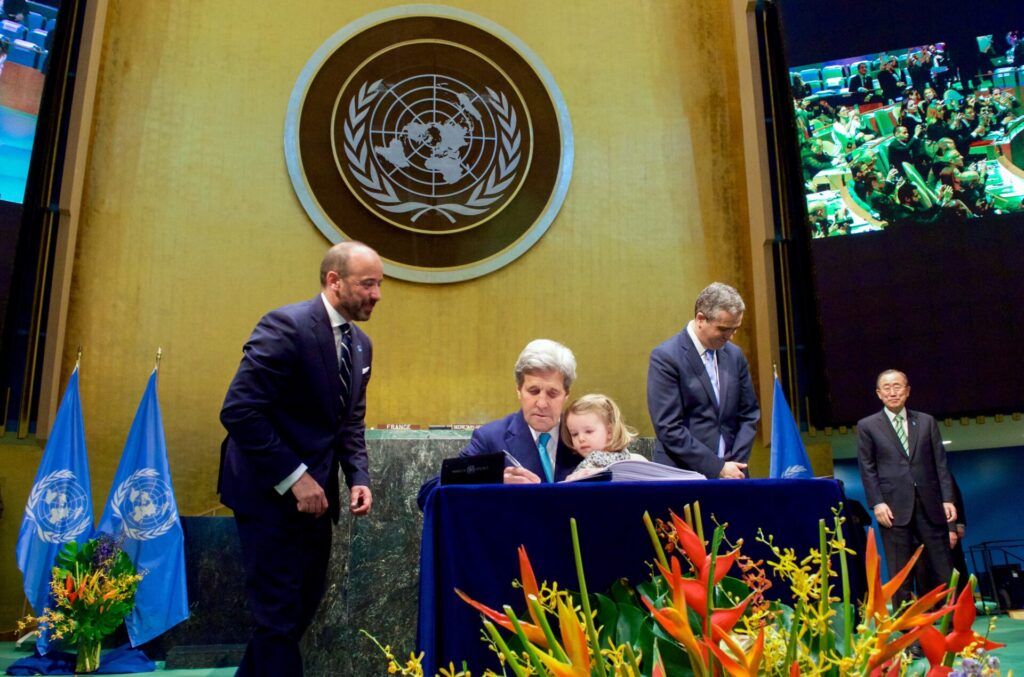 Then-US Secretary of State John Kerry signs the Paris Climate Agreement at the UN General Assembly Hall in New York on Earth Day, April 22, 2016. (Photo: US State Department)
Listen to this article:
Listen to this article
--:--
This audio was generated using an automated voice. Learn more.
The Paris Climate Accords were signed on April 22—Earth Day—ten years ago today. According to the United Nations, it was the largest one-day signing of an international agreement in history.
But also, on this day in history: In 1965, the Manchester Evening News ran an article on carbon dioxide buildup; in 1975, members of the UK World Trends Committee of the Cabinet Office met to discuss the issue of climate change; in 1993, the Australian Financial Review covered US President Bill Clinton’s pledge to cut emissions; and in 2022, a handful of Silicon Valley behemoths announced they would invest $925 million in carbon removal over the next eight years. (I wonder how that’s going.)
These obscure tidbits from climate history are easy to surface thanks to environmental historian Marc Hudson, who has been meticulously publishing various pieces of climate ephemera on his blog, All Our Yesterdays, since late 2021. It’s an incredible resource for anyone interested in the history of climate science, policy, and activism.
The name of the website, Hudson says, comes from Macbeth’s “Tomorrow, and tomorrow, and tomorrow” speech:
Tomorrow, and tomorrow, and tomorrow,
Creeps in this petty pace from day to day,
To the last syllable of recorded time;
And all our yesterdays have lighted fools
The way to dusty death. Out, out, brief candle!
Life’s but a walking shadow, a poor player,
That struts and frets his hour upon the stage,
And then is heard no more. It is a tale
Told by an idiot, full of sound and fury,
Signifying nothing.
I reached out to Hudson to discuss how the project started, what he’s learned over the past five years, and what he describes as climate’s “Groundhog Day” problem.
The following interview has been edited for length and clarity.
Jessica McKenzie: Can you start by telling me why you started this project?
Marc Hudson: All Our Yesterdays is a website that is mostly dedicated to “on this day in 1953” or “on this day in 2012” posts so that people who read it have a better sense of just how long we have been responding—or pretending to respond—to the threat of carbon dioxide build up. Alongside those posts, there are also interviews. Last night, I received the answers to a set of questions from an author who’s got a book out called The Hobo, which is about hobos and environmentalism. I do interviews with academics about their work, with activists.
If I go to an event that I think is worth analyzing and sharing with people, I’ll do a write-up. I’ll try to connect the campaign that’s happening now to previous campaigns around the same issue, and try and build up a sense that, especially among activist communities, that many of the things that we do, we’ve been doing for a very long time—and they don’t always work to achieve our goals. Most of the environmental activism that I see is a critique of the government or corporations, but I also think that activists need to take a look at themselves, and All Our Yesterdays tries to do that.
McKenzie: What kind of archival materials are you normally sharing?
Hudson: The materials can be anything from a memo between UK civil servants that I’ve dug out of the National Archives in London. I’ve just been at the State Library of South Australia and took copies of various activist publications. Newspaper archives are a really good source. Some of them are digitized, and others you have to manually go through on microfilm.
My proudest recent acquisition is a 1973 letter to a newspaper here in Adelaide, Australia, where the writer is talking about the threat to the climate from the continued use of fossil fuels. Hansard—which is like the Congressional Record in the Westminster system—is often digitized. And books, both popular and academic, and academic articles. Occasionally there’ll be a footnote, and I’ll have to chase it down and do some Googling, and then I can get an exact date for a factoid that I’m interested in.
Maybe 80 percent of the posts are from Australia, the United Kingdom, or the United States. Australia, because that’s where my initial PhD research was; the UK, because that’s where I live; and the United States, because for the longest time, up until the 1980s, most of the work on climate change and climate policy was being done in the US, and there’s a really rich digitized archival record—books, articles, congressional record, digitized papers of politicians, and so forth.
McKenzie: When you’re looking for new things, what’s your methodology?
Hudson: I try not to [look for new things], now. I’ve kind of hit saturation in that I’ve been doing this for four or five years, and I still have things that I can write about. Occasionally I will want to track down the sequence of a series of events. Let, me give you an example, though.
When I was at the National Archives last March, there was a kind of a stray reference to a bunch of British parliamentarians who went to United States in the mid 70s during the whole concern about energy security. And I did some Googling, and then I discovered that—this is a name you probably don’t know, Paul Tsongas, who was a Democratic senator from Massachusetts. He held hearings on climate change, on energy and coal in 1977.
So you go fossicking, and you use keyword searches, and it’s great if they have an unusual surname. If their name is John Smith, you’re a bit stuffed, but Tsongas is a nice, unusual name. You don’t use climate change because nobody talked about it, then you use either the greenhouse effect or simply carbon dioxide. Google is a really good first source for that. Also, as I mentioned, library archives, and just thinking a bit laterally sometimes. Coming back to microfilm, that 1973 letter doesn’t use the term “greenhouse effect” or even “carbon dioxide,” so I wouldn’t have found it. I just stumbled on it.
And this, I guess, would be what I’d say to anyone who fossicks in archives: Don’t go straight to the thing you’re looking for. Browse and scan, not in the digitized sense, but, you know, follow your spider senses. They tingle sometimes.
McKenzie: When you think back on everything you’ve posted to date, is there anything that stands out as particularly shocking, surprising, depressing, moving, or inspiring?
Hudson: All of the above. A lot of it is depressing.
Two things that I’d point readers to, would be that from 1953 onwards, credible scientists with good resources and good institutional backing were talking about carbon dioxide buildup. There’s a guy called Gilbert Plass. In 1953, he gave a presentation at the American Geophysical Union meeting. And that’s kind of the start, as far as I’m concerned, of the modern carbon dioxide theory.
Obviously, there’s a guy called Svante Arrhenius, but he thought it would take thousands of years. Plass realized that it would happen by the end of the 20th century, because of the enormous amount of fossil fuels that were being used. There are a couple of other even more influential people. And I should give a shout out to a journalist called Rebecca John. She dug into Charles Keeling’s history and discovered that he’d actually worked for an oil company measuring carbon dioxide before he started working for the US government.
Then there is this thing called the CO2 Newsletter, and this is where I come back to archives. By just dumb luck, I was researching United Kingdom energy policy, and I was at the National Archives, looking through a folder, and it was literally memos between UK civil servants. And I was getting a little bit bored, and then I turned over the next page, and there was this thing called CO2 Newsletter, and it was volume three, number three from like 1981 and I looked at it, and I blinked. I’d never heard of it. There was eight pages of sort of dense information, and the author was a geologist called William Barbat. And I was astonished. I wouldn’t have believed it if you told me the day before that this thing existed. Barbat had set up the CO2 Newsletter in 1979 in an effort to get government business and campaigning groups to take the CO2 issue seriously. Eventually—I’ll cut out all the boring details in between—I managed to get a full set from his daughter. Barbat only died a couple of years ago, and his daughter has given me permission to digitize and post all of the newsletters. And I’m getting various people to do commentaries: scientists, activists, etc. Barbat wrote this article about, well, how quickly will the Greenland ice sheet melt, and Antarctica, and I managed to get a Dutch glaciologist to do an analysis of how well Barbat had done. And the answer was, pretty well. You know, Barbat was a smart, smart guy.
The key takeaway for me there is that really, by the late 1970s, the significant scientific doubt about carbon dioxide buildup and whether it would be an issue, which had been brewing from the early 1950s, had been resolved. There were always quibbles about how quickly something will happen, and a lot of it hinges on how much fossil fuels we burn—maybe we’ll go nuclear, or maybe there’ll be a depression, and we won’t be using quite as much energy so that things will be a bit delayed. But really what Barbat was saying was, we have to act now, not in five years, not in 10 years. We have to act now. And in the last commentary that I posted, Ana Unruh Cohen made the point, as others have, that you could quote this stuff as social media posts today, and no one would blink, and yet Barbat was saying it in 1980.
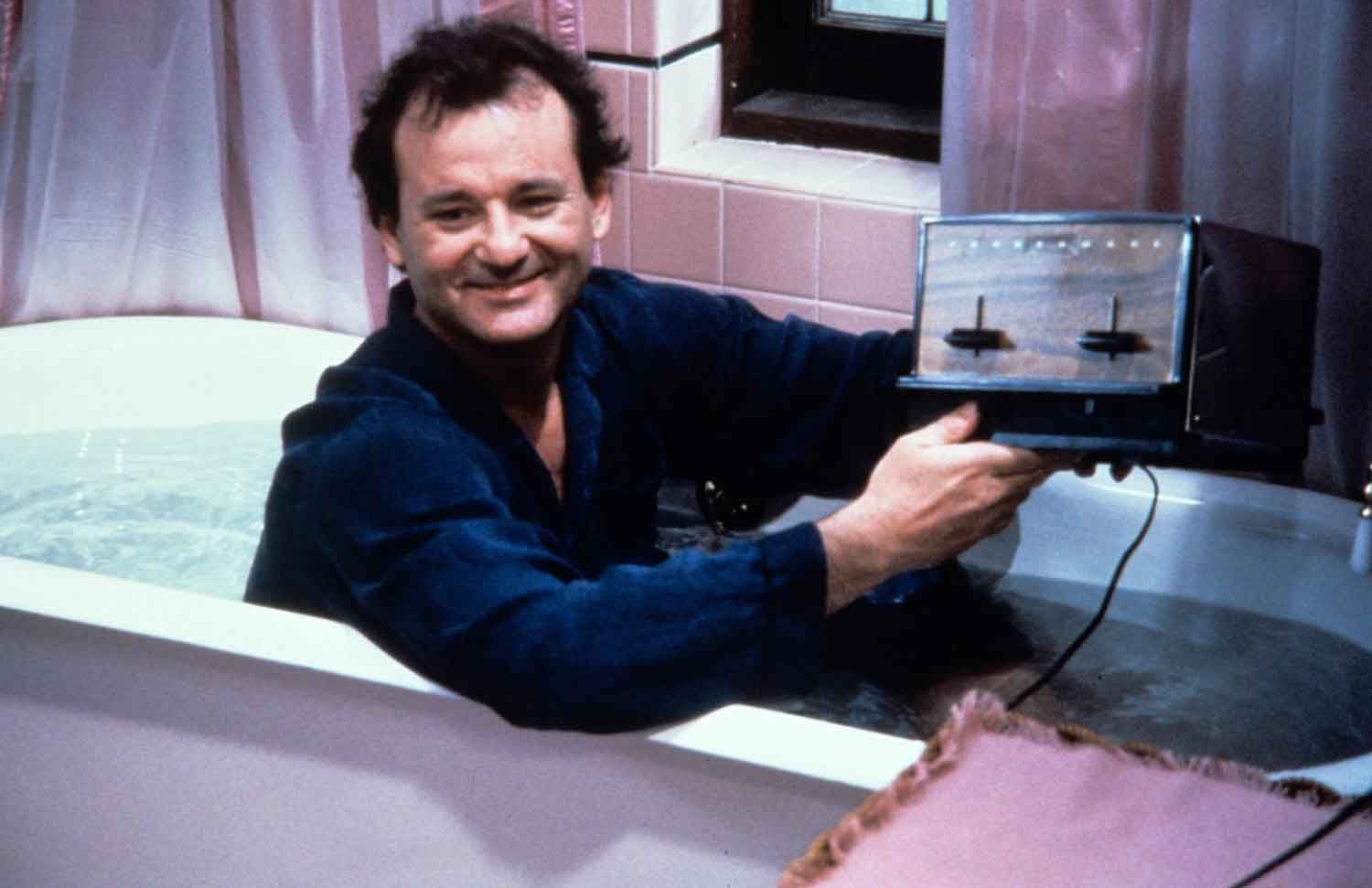
McKenzie: You once described climate activism and policymaking as having a bit of a Groundhog Day problem. What do you mean by that?
Hudson: I mean that if you have been around for long enough, and I have, I’m 55, you see the same sort of patterns and sequences where everyone gets very energized and excited and demands instant change. And then the government says, “Oh yes, this is very important. We’re going to set up a panel of experts.” And then the panel of experts produces a report that says: “We need to do A, B, C, D, E and F.” And the government says: “Well, we’ll investigate this closely.” And then nothing happens, and everyone goes back to sleep.
Or there’s a cycle of—Extinction Rebellion is a really good example—everyone running around, demanding urgent action, and after three years, they’re exhausted, understandably exhausted, and go home and decide that nothing can be done.
And you know, I participated in a previous wave. So it seems to me that nobody learns anything. If you say, we tried this in 2015, somebody will turn around to you and say, “piss off granddad,” which is understandable, because when I was a young, bright-eyed optimist, if someone said to me, “we tried that in 1968,” I’d have said, “piss off granddad.”
But the trouble is, in the movie, as you recall, every day, Bill Murray wakes up and it’s the same previous morning. That’s not the case with us. We’ve added billions and billions of tons—I think it was a one-and-a-half trillion tons of carbon dioxide into the atmosphere. And every day we wake up, Punxsutawney is actually a little bit warmer.
McKenzie: What have you learned from the project over the years, and how has it evolved?
Hudson: I’d say the main learning has been to really sharpen my understanding of how scientists slowly became more confident of their findings, and how by the mid-1970s they were confident enough to really start pushing, to try to push the politicians. I’ve identified a few people who I think played key roles in that push, and one of them is really interesting. He’s a nuclear specialist, who’s not much known anymore, called Alvin Weinberg. And I haven’t really nailed it down, but I suspect that Weinberg was crucial in the early/mid-70s for helping create the opportunities for scientists to pressure the Carter administration.
The way the project evolved is that the daily posts are now, I think, better. They’re more structured, because what I do is I break it down into broader context and specific context, and because I know more, I’m able to give a better answer to those questions of context. And also I’m able to better answer the “what happened next question.”
McKenzie: What do you hope a reader dipping into one post or 20 posts will take away from the project?
Hudson: Obviously it will depend on which post or posts they read. I hope they get a sense of just how long we’ve been doing the same things and expecting a different result. There’s a real presentism with climate. Every few years, there’s a new big conference, whether it’s Copenhagen or Paris or before that, Kyoto, and sort of all the previous history gets expunged, and you only go back as far as that last one. At the moment, we’ve still got Paris, which is now over 10 years old.
I hope that people reading will understand that we have been pretending to solve, and failing to solve the climate issue, not just since 1988 but you could argue 1978 and that we’ve been warned about it in 1958 and 1953. So that’s what I hope they get from the history.
What I hope they get from the event posts that I do, is that they understand that the forms of activism that we do, where everyone troops into a room, sits in rows and listens to someone at the front and then there is maybe a question and answer session, which is dominated by boring old white men, is not the only way that you can do meetings. We need to innovate, because if we keep doing the same things, we’re almost certainly just going to get the same result. And Punxsutawney is getting warmer. I hope that people understand that we need to take chances, we need to innovate in the formats of our meetings and our rallies and publications and so forth.
Together, we make the world safer.
The Bulletin elevates expert voices above the noise. But as an independent nonprofit organization, our operations depend on the support of readers like you. Help us continue to deliver quality journalism that holds leaders accountable. Your support of our work at any level is important. In return, we promise our coverage will be understandable, influential, vigilant, solution-oriented, and fair-minded. Together we can make a difference.
Keywords: archives, climate history, climate policy, climate science
Topics: Climate Change

Jessica McKenzie
Jessica McKenzie is an editor at the Bulletin of the Atomic Scientists. Her work has been published in The New York Times, National Geographic, Audubon Magazine, Backpacker, The Counter, and ... Read More









Leave a Reply