The logic for US ratification of the Comprehensive Nuclear Test Ban Treaty
By Steven Pifer | March 7, 2024
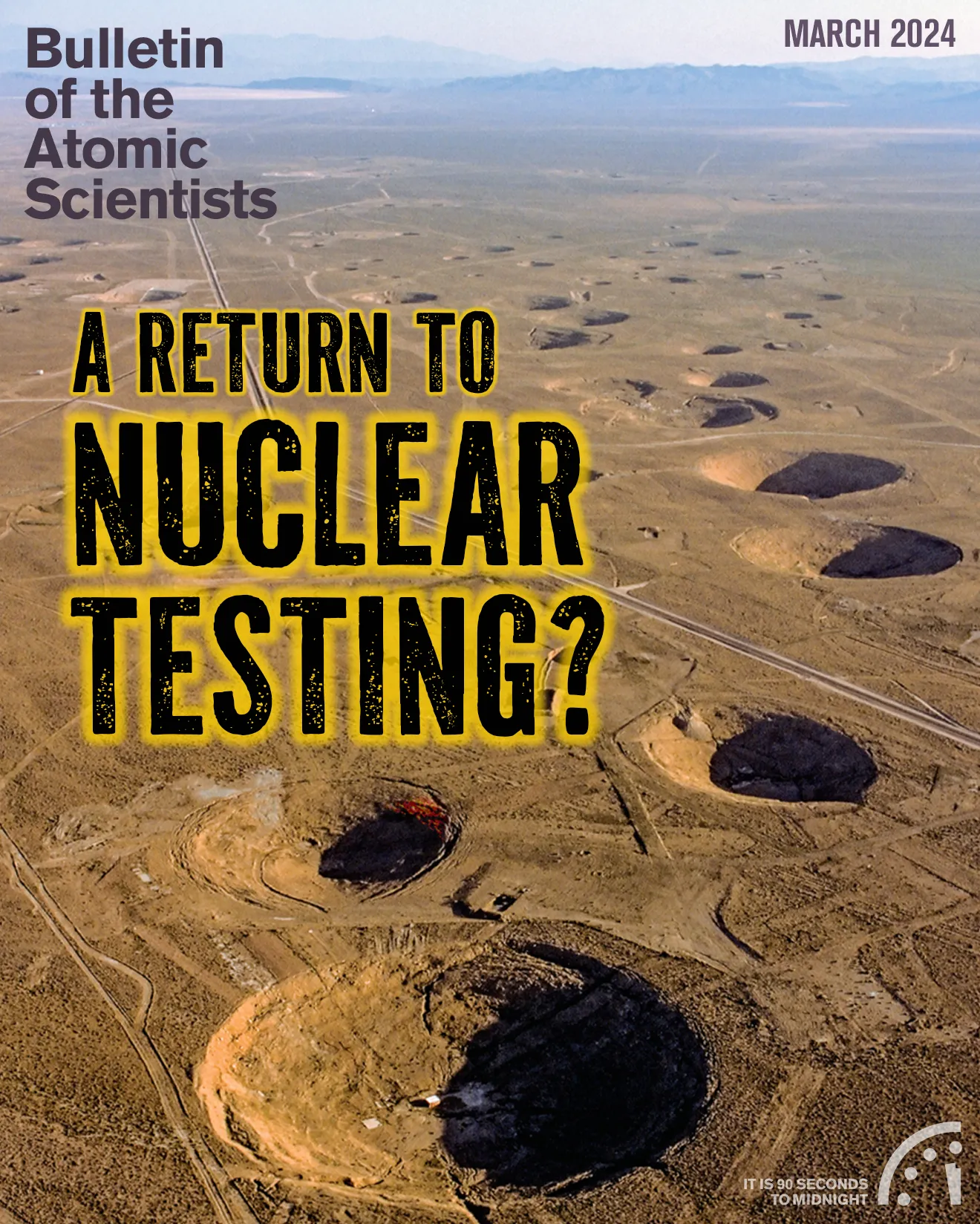
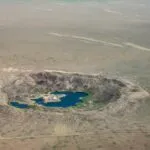
A radiation warning sign stands on Frenchman’s Flat, where nuclear tests used to take place in the Nevada National Security Site, south of Yucca Flat and north of Mercury, Nevada. Photo Credit: Ted Streshinsky / CORBIS / Getty Images
The logic for US ratification of the Comprehensive Nuclear Test Ban Treaty
By Steven Pifer | March 7, 2024
Beginning in 1963, the United States has accepted increasingly stringent limitations on its ability to test nuclear weapons. Efforts to restrict nuclear testing culminated in 1996 with completion of the Comprehensive Nuclear Test Ban Treaty (CTBT), prohibiting tests that generate a nuclear yield. However, 28 years later, in part due to the US Senate’s failure to consent to ratification, that treaty is not in force, though North Korea is the only state to have conducted a nuclear test since 1998.
The Stockpile Stewardship Program (SSP) now provides confidence in the reliability of US nuclear weapons without the need for nuclear explosive testing. Advances in the means to detect nuclear tests, including the Comprehensive Test Ban Treaty Organization’s International Monitoring System, mean almost any test would be exposed. The treaty is manifestly in the US national interest, as it would prevent other nuclear weapons states from advancing their nuclear knowledge and expertise and producing more sophisticated nuclear weapons. The United States is one of nine states whose failure to ratify prevents the treaty’s entry into force. An effort to secure Senate consent to ratification would require a determined push by the White House, but in present circumstances even that would probably fall short given the difficult international climate and domestic US politics. The treaty will remain in limbo for some time to come.
Increasingly stringent limits on testing
Interest in a ban on nuclear testing began to grow a decade after the first nuclear explosion took place at Alamogordo, New Mexico, in 1945. That stemmed in part from environmental concerns, as the public became more aware of the threat posed by radioactive fallout generated by above-ground nuclear explosions. The Soviet Union and the United States began diplomatic sparring over a test ban in 1958, when Moscow said it would halt testing if Washington did. The two countries, joined by Britain, began discussions later that year. Negotiation of a comprehensive ban faltered over differences on verification measures, particularly on-site inspections, and the negotiation turned to a limited test ban. (National Academy of Sciences 1985)
The American, Soviet, and British foreign ministers signed the Limited Test Ban Treaty (LTBT) in August 1963. The treaty prohibited nuclear testing in the atmosphere, in outer space, and under water, effectively restricting nuclear tests to underground—with the proviso that any radioactive debris that leaked had to be confined within the borders of the state conducting the test. The treaty provided no verification measures. Currently, 125 states are party to the LTBT (Center for Arms Control and Non-Proliferation 2017).
Following the conclusion of the LTBT, US nuclear testing moved underground, either at the bottom of vertical shafts or in tunnels drilled horizontally. The bulk of the nuclear tests took place at the Nevada Test Site north of Las Vegas, though a small number were conducted elsewhere in the continental United States and Alaska (Office of the Secretary of Defense 2020). The Soviet and British testing programs likewise moved underground, though France and China continued to conduct above-ground tests.
In 1974, the United States and the Soviet Union concluded the Threshold Test Ban Treaty (TTBT), which limited their underground tests to yields of no more than 150 kilotons—the equivalent of 150,000 tons of TNT, approximately ten times the yield of the bomb that destroyed Hiroshima. In 1976, the two countries signed the Peaceful Nuclear Explosions Treaty (PNET). It restricted nuclear explosions conducted underground for peaceful purposes to no more than 150 kilotons (United States Arms Control and Disarmament Agency 1990).
Due to questions about verification, the TTBT and PNET did not enter into force until 1990. Key to entry into force was data obtained from the Joint Verification Experiment conducted in 1988. US monitors with equipment were on-site during a Soviet nuclear test at Semipalatinsk, while Soviet monitors were present for a US test at the Nevada Test Site. The data gathered by US monitors put to rest questions regarding Soviet compliance with the 150-kiloton limit (The American Presidency Project 1988).
In 1991, Soviet President Mikhail Gorbachev declared a moratorium on underground nuclear testing, which Russian President Boris Yeltsin continued after the Soviet Union’s dissolution at the end of that year. In 1992, Congress passed legislation imposing a US test moratorium. President George H. W. Bush was decidedly unenthusiastic about the moratorium but reluctantly signed it into law. President Bill Clinton decided to continue the moratorium and adopted the objective of a complete ban on nuclear testing (von Hippel 1999). Negotiations began in 1994.
Completed and opened for signature in 1996, the Comprehensive Nuclear Test Ban Treaty (CTBT) prohibits “any nuclear weapon test explosion or any other nuclear explosion.” That includes any explosion that produces a nuclear yield. The treaty has been signed by 187 countries, of which 177 have ratified it. For entry into force, the treaty requires signature and ratification by 44 countries with nuclear expertise listed in the treaty’s Annex 2. Nine of the 44 have not yet done so: China, Egypt, India, Iran, Israel, North Korea, Pakistan, Russia, and the United States (Arms Control Association December 2023). (Russia ratified the treaty but revoked its ratification in 2023).
US failure to ratify the CTBT
Although President Clinton was the first to sign the CTBT in 1996, the Senate did not take up the treaty until October 1999. The Clinton administration offered a number of safeguards, including a Stockpile Stewardship Program to maintain confidence in the US nuclear arsenal, a capability to resume nuclear testing if the United States were to leave the CTBT, and an understanding that, if the secretaries of defense and energy could not certify confidence in “the safety or reliability of a nuclear weapon type,” the president would be ready to invoke the CTBT’s withdrawal clause so that the necessary nuclear testing could be conducted.
Unfortunately, the Clinton administration had no focused campaign to secure Senate support for the treaty, while treaty opponents moved to short-circuit time for Senate hearings and then pushed for a vote. When it became clear the treaty lacked the 67 votes needed for consent to ratification, the administration attempted to delay the vote, but treaty opponents forced it to proceed. The resolution on ratification failed by a vote of 48 (for) to 51 (against). Two issues are generally cited for the failure: questions regarding the US ability to verify whether other states adhered to the CTBT, and questions regarding the US ability to maintain safe and reliable nuclear weapons absent testing (Kimball 2009).
The Clinton administration reaffirmed its commitment to a moratorium on testing, which all subsequent US administrations to the present have continued to observe; the last US nuclear test was conducted in 1992. Apart from a series of nuclear tests conducted by India and Pakistan in 1998, only North Korea has conducted nuclear tests over the past 25 years. The six North Korean tests carried out over the past 18 years contrast with more than 2,000 nuclear tests conducted in the 60 years between 1945 and 2005 (Arms Control Association August 2023).
As of the end of 2023, there have been 2,056 nuclear tests recorded, the large majority between 1950 and 1989. Eight countries conducted the tests: United States—1,030; Soviet Union/Russia—715; Britain—45; France—210; China—45; India—3; Pakistan—2; and North Korea—6. India and Pakistan’s numbers somewhat understate their tests, as some were conducted simultaneously and counted as a single test (AtomicArchive 2024). Israel is widely thought to have nuclear weapons, and some believe it may have conducted a nuclear test off the coast of South Africa in 1979 (Borger 2014).
Better answers to the key questions
Former US Secretary of State George Shultz was asked for his view on ratification of the CTBT in 2013. He reiterated a position he had first expressed several years before: “A senator might have been right to vote against it when it was first put forward and right to vote for it now. … Why? Because things have changed” (Kimball 2013). Indeed, things had changed, both with regard to the ability to monitor the reliability of the US nuclear arsenal and the ability to detect nuclear tests. Things have continued to change over the past ten years.
The Stockpile Stewardship Program (SSP), administered by the US Department of Energy’s National Nuclear Security Administration, has among its responsibilities the task of ensuring that American nuclear weapons remain safe and reliable. The SSP was in its infancy when the Senate considered CTBT ratification in 1999 but now is nearly 30 years old. The program employs a variety of means to assess the state of US nuclear weapons and their safety and reliability without conducting nuclear explosive tests. As part of the program, the directors of three national labs (Lawrence Livermore, Los Alamos, and Sandia) plus the commander of Strategic Command must submit annual certifications regarding the reliability of US nuclear weapons (US Department of Energy, National Nuclear Security Administration April 2023).
Each year, the annual assessment process has resulted in the conclusion that the United States has no technical reason to resume nuclear testing (Arms Control Today 2023). Senior officials at the national laboratories have in the past expressed confidence that, if the SSP is adequately funded, nuclear testing should not be necessary in the future. Moreover, the use of technologies and special equipment developed for the program—such as the Dual-Axis Radiographic Hydrodynamic Test Facility at Los Alamos—has enabled a better understanding of some aspects of nuclear explosions that were not well understood with nuclear tests.[1]
To maintain and modernize the US arsenal while ensuring that the weapons remain safe and reliable per the requirements of the SSP, the National Nuclear Security Administration extends the service life of existing nuclear warheads through life-extension programs. The typical life-extension program may incorporate modifications or alterations, but those are designed so that they will not negatively affect the weapon’s reliability, that is, the weapon will work as intended. Moreover, the modifications and alterations are designed so as not to require nuclear explosive testing. One current such program is the B61-12 gravity bomb. The National Nuclear Security Administration is developing one “new” nuclear warhead, the W93 for the Trident submarine-launched ballistic missile. It is based on designs and parts that have been tested in the past and will not require nuclear explosive testing in order to be certified for deployment (US Department of Energy, National Nuclear Security Administration 2022).

Other than the W93, the US military in the past 20 years has considered two other “new” weapons. One was the Reliable Replacement Warhead, which would use a conservative design and higher performance margins and not require nuclear explosive testing. The other weapon was an earth penetrator designed to destroy deep underground targets. Such a warhead could produce significant radioactive fallout (undesirable), and an adversary could simply bury targets even deeper or disguise their locations (O’Hanlon 2008). Neither weapon is currently under consideration.
The 24 years since the Senate considered the CTBT have also seen significant developments in the ability to detect nuclear tests. The US Nuclear Detonation Detection System, whose full capabilities are classified, continues to be upgraded (US Department of Energy, National Nuclear Security Administration August 2023). Moreover, the CTBT Organization, which operates even though the CTBT has not entered into force, manages the International Monitoring System. That system deploys some 300 seismic, hydroacoustic, infrasound, and radionuclide stations around the world to monitor for nuclear tests (Comprehensive Nuclear Test Ban Treaty Organization 2024).
While detecting nuclear explosions poses technical challenges, the International Monitoring System should be capable of identifying tests over one kiloton in yield and likely lower.[2] The system has detected all North Korean tests. Even though the International Monitoring System was not yet fully operational, 20 seismic stations detected and fixed the location of the first test in 2006, which was small (some estimate about one kiloton). One hundred seismic stations detected the 2017 test, the largest that North Korea has conducted (Comprehensive Nuclear Test Ban Treaty Organization 2024).
The International Monitoring System might not be able to detect extremely low yield tests. The US government has expressed concern that China and Russia may have conducted tests at their Lop Nur and Novaya Zemlya sites that violated the “zero yield” standard (US Department of State 2022). The National Research Council assessed in 2012 that, while hydronuclear tests producing yields of less than one ton might not be detected, it could identify no significant advantage the testing state would achieve. For a state beginning a nuclear weapons program, such tests would prove expensive in terms of the fissile material used. Moreover, the National Research Council concluded that, were Russia to conduct such tests, the United States would have no need to resume nuclear testing in response (National Research Council of the National Academies 2012).
Entry into force of the CTBT would allow for conduct of on-site inspections (Comprehensive Nuclear Test Ban Treaty Organization 2024). Those could increase the chances of detecting prohibited nuclear tests, and the very possibility of inspections could deter such behavior. With the CTBT’s on-site inspections not yet in force, National Nuclear Security Administration Administrator Jill Hruby in June 2023 said the United States was considering transparency measures to allow reciprocal observation of activities at the Nevada National Security Site (formerly, the Nevada Test Site). Among other things, those measures might ease any concerns about US subcritical tests that, because they do not produce a sustained chain reaction, do not exceed the “zero yield” standard. She expressed interest in discussions with Russian and Chinese officials on possible bilateral or trilateral measures. (National Nuclear Security Administration 2023) As of the end of 2023, neither Russia nor China had taken up the offer.
The CTBT is in the US interest
As Secretary Shultz noted, the questions senators had in 1999 now have far better answers. Completing the CTBT—that is, ratifying and bringing it into force—is very much in the US national interest. Doing so would lock in an American advantage in knowledge gained from nuclear testing. First, the United States carried out far more nuclear tests than any other country. In fact, it conducted about one-half of the 2,056 nuclear tests to date. Second, the US tests likely yielded more information about weapons effects than tests by other countries. When the author visited the Soviet nuclear test site at Semipalatinsk as part of an official US delegation in 1988, the Soviets showed the vertical shaft for an upcoming test; it was about three feet in diameter. An American delegation member commented that US vertical shafts were typically eight to ten feet in diameter, the larger diameter allowing greater area to hang more instruments in the shaft to measure different effects of an underground test.[3] Third, no other country has a system to match the SSP for monitoring the safety and reliability of nuclear weapons.
While other nuclear weapons states—except for North Korea—currently observe declared or de facto moratoria on nuclear testing, the CTBT would make that an international legal obligation. By preventing the conduct of nuclear tests, the CTBT would prove a hindrance to any country seeking to acquire its own nuclear weapon. Moreover, it could prevent development of more sophisticated nuclear weapons. For example, a prohibition on testing could pose a severe obstacle to a Chinese effort to miniaturize its nuclear warheads in order to be able to place a greater number on its strategic ballistic missiles
US ratification would provide an incentive for others to ratify or, at the least, remove an excuse for their failure to do so. Chinese officials in the past have suggested they would ratify once the United States did so. Russian President Vladimir Putin attributed Russia’s unfortunate 2023 decision to revoke its ratification of the CTBT to the US failure to ratify and to Moscow’s desire for so-called “parity” with the United States (signed but not ratified the treaty) (PBS Newshour 2023).
And why it will be difficult to achieve
While ratification of the CTBT would make eminent good sense for the United States and for global non-proliferation in general, it is difficult to see it happening in the foreseeable future. At a minimum, securing Senate consent to ratification would require a major, determined push by the president and administration. Even with that, the two-thirds Senate hurdle likely would prove too high. Some doubt that any treaty could garner the necessary 67 senate votes, but it is particularly difficult at present given American domestic politics. President Joe Biden supports the CTBT, which was negotiated and signed by an earlier Democratic administration. Some Republican senators would likely ignore the national security merits of the treaty and oppose ratification simply to deny President Biden a “win.”
The international environment also does not appear conducive to bringing the CTBT into force. US-Russian and West-Russian relations have fallen to post-Cold War nadirs, and President Putin appears to regard weakening international arms control regimes as a mechanism to “punish” the West for its support of Ukraine. Recent activities at Russia’s Novaya Zemlya have raised concerns about Russian plans (Giveh 2023). China’s relationship with the United States and increasingly with Europe is troubled, and China has renovated and expanded facilities at its Lop Nur test site, suggesting that it may be preparing the ground for possible future nuclear weapons tests (Broad 2023). Meanwhile, North Korea shows no sign of flagging interest in expanding its nuclear arsenal and capabilities.
These circumstances make it difficult to see the CTBT in force any time soon. Hopefully, individual countries will continue to observe their testing moratoria. If the moratoria were to cease, resumed nuclear testing would end another element of the international regime to control nuclear arms and prevent nuclear proliferation. That could fuel a nascent arms race that already appears to be developing among the United States, Russia, and China.
Acknowledgements
The author is grateful for comments on the draft provided by Daryl Kimball and Michael O’Hanlon. Of course, he remains responsible for the contents.
Endnotes
[1] Author’s discussions with senior officials at Los Alamos and Sandia National Laboratories, June 2013.
[2] Author’s conversation with officials at CTBT Organization in Vienna, April 2011.
[3] Author’s conversation with Nevada Test Site official, January 1988.
Together, we make the world safer.
The Bulletin elevates expert voices above the noise. But as an independent nonprofit organization, our operations depend on the support of readers like you. Help us continue to deliver quality journalism that holds leaders accountable. Your support of our work at any level is important. In return, we promise our coverage will be understandable, influential, vigilant, solution-oriented, and fair-minded. Together we can make a difference.
Get alerts about this thread
0 Comments
Oldest

Steven Pifer
Steven Pifer is an affiliate of Stanford's Center for International Security and Cooperation, a nonresident senior fellow with the Brookings ... Read More