Michael Mann, on how the second US withdrawal from the Paris Agreement may alter the world’s climate change landscape
By Dan Drollette Jr | September 4, 2025
Climate scientist Michael Mann in Iceland, 2016. Image courtesy of Michael Mann.
Michael Mann, on how the second US withdrawal from the Paris Agreement may alter the world’s climate change landscape
By Dan Drollette Jr | September 4, 2025
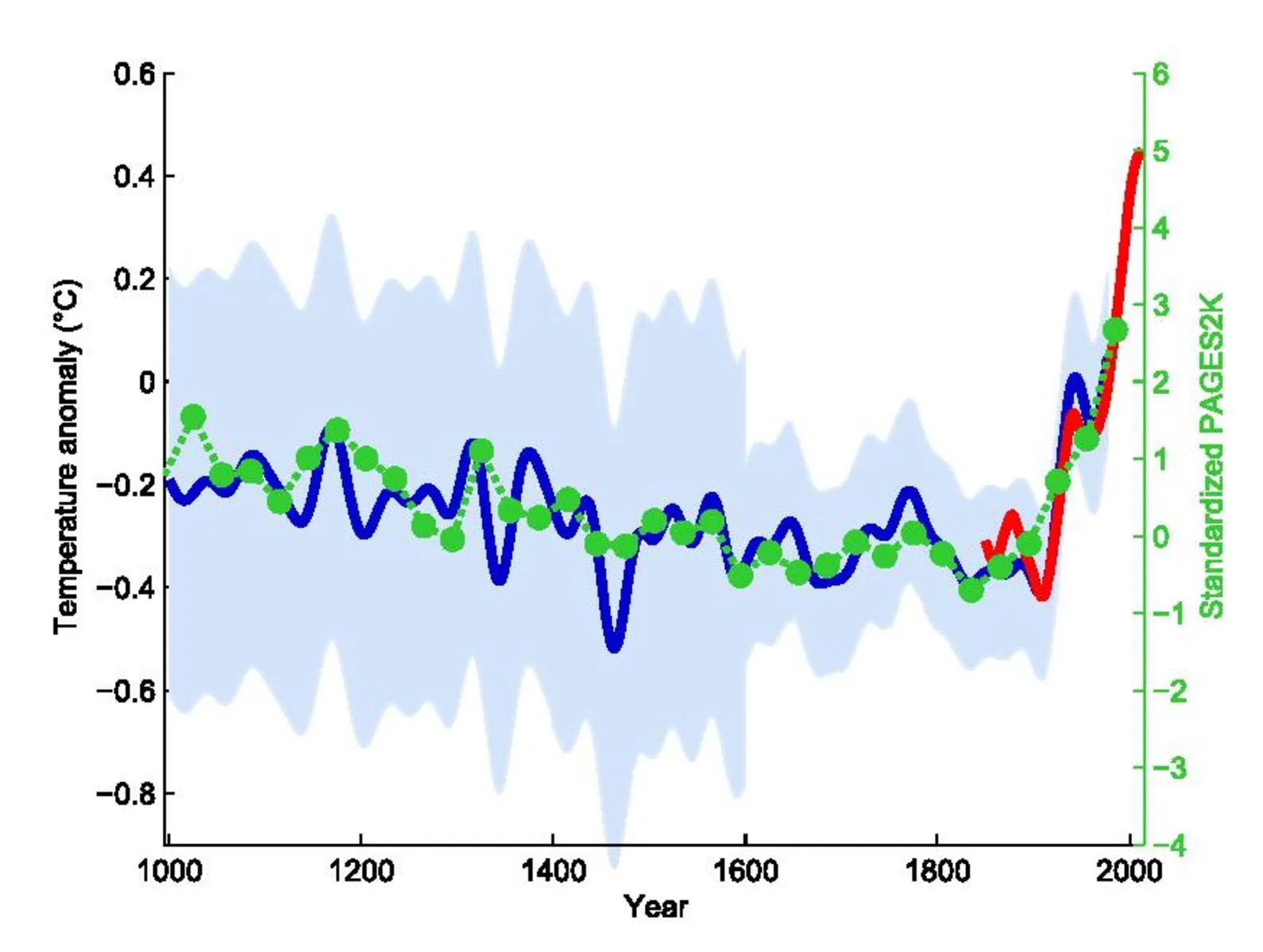
When it comes to the hard-core science end of climate change—and those scientists who have been on the receiving end of the ire of climate change deniers—the first name that comes to mind is climate scientist and geophysicist Michael Mann. He is famous for the work that he and his team published in 1999 that resulted in the “hockey stick graph,” which was one of the first depictions to clearly show the correlation between the rise in average global temperatures and the increase in the burning of fossil fuels.
A presidential distinguished professor and director of the Center for Science, Sustainability and the Media at the University of Pennsylvania, Mann is the author of several articles, essays, and books about climate change, including Our Fragile Moment: How Lessons from Earth’s Past Can Help Us Survive the Climate Crisis, and a new book coming out this autumn on the strategies used by climate change denialists.
So, Mann seemed ideally placed to tell me what may happen now that the United States has pulled out again from international climate efforts and shows signs of turning into what some observers characterize as an authoritarian state ruled by plutocrats and fossil fuel interests—in other words, a petrostate.
After what has been shaping up to be another banner year of record heat waves, droughts, wildfires, and hurricanes, Mann argues that the obstacles to keeping global warming below catastrophic levels aren’t physical or technological; they are almost entirely political. Consequently, they can be fixed—if the political obstacles can be overcome.
(Editor’s note: This interview has been condensed and edited for brevity and clarity.)
Dan Drollette: A recent New York Times article[1] said that while many observers had hoped that Senate Republicans would save clean energy, they really have not—at least so far. When it comes to federal policy, everything is stacked against renewable energy. Since you’re the climate scientist who originally came up with the “hockey stick graph” in 1999,[2] I was wondering: What’s your outlook on the prospects for fighting climate change?
Michael Mann: We’re certainly facing adversity when it comes to a clean energy transition in the US right now, what with the current administration and congressional Republicans working together to advance what’s essentially a fossil-fuel agenda.
And you’re absolutely right. There were a lot of clean energy advocates and climate activists who believed that because many of the Inflation Reduction Act’s clean energy incentives of the Biden era were specifically targeted to red states, that would encourage the politicians in those states to embrace these policies. Because these incentives—in the form of battery-manufacturing plants, for example—were not only good for the people of that state, they were a source of good jobs in that state. So, there was a certain amount of faith that the politicians in those states would be interested in doing the bidding of the people they represent. But in fact, we’re learning that it’s far more important to them to do the bidding of the powerful vested interests that have taken over—in particular the fossil fuel industry, which has a stranglehold over today’s Republican Party.
That wasn’t always the case, but it’s certainly true today.
Drollette: What does that mean for the near future?
Mann: It’s important to take a step back and recognize that even if the United States eases off some of the clean energy provisions and incentives that were passed, we’re already on a decarbonization trajectory. The market for clean energy is becoming increasingly competitive against fossil fuel energy. In many places, fossil fuel energy is already hugely more expensive than renewables.
And that means that the green transition will continue. The transition will slow down because of the obstinance of the current administration and its congressional enablers—but it will continue.
Because what’s going to determine the trajectory of clean energy is not about the US in isolation. It’s also about what’s happening in other countries—and we’re still seeing quite a bit of progress there, with steady decarbonization of the global energy infrastructure.
Drollette: Why is that?
Mann: For the simple reason that it’s more economical to go with clean energy, especially in developing countries. Why build a huge, expensive electricity grid based on fossil fuels when you can deploy a cheaper, distributed, clean-energy solution based on solar, wind, and geothermal energy? Especially when there’s now good energy storage technology to deal with intermittency issues. So, the transition is happening; it just has to happen faster to have any real effect on reducing global warming.
And that means we do need more incentives. We need to level the playing field even more so that clean energy can compete fairly against fossil fuel energy in the financial marketplace.
I’d say we’re making progress, but we’re not yet making enough progress to keep us under certain critical sort of levels of interference with the climate system—that 1.5-degree Celsius, or roughly 3-degree Fahrenheit, level of global warming we keep hearing about so much. We won’t be able to keep our carbon budget below that target if we don’t accelerate this clean energy.
Drollette: Do you think that there was too much emphasis on promoting 1.5 degrees as the absolute cut-off point for climate change? I mean, from my understanding of what your fellow climate scientists have said, it’s not as if there is a cliff at 1.5—meaning that everything is wonderful at 1.49 degrees but we should all give up hope if the world heats up to 1.51 degrees. It’s not as simple as that; it’s more of a continuum—a case of continuing the fight to at least keep the effects of climate change within somewhat reasonable kind of levels.
Mann: You’re right, it’s not like it’s a cliff that we go over. Instead, at 1.5, it’s bad, but at 1.6 degrees Celsius, worse stuff happens. And at 1.7, it’s even worse.
But in my view, this 1.5 figure is a critical target, because at that level of warming, bad things happen—and people in the climate research community and in climate communications have tried to be pretty clear about that.
Maybe a better analogy is that humanity is on a dangerous highway, and the further we drive down that highway, the more danger we encounter. So, we want to get off at the earliest exit we possibly can. But if we miss the 1.5 exit, we don’t give up and drive all the way to the middle of nowhere; instead, we take the next available exit and try to keep warming at 1.6 Celsius or below.
Above all, we should avoid the idea that: “We should give up, because it’s not remotely attainable.” That is so wrong-headed.
And we do have to recognize there are some bad actors out there who are doing everything they can to confuse the issue. They do this by clouding the scene, and sort of fanning the flames of climate denial or delay—or even promoting flat-out climate doom-ism.
Drollette: Climate doom-ism?
Mann: That’s a strategy used by polluters and their advocates. The idea is that if you can get enough people to truly believe that it’s too late to do anything, then it follows that the public will accept the idea that there’s no longer any need to take action against climate change—so we can keep burning fossil fuels.
And this kind of thinking was used against something that was very reasonable: an actionable target of a maximum of 1.5 degrees Celsius of warming of the planet, which was absolutely achievable a decade ago.
Drollette: I notice you’re using the past tense.
Mann: Well, let’s just say that the window of opportunity is rapidly closing, to mix metaphors. Because humanity is really burning through the carbon emissions budget. We’ve only got a few more years at current levels.
Now, there is some good news, in that carbon emissions are no longer going up.
The bad news is they’ve got to come down, and come down rapidly.
And the only thing holding us back is political obstacles. The hold-up is not because of the physics of the climate or the technology; we have the technology to do it.
When polluters say “You have to give up on 1.5 Celsius because it’s not do-able,” what they really mean is: “We’re not going to let you do it—and when you give up on that target and move to 2.0, we’ll pull the same thing again.”
So we should continue to talk about 1.5 as long as it’s physically possible.
And at this point, we’re only talking about breaching that target briefly and shallowly—which is a whole lot better than racing past it and continuing to warm at the current rate.

Drollette: Some of your comments sound pretty similar to those of a climate scientist who used to be on the Bulletin’s board, Ray Pierrehumbert.
Mann: Ray is one of the most brilliant climate scientists around; he and I have collaborated quite a bit in writing about geoengineering—which to my mind simply employs the latest set of tactics to diminish the importance of decarbonization by saying that humanity can just engineer our way out of this problem[3].
Drollette: So you’re saying that proponents of it are essentially using the possibility of geoengineering as a sort of excuse to say: “We don’t need to cut back on carbon emissions or do anything else to stop the climate crisis, because a yet-to-be-invented machine will fix everything tomorrow?”[4]
Mann: And we’ll need to keep it operating forever and ever, for the rest of time.
One interesting sidelight that I think you folks at the Bulletin will appreciate from your work in highlighting existential threats: One of the earliest proponents of geoengineering was none other than Edward Teller.
I think Edward Teller never met a dangerous technology proposal that he didn’t like—whether it’s the hydrogen bomb, geoengineering, or Ronald Reagan’s “Star Wars.” Teller was one of the main proponents behind the Strategic Defense Initiative—as Reagan’s Star Wars[5] was formally called—which I experienced when I was at UC Berkeley in the ‘80s as a physics student and Teller was there.
Drollette: I wasn’t aware that Teller was a proponent of it, though it would tie in with all the other things that I’ve read.
Getting back to climate change: What does it mean for global warming now that Trump has pulled the US out of the Paris Agreement yet again?
Mann: Well, as I had written in an article for the Bulletin’s website[6] a few months ago, America has now become a petro-state, right up there with Saudi Arabia and Russia. And by that, I mean one of a handful of countries where our policies are almost entirely dictated by an entrenched fossil fuel industry. One can see the United States openly collaborating with Russia and Saudi Arabia to do everything they can to scuttle global climate action because it’s a threat to their business model.
So Americans have to recognize—as uncomfortable as it is—that we are now a bad actor in this space. And by “we” I mean the administration that represents us internationally. There are many good folks in the US, obviously, who are very unhappy with the current regime and what they’re doing. But as far as the rest of the world is concerned, they look at the United States as a bad actor that they’re going to have to work around.
Consequently, we’re going to see Europe and other countries take the lead in fighting climate change. We’re actually going to see China, of all things, taking far more leadership in this area than the United States. And that allows the Chinese leadership to present themselves as similarly taking the high road when it comes to human rights, its treatment of ethnic minorities like the Uyghurs, the surveillance state[7], and all of their sort of hegemonic behavior in recent years. So it helps situate China as the true leader in the world, while it helps to diminish the standing of the United States to the rest of the world.
Drollette: At the risk of over-simplifying, should the planet be pinning its hopes on Europe and China when it comes to fighting climate change?
Mann: Yes. It’s ironic, isn’t it, that an authoritarian regime like China might be best-situated to act on climate. But because of the top-down structure of their government, their leaders can decide “We’re going to do this” and make it happen. They don’t answer to fossil-fuel industry lobbyists in the way that politicians in the US do.
And so, we have to pin our hopes in a substantial part on China and Europe.
There’s just a handful of bad actors right now that are trying to prevent meaningful progress on climate, and unfortunately the United States now happens to be one of them.
Drollette: I remember doing a Bulletin interview[8] a few years ago with someone who wrote a paper for the peer-reviewed journal Science that found that there was a relative handful of companies responsible for the vast majority of all the world’s carbon emissions. He said you could fit the CEOs of all those bad actors into a single school bus.
Mann: That’s right, less than roughly 100 companies are responsible for 70 percent of historical carbon emissions. By the way, that’s what matters—historical carbon emissions, meaning the total slug of carbon that you’ve put into the atmosphere. And the United States, by a substantial margin, has put more carbon pollution into the atmosphere than any other country. We are responsible for more of the warming than any other country. It’s critical to understand that.
But yes, 70 percent of the emissions come from under 100 polluting companies or corporations. Some of them are state-owned, such as in Russia, while some are privately held.
But in the end, that’s exactly right. You could get less than 100 CEOs or their equivalents in a room, and they’re the ones who are responsible for 70 percent of the carbon emissions—which tells you something about all of these efforts to pin emissions on us individual consumers, right?
And that’s one of the primary tactics being used by polluters: deflection.
Drollette: And by “deflection,” you mean…
Mann: … this idea that the solution to climate change comes down to each of us consumers taking responsibility for our own individual carbon footprint—when in fact, the real problem is these 100 polluting companies.
Our carbon footprint as consumers is the size of Cinderella. Their footprint is the size of Bigfoot—and that’s the footprint we have to worry about.[9]
Drollette: Why is it so hard to deal with the Bigfoots of the carbon-emissions world?
Mann: The problem is that while we like to think that this is a democracy, and we can affect change through democratic mechanisms, it is now a plutocracy. A small number of extremely wealthy individuals are buying our media and politicians, and now they have bought the Supreme Court.
That’s where we are right now.
Drollette: Can climate science recover from the twin pincers of the fossil fuel misinformation campaign and the Trump frontal assault?
Mann: Many of us are struggling with the challenges of this current, oppressive environment.
And the challenge is not limited to just climate research but to science writ large—which is the theme of my forthcoming book this September, Science Under Siege, co-authored with Peter Hotez. I hope that does not come across as a gratuitous plug, but the book is aimed squarely at this assault on science we’re talking about—not just climate science, but also vaccine research and public health. There’s so much misinformation and disinformation enabling the world of anti-science, climate denial, and vaccine denial.
Drollette: Speaking of which, there was a recent New York Times article[10] headlined “It’s a really bad time to be an expert in Washington.”
Mann: They got that right. And it’s not just science, it’s any kind of expert, because experts are a threat to authoritarian regimes. Just look back at history and see what happened in the Soviet Union under Stalin; time and time again, authoritarian regimes want to institute a top-down ideology that is intolerant and suppresses dissent. Because their biggest challenge is free-thinking intellectuals, academics, and those who are willing to speak truth to power.
Historically, these regimes have used their influence to suppress and even jail scientists because they didn’t like their message. In the Soviet era, the biologist Lysenko had these crackpot theories about inheritance but rose to the highest level of influence—and used his authority and power to actually jail any scientists who challenged him.
Now we’re seeing the Lysenko/Soviet playbook being employed by the modern United States: RFK Junior has made similar sorts of statements when it comes to criminalizing certain areas of research. He’s threatening journals that won’t publish his preferred views—views which aren’t supported by any actual science regarding pandemics or vaccines.
It’s a scary time for anybody who cares about policy that is informed by solid and reliable science.
Drollette: What would you say to someone who’s entering the climate field today?
Mann: I would tell them that I know where they’re coming from; I understand why they are fearful. I can see how undergraduates are wondering if it’s even worth going into environmental science when there will be no new jobs, and anyone already in the field is suspect. I can see why they would ask themselves: “Why would I want to subject myself to this? Should I consider leaving the field of science, and look for a job elsewhere?”
But that’s exactly what these bad actors want: To send a very clear signal to young scientists of “Don’t you dare go down this path, don’t you dare speak truth to power. Don’t do science that threatens the special interests that fund our political party today.”
And that’s all part of their mode of operations, which I experienced myself, back in the late 1990s. I’ve talked about it before in articles, interviews, and books—how the hockey stick graph of climate change clearly emphasized how unprecedented the warming that’s happening today really is, which made it turn into an iconic symbol in the climate debate. It became a rallying point, in a sense—and I consequently found myself under attack, and have been fighting back against those attacks for decades now.
So I tell young people that I feel like we’re fighting the good fight. These are fundamental American values that I think that we have to protect.
Let me give you an example of just how deeply, fundamentally American they are. I teach at the University of Pennsylvania, so I think a lot about the legacy of Benjamin Franklin, who, of course, was a revolutionary. But Franklin was also a climate scientist—he actually gave us the very first graphic depiction of the Gulf Stream, in the form of a hand-drawing.
And Franklin was an inventor, and a clean energy advocate. He developed a cleaner-burning stove—what we now call the Franklin stove. Franklin sued a tannery that was dumping hazardous chemicals into the Delaware River.
So when I am giving lectures, I think about the legacy of Benjamin Franklin—one of our founding fathers—and what he would be saying to our students today. I tell them that I think we have to draw upon that legacy, and remember what made us great.
I tell students who are just starting out to continue to fight for those principles. There’s nothing more worthy than fighting the good fight, and there’s nothing to be ashamed of if you go down in battle fighting the good fight—and I’m determined to do that myself, along with many of my colleagues. I hope that sends a message to younger scientists that we’re not going to give up. Be part of this fight for what’s right, for science, for reason, for fact-based discourse and policy making. Nobody should have to apologize for fighting for those things.
Drollette: And you think that’s the best way to stop the excesses of Trumpism?
Mann: Yes. I know that a lot of our institutions have failed us, but I do believe there is a breaking point—where they go too far, and there is a huge pushback from the people.
Now, I do sometimes worry about what form that might take. If history is any guide, when people feel oppressed, it often leads to mass conflict. There is going to be a breaking point if the fossil fuel interests and Trump continue to pursue this agenda. I’m pretty confident about that.
So I hope that they do not take us further down this road, because it leads to a very bad place that is a threat to all of us.
I think there are enough reasonable Republicans out there that they could join with Democrats and form a coalition to restore the principles of democracy, governance, and our politics, and steer the ship back in the right direction before it becomes too late.
Unfortunately, a lot of people out there are scared—they probably want to do the right thing, but are afraid, frankly. But that’s how fascist regimes take hold: Fear is their primary weapon, and I feel that’s what we’re seeing now.
Drollette: What does all that mean for those who work in science and in academia?
Mann: I think we have to tap into the broader discourse and understand the way the person on the street really feels. We scientists and academics need to get a handle on the political atmosphere—the world of the larger electorate—and pay attention.
Fortunately, I think that’s starting to happen. A lot of academics and intellectuals are now focusing on what’s happening, why it’s happening, and trying to understand our shifting public discourse. They’re looking into how our media environment is changing, and why and how it is becoming dominated by a small number of voices on the internet and podcasts and social media. Here at the Annenberg School for Communication at Penn, there’s been quite a bit of work in trying to understand those movements—and how to push back at the misinformation and disinformation that’s being promoted within these venues.
So I think we climate researchers and scientists need to have our ears to the ground. And it’s not just limited to academia, but includes ordinary citizens too—all of us need to be making every effort we can to understand what’s happening out there, if we are to be successful in steering this ship away from the rocks before it’s too late.
Endnotes
[1] See the June 16, 2025 issue of the New York Times titled “Many Hoped Senate Republicans Would Save Clean Energy. They Mostly Didn’t” by Lisa Friedman and Brad Plumer at https://www.nytimes.com/2025/06/16/climate/senate-republicans-tax-package-clean-energy.html
[2] The “hockey stick graph” is a simple plot representing the rise in average global temperatures over time. It showed that there was a distinct rise in temperature as soon as the Industrial Revolution arrived—when people started to burn much more fossil fuel, causing more carbon to be emitted into the atmosphere. The graph looked like a hockey stick lying on its side, with a long, slow, gentle rise in temperature over a thousand years, followed by a short, abrupt, dramatic rise starting after roughly the mid-1800s. A more detailed explanation can be found at the Skeptical Science website https://skepticalscience.com/broken-hockey-stick.htm
[3] See the article “There is no Plan B for dealing with the climate crisis” by Raymond Pierrehumbert in the the August 30, 2019 issue of the magazine of the Bulletin of the Atomic Scientists at https://doi.org/10.1080/00963402.2019.1654255. For additional reading, see the June 20, 2024 article on the Bulletin’s free website “The University of Chicago’s new climate initiative: Brave research program or potentially dangerous foray into solar geoengineering” by Jessica McKenzie at https://thebulletin.org/2024/06/the-university-of-chicago-new-climate-initiative/.
[4] See the June 23, 2017 article “The trouble with geoengineers ‘hacking the planet’ ” on the Bulletin’s free website at https://thebulletin.org/2017/06/the-trouble-with-geoengineers-hacking-the-planet/
[5] “Star Wars” was the nickname for Reagan’s space-based defense system, that was supposed to protect the mainland United States from nuclear attack with a combination of lasers, particle beam weapons, and new technologies such as “brilliant pebbles.” (The idea behind the latter was that thousands of small satellites in low-Earth orbit, equipped with missiles, could knock out any ICBM launched from the Soviet Union before the ICBM could do any damage.)
[6] “Welcome to the American petrostate,” by Michael Mann, published on November 7, 2024 in the Bulletin’s free website https://thebulletin.org/2024/11/welcome-to-the-american-petrostate/
[7] For more, see “The high-tech surveillance state is not restricted to China: Interview with Maya Wang of Human Rights Watch” in the September 8, 2022 issue of the magazine of the Bulletin of the Atomic Scientists at https://doi.org/10.1080/00963402.2022.2109319
[8] See the 2016 interview with researcher Richard Heede, titled “Just 90 companies are accountable for more than 60 percent of greenhouse gases” and accessible on the Bulletin’s free website at https://thebulletin.org/2016/10/just-90-companies-are-accountable-for-more-than-60-percent-of-greenhouse-gases/
[9] This position is echoed by Columbia University climate scientist Adam Sobel, who argues that shifting the blame from producers to consumers is becoming an increasingly common tactic. See his free Bulletin website article, “Why we need to take back Earth Day,” published on April 21, 2021 at https://thebulletin.org/2021/04/why-we-need-to-take-back-earth-day/
[10] More information can be found at the June 6, 2025 New York Times article by David Sanger titled “It’s a Really Bad Time to Be an Expert in Washington” at https://www.nytimes.com/2025/06/06/us/politics/experts-trump-doge-cuts.html
Together, we make the world safer.
The Bulletin elevates expert voices above the noise. But as an independent nonprofit organization, our operations depend on the support of readers like you. Help us continue to deliver quality journalism that holds leaders accountable. Your support of our work at any level is important. In return, we promise our coverage will be understandable, influential, vigilant, solution-oriented, and fair-minded. Together we can make a difference.
Keywords: Green New Deal, Paris Agreement, Trump, clean energy, climate change, renewables
Topics: Climate Change
Get alerts about this thread
0 Comments
Oldest

Dan Drollette Jr
Dan Drollette Jr is the executive editor of the Bulletin of the Atomic Scientists. He is a science writer/editor and foreign correspondent ... Read More

ALSO IN THIS ISSUE