
The climate consequences of the US-Russia global realignment
By Robert Orttung, Debra Javeline, Graeme Robertson, Richard Arnold, Andrew Barnes, Edward Holland, Mikhail Troitskiy, Judyth Twigg, Susanne Wengle | September 4, 2025
Magistralnaya Street powerplants in Moscow. Image courtesy Wikipedia / Andrey Filippov, published under Creative Commons Attribution 2.0 Generic license.
The climate consequences of the US-Russia global realignment
By Robert Orttung, Debra Javeline, Graeme Robertson, Richard Arnold, Andrew Barnes, Edward Holland, Mikhail Troitskiy, Judyth Twigg, Susanne Wengle | September 4, 2025
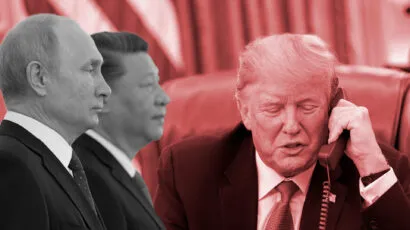
In February, Donald Trump triggered a global geopolitical realignment by resuming direct relations with Vladimir Putin’s Kremlin, agreeing by phone to “work together, very closely,” according to the US president (Collins and Liptak 2025). Up to that point, the United States had worked with its European allies to isolate, sanction, and defeat Russia in response to its launch of full-scale war against Ukraine in 2022. But since taking office, Trump has been demonstrably more amenable to Russia’s goals, even going so far as to call Ukrainian President Volodymyr Zelensky a “dictator” (Robbins 2025). Putin and Trump’s relationship was further cemented by the Kremlin, which commissioned a flattering portrait of Trump—fist raised in a gesture of defiance after the attempted assassination last year—and gifted it to the US president in March (Chance 2025).
In addition to unsettling decades of cooperation between the United States and its European allies, a geopolitical rapprochement between two of the world’s largest carbon emitters will have significant consequences for the global effort to stabilize the climate—both for better and for worse.

Both Trump and Putin support the further development of their countries’ fossil fuel reserves. Trump has already announced that he will pull the United States out of the Paris accord (McGrath 2025), as he did in 2019, and he is working quickly to dismantle many of the efforts the Biden administration launched to support renewable energy (Columbia 2025). Putin has asserted that climate change could be a net positive for his country and may hope to reduce Russia’s isolation by building stronger ties with Trump’s team through a variety of business ventures, including efforts to extract Arctic fuels (Javeline et al 2024).
Taken together, the United States and Russian activity represents 17.6 percent of global greenhouse gas emissions, a percentage that will not be reduced and may even increase (Friedrich et al 2023). Their narrowly self-interested approach to climate change will make it harder to raise adaptation funding for developing nations while likely increasing negative impacts. Accordingly, we explore the motivations and consequences behind Trump and Putin’s roles as spoilers of climate action. At a time when many think direct action is necessary, the two countries are leading a global retrenchment on climate progress.

Realignment belies differences
Putin has welcomed Trump’s initiative to restore direct ties, which might suggest their pursuit of similar goals. However, the approaches and outcomes that benefit each leader differ, and the two leaders may struggle to identify a strong set of common interests.
Trump’s “America First” policy marks a retreat from international commitments. Putin, by contrast, wants Russia to be a global player and is actively courting countries in the global south to expand Russian influence. While Putin initially downplayed climate science, even suggesting in 2018 that global warming might be caused by “cosmic changes… in the galaxy” rather than human activity, in recent years, he started acknowledging climate issues in global forums (Myznikova 2025). For example, at the 2022 UN climate summit (COP27), Russia backed the creation of a new fund to compensate vulnerable nations for climate “loss and damage” (UWEC 2022). In other words, the Russian leader demonstrated willingness to finally respond to the claims of vulnerable nations—in sharp contrast to Trump.
With the support of US oil companies, Trump announced a policy of “drill, baby, drill” during his second inaugural address, hoping to bring down the price of oil to spur growth in the American economy (McGrath 2025). Putin, by contrast, would prefer high oil prices since oil is his country’s main export (OEC 2025), and he depends on the revenue to support his war effort (AFP 2025).
In the past, Russia sold most of its output on the European market. Since 2022, the European Union has eliminated purchases of Russian coal and oil, and has been working to reduce its dependence on Russian natural gas, with imports down to 10 percent of 2022 levels (Sharples 2025). While China and India have bought Russian oil, keeping sales steady since 2022, Russia’s companies have not been able to restore or replace European gas sales. The Germans remain skeptical of Russian intentions (Vakulenko 2025), so a sales resumption before the end of the Russo-Ukrainian war is unlikely. The EU climate commitments are codified in the European Climate Law (European Commission 2025), and public opinion in Europe backs clean energy (European Union 2025). Yet the high cost of transition, economic uncertainty associated with Trump’s tariff regime, and the need for increased defense spending may push some European countries and citizens to welcome the return of Russian energy, possibly in the form of liquid natural gas (LNG) exportsin 2025, as a cost-saving measure (Hernandez et al. 2025).
Whereas Trump has denounced climate change as a “hoax” and pulled the United States out of international environmental negotiations, Putin is playing a much more subtle and opportunistic game. Russia uses climate change as a strategic instrument, particularly as it tries to restore favor with the European Union. Nevertheless, Trump and Putin have similarly benefitted from the construction of narratives that support the development of more fossil fuels and downplay the dangers of increasing global temperatures. Both leaders are adept at playing on—and adding to—the language people use and how that affects the way they see the world.
Impact of US-Russia relations on climate change negotiations
Improved US-Russia relations likely will alter the geopolitics of climate diplomacy. Under the Biden administration, the United States often pressured Russia (and other major emitters) to enhance their climate commitments—for instance, calling out methane emissions (White House 2021) or pushing for a global coal phase-out (Northey 2024). These efforts usually achieved little, and the United States just as frequently acted as a spoiler. Now, with Trump prioritizing a friendly rapport with Moscow, discounting climate change, and revoking climate commitments, Washington is far less likely to challenge Russia on environmental grounds. Russia did set a 2060 net-zero goal and submitted pledges under Paris (Climate Action Tracker 2022), but those plans lacked ambition and enforcement; with a friendly US administration that is equally unconcerned about climate, Moscow has little external incentive to strengthen its targets.
To the extent that the United States stays involved, we may see informal US-Russia cooperation or mutual understanding to resist certain climate initiatives that they perceive as threatening their energy interests. For example, at UN climate talks, an aligned US-Russia front might oppose aggressive language on fossil fuel phase-outs or water down commitments to curbing oil and gas production. It is not clear what Russia would do if Trump simply ignores future UN climate negotiations. However, Russia pays little to participate in international forums, claiming to demonstrate its climate bona fides while working behind the scenes to highlight Western hypocrisy on this issue.
In climate diplomacy circles, the new US-Russia great-power dynamic raises concerns of a splintered approach: A bloc of countries aggressively pursuing decarbonization (EU, climate-vulnerable nations, maybe China) versus a bloc of influential holdouts (the United States, Russia, Saudi-led petro-states) prioritizing energy over climate. Navigating this split will be the central challenge for multilateral initiatives like future COP negotiations such as those taking place in Brazil later this year.

Impact of US-Russia relations on humanity
Although the nature of the evolving US-Russia relationship is unclear, the countries’ current focus on increased fossil fuel production will likely have a range of negative consequences. The global health impacts of climate change include illness and death directly attributable to extreme weather events, disruptions of food and water systems, more favorable conditions for the spread of pathogens and their vectors, and interrupted access to health care, all disproportionately affecting already vulnerable and disadvantaged communities (World Health Organization 2023). Neither the United States nor Russia are immune to these effects, which will impose significant medium- and long-term costs (Climate Investment Funds 2024). Russia is the main source of wheat for over a hundred countries, including many less-developed countries in Africa and Asia, with Egypt, Indonesia, and Bangladesh being the main importers. Contrary to state claims (no author 2021), Russian agricultural producers face climate threats to yields and harvest, which increased US and Russian emissions may exacerbate, thereby increasing food insecurity among the world’s most vulnerable. Beyond all the political, economic, and security concerns that a Trump-Putin collaboration raises, the toll on humanity from a warming planet may ultimately be the most costly.
(This article was written by the PONARS Task Force on Russia in a Changing Climate, consisting of Robert Orttung, Debra Javeline, Graeme Robertson, Richard Arnold, Andrew Barnes, Edward Holland, Mikhail Troitskiy, Judyth Twigg, and Susanne Wengle)
Together, we make the world safer.
The Bulletin elevates expert voices above the noise. But as an independent nonprofit organization, our operations depend on the support of readers like you. Help us continue to deliver quality journalism that holds leaders accountable. Your support of our work at any level is important. In return, we promise our coverage will be understandable, influential, vigilant, solution-oriented, and fair-minded. Together we can make a difference.
Keywords: European Union, Russia, US, climate change, energy, fossil fuels
Topics: Analysis, Climate Change, Special Topics

Robert Orttung
Robert Orttung is a research professor of international affairs at George Washington University. ... Read More

Debra Javeline
Debra Javeline is a professor of political science at the University of Notre Dame. ... Read More

Graeme Robertson
Graeme Robertson is a professor of political science at University of North Carolina at Chapel Hill. ... Read More

Richard Arnold
Richard Arnold is a professor of political science at Muskingum University, Ohio. ... Read More

Andrew Barnes
Andrew Barnes is an associate professor of international studies at Kent State University. ... Read More

Edward Holland
Edward Holland is an associate professor of geosciences at the University of Arkansas. ... Read More

Mikhail Troitskiy
Mikhail Troitskiy is a visiting professor at the Fletcher School of Law and Diplomacy, at Tufts University. ... Read More

Judyth Twigg
Judyth Twigg is a professor of political science at Virginia Commonwealth University. ... Read More

Susanne Wengle
Susanne Wengle is an associate professor of political science at the University of Notre Dame. ... Read More

ALSO IN THIS ISSUE








Leave a Reply