
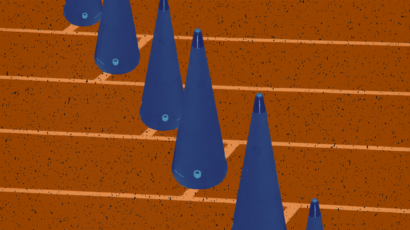
Image of a spinning top shown with dye injection. Photographer Bavand Keshavarz was a post-doctoral lecturer in Mechanical Engineering at MIT, studying soft matter mechanics and fluid dynamics, when he took this photo. (He is now an assistant professor at Duke University.) Keshavarz said “I often think about ideas that can help me visualize the hidden fluid patterns that are around us in our daily life but are either too fast or too subtle for us to notice.… I explore these hidden patterns and make them visible to our naked eyes through methods such as high-speed flash photography or dye visualization...
By freezing time with the high-speed flash, all the fast and blurred patterns emerge still and clear in the image and we thus make the hidden underlying world visible to us.” The photo was part of his winning entry in the Wiki Science Competition in 2021.
Image courtesy of Bavand Keshavarz / Wikimedia Commons under CC-BY-SA 4.0 license.
When I sent Kim Stanley Robinson the short stories we had deemed finalists in the Bulletin’s first-ever short fiction contest, Write Before Midnight, I was a bit apprehensive. The other preliminary judges and I had gone through more than 750 entries; it was a tsunami of verbiage of all types and of widely varying quality. The prompt for the contest asked only that entries have at least a tenuous connection to the Bulletin’s mission; some of those connections were pretty tenuous.
To my way of thinking, the final 10 stories I sent to Stan all seemed at least competent. But I wasn’t sure if they were good only in comparison to the many disorderly efforts at storytelling that my editorial helpers and I had dutifully read. I was, after all, sending them to Kim Stanley Robinson—who, The New Yorker has opined, is “generally acknowledged as one of the greatest living science-fiction writers,” and whose work The Atlantic has called “the gold standard of realistic, and highly literary, science-fiction writing.” His books have been translated into 29 languages. He’s had an asteroid named after him, for god’s sake.
I was ready to apologize for wasting his time at any suggestion that our stories were wanting.
Stan’s response was so generous and heartwarming that I’m going to quote quite a bit of it, with editing for (as they say) conciseness and readability:
Dear John
First, congratulations on a great batch of stories… I’ve seen a ton of unpublished stories, and I can say that you got a really fine group, at least the final ten you sent me.
As for my job, I don’t like it. I like all the stories. I’ll attach my notes on each and feel free to send them along to the writers if you like—maybe send the whole document to all the writers, whatever.
Then as to my choices—again, I don’t like it. However, I must admit I agreed to do it. I’m going to have to remember that the principle involved is something I need to avoid—judging, choosing, rating; stories are not to be treated like that.
For now, first I’m thinking there should be 7 stories in the group called finalists:
“Good Boy“
For me, the best thing to do would be to declare a “seven-story tie” between those seven above. Why not, who cares? It would be fun. You could just say “our designated judge Stan has excellent literary taste and so has been forced to declare a seven-story tie in the interest of truth and justice.”
And I wonder if an anthology of all these could be assembled.
In any case, congratulations again, thanks for thinking of me, I’ll remember not to agree to do such a thing again, but in the meantime, it has been a really fun reading assignment.
yours, Stan
I was and am thrilled to hereby declare that Kim Stanley Robinson has excellent literary taste and that the Write Before Midnight short fiction competition has ended in a seven-way tie. The seven winning stories follow this introduction; prize money will be split equally among the winning authors. Stan was kind enough to comment on each of the winning stories; his comments are included in this collection.
I congratulate all the authors and thank everyone who entered our first foray into fiction. If I have any influence over the course of future events, it will not be our last. The Bulletin’s mission—protecting civilization from manmade existential threats like nuclear weapons and climate change—is important. Filling civilization with art and the humanity it fosters is important, too.
Together, we make the world safer.
The Bulletin elevates expert voices above the noise. But as an independent nonprofit organization, our operations depend on the support of readers like you. Help us continue to deliver quality journalism that holds leaders accountable. Your support of our work at any level is important. In return, we promise our coverage will be understandable, influential, vigilant, solution-oriented, and fair-minded. Together we can make a difference.
Keywords: commentary, criticism, satire
Topics: Fiction, Magazine, Personal Essay, Satire, Special Topics

John Mecklin
John Mecklin is a veteran public-interest journalist. He stepped down as editor in chief of the Bulletin of the Atomic Scientists mid-August ... Read More







Thank you to John Mecklin, Kim Stanley Robinson and all involved for this unique contest. I was not a finalist (far from it, I’d wager) but the contest ignited a passion I didn’t know I had for—what do we call it?—Midnight art. Please do keep the contest going, at least until the Clock starts going backwards.
Will this be repeated next year? Would love to give it a shot!