The radiation risks of Iran’s nuclear program, with or without a strike on Fordow
By François Diaz-Maurin | Analysis | June 20, 2025
 (Map: Thomas Gaulkin / Datawrapper. Image: Google Earth)
Editor’s note: On Saturday, President Donald Trump announced on his Truth Social platform that the United States has carried out strikes against Iranian nuclear sites, including Fordow, Natanz, and Isfahan. This article will be updated as details emerge of the US attack.
Since launching its surprise attack on June 13, Israel has carried out multiple air strikes on nuclear facilities across Iran. The attacks on a research reactor, enrichment plants, and other nuclear facilities have led to significant damage visible from satellite imagery and concerns of possible radiological and chemical release.
Speaking at the UN Security Council on Friday, Rafael Grossi, the director-general of the International Atomic Energy Agency (IAEA), said that “no radiological release has affected the public,” adding, however, that “[Israel’s] attacks on Iranian nuclear sites have caused a sharp degradation in nuclear safety and security.” Since June 13, several of Iran’s key nuclear sites have been damaged, including the two enrichment facilities at Natanz, four buildings at Isfahan, and a research reactor at Khondab. According to Grossi, no increase in radiation levels was measured outside of the damaged facilities, although toxic chemicals and radiological contaminants may have been dispersed inside some of these facilities, including at the underground Natanz enrichment plant.
According to the IAEA, Iran’s total inventory of enriched uranium as of May 17 was approximately 9,250 kilograms. This figure includes 8,400 kilograms of uranium hexafluoride gas; 620 kilograms of uranium oxide; 71 kilograms of uranium metal in fuel assemblies, plates, and rods; 4 kilograms of uranium in targets; and about 140 kilograms of uranium in liquid and solid scrap (radioactive waste).
The IAEA also estimates that over 400 kilograms of the uranium hexafluoride gas have already been enriched to 60 percent—a level considered highly enriched, but not yet weapons grade. This material sits outside of international oversight, Ian Stewart, a non-proliferation expert, explains. It’s enough for about 10 nuclear weapons, he says.
The location of Iran’s highly enriched uranium is unknown, but it could already be in the hands of Iran’s Islamic Revolutionary Guard Corps (IRGC) and stored at one of several secret facilities. Indeed, on Thursday, a senior IRGC official reportedly said they had preventively transferred all the enriched uranium to hidden locations. Iran might also have undisclosed centrifuges, possibly at these alleged secret sites, available to further enrich (concentrate) its stockpile of 60-percent uranium. These may even already be operating.
Mined uranium naturally is made of less than 1 percent fissile uranium 235, which can be used in nuclear chain reactions. Going from a concentration of less than 1 percent uranium 235 to 60 percent uranium 235 takes much longer than further purifying 60-percent uranium 235 to a 90-percent concentration, the level considered “weapons grade.” Experts estimate that it could take as little as five to six days for Iran to complete this step and enrich enough uranium for one nuclear weapon.
Iran weaponizing this material, while rightly an extremely urgent concern, is not the only potential risk related to the country’s nuclear stockpile. While much remains unknown about the whereabouts or conditions of Iran’s highly enriched uranium, the material poses a contamination or radiation exposure risk, regardless of whether the material is targeted in an attack.
A large amount of enriched uranium hexafluoride gas stored in tanks in a relatively small area would represent a significant chemical risk if attacked. Not knowing how much of this material is inside the tanks or the conditions under which it is stored makes this risk even greater.
Hurried transport and improper storage conditions could also significantly increase the risk of exposure to toxic chemicals. While uranium hexafluoride gas is not directly fissile, if moisture enters transport or storage cylinders, uranium, especially enriched uranium, becomes more reactive, creating conditions in which a nuclear fission chain reaction could occur. This could potentially lead to a chemical explosion of the cylinders, resulting in a significant dispersion of uranium hexafluoride gas into the facility and possibly into the environment—a scenario possible even without an attack.
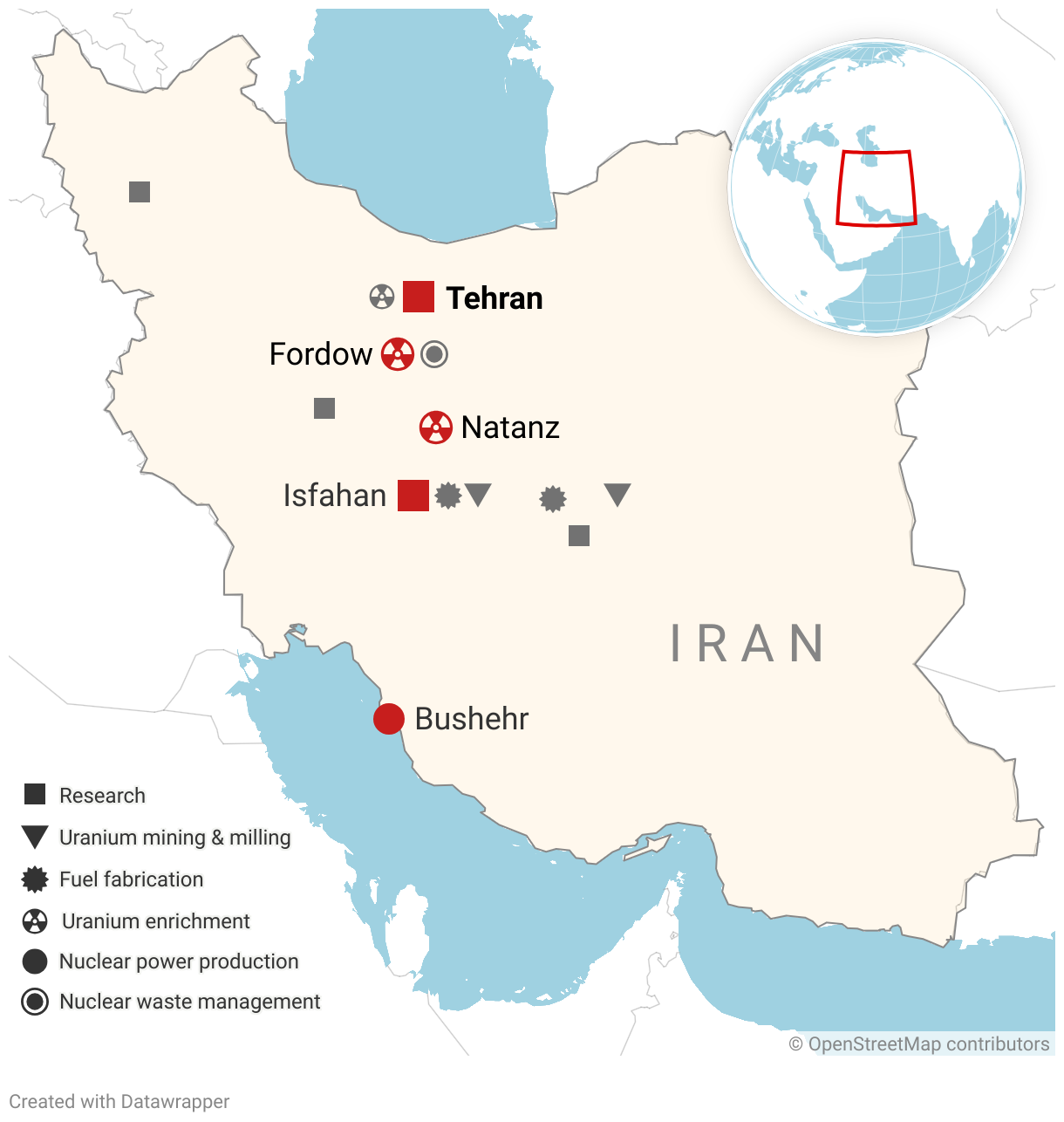
Operating or probably operating nuclear facilities in Iran as of June 12, 2025. In red are the main nuclear sites. Locations are approximate. Map: Thomas Gaulkin / Datawrapper. Source: Nuclear Threat Initiative.
To better understand the risk of radiological contamination stemming from the Israel-Iran conflict, I’ve attempted to break down the type and scale of the risks involved based on the publicly available information about Iran’s nuclear sites from before the Israeli attacks. For a more accurate assessment, we would need complete knowledge of the current chemical and physical properties, quantities, and storage conditions of the nuclear material inventories at these sites, which we do not have.
Here is an overview of what could go wrong at the facilities that were operating or probably operating as of June 12, before Israel’s attack:
Natanz (very low; mostly chemical toxicity)

Natanz, about 300 kilometers south of Tehran in the Isfahan province, is Iran’s main enrichment facility. It hosts both an underground fuel enrichment plant (FEP) for commercial nuclear power reactors and a more technologically advanced above-ground pilot fuel enrichment plant (PFEP). The nuclear material and enrichment equipment of both plants are under international oversight by the IAEA.
The site received worldwide attention after an exiled Iranian political dissident disclosed in 2002 that Iran had covertly moved gas centrifuges and equipment at Natanz, resulting in international concerns that the facility may be used for military purposes. The site has been targeted by cyber attacks and sabotage multiple times in the past, and Iran has accused Israel of being behind these attacks.
The site was attacked in the early hours of Israel’s June 13 operation, destroying an above-ground electric substation as well as a uranium hexafluoride gas storage facility. Following the attack, Grossi said that uranium isotopes contained in uranium hexafluoride gas may have been dispersed inside the storage facility. The radiation from these uranium isotopes, primarily in the form of alpha particles, could pose a significant danger if inhaled or ingested. This risk can be managed with appropriate protective measures.
The main risk inside the storage facility is the chemical toxicity of uranium hexafluoride gas and fluoride compounds generated in contact with water. The radiological risk from enriched uranium at Natanz is likely to be much smaller than the chemical toxicity from the fluorine.
Grossi also said of the roughly 15,000 centrifuges operating underground at Natanz that they were “severely damaged if not destroyed altogether,” most probably as a result of power cuts caused by Israeli strikes destroying the above-ground electricity facility. The FEP facility consists of a three-floor large underground building below ground and protected by a 2.5-meter-thick concrete structure. The facility itself is believed not to have been damaged by the attack. Despite the attack, the underground facility’s exact operability status is unknown.
Fordow (very low; mostly chemical toxicity)

Fordow is Iran’s second pilot fuel enrichment plant (FFEP). It is located deep underground, at about 80 to 90 meters deep, inside a mountain near the city of Qom in northern Iran. According to the IAEA, the facility hosts 1,044 IR-1 centrifuges as well as 1,740 IR-6 centrifuges of Iran’s most advanced type. Overall, Fordow can produce between 30 and 35 kilograms of highly-enriched (60 percent) uranium per month. The plant could also be diverted to produce 25 kilograms of 90-percent enriched uranium hexafluoride—enough for one weapon—in as little as three days, Stewart says.
As of Friday, June 20, the facility had not been targeted either by air strikes or sabotage operations. Conventional missiles used by Israel are not capable of destroying the facility. But the United States and Israel have reportedly prepared plans to destroy the facility, with an attack believed to possibly occur in the next days, despite doubts about whether destroying the facility is technically feasible and needed to roll back Iran’s nuclear program.
Options to destroy Fordow go as far as including the possibility of using a low-yield nuclear weapon that could deliver enough explosive to destroy Fordow. Past the enormous escalation risk and international norm-breaking from such a move, the explosion of a nuclear weapon would result in vastly more radiation risk from the radioactive fallout of the nuclear explosion itself than from the possible release of uranium from Fordow’s enrichment halls.
Isfahan (moderate)

Isfahan is home to a vast nuclear technology center near Isfahan, Iran’s second-largest city, and is considered to be one of the most important sites for Iran’s nuclear program. The site operates three small research reactors, and a fourth is planned to be built. In addition, the site includes a central chemical laboratory, a uranium conversion plant that converts uranium into uranium hexafluoride to be used in centrifuges for enrichment, as well as a reactor fuel manufacturing plant, and a nuclear waste storage facility. The site also includes a facility to convert uranium hexafluoride into triuranium octoxide (also known as “yellowcake”) and produce fuel plates to be used for experiments in the Tehran Research Reactor.
In 2021, the IAEA found equipment at the uranium conversion plant for producing uranium metal that could potentially serve to manufacture the core of an implosion nuclear weapon. The agency also found that Iran had produced uranium metal in the “yellowcake” conversion facility using natural uranium in violation of the Joint Comprehensive Plan of Action (JCPOA).
Uranium metal is less chemically hazardous than uranium hexafluoride gas, but it poses a significant radiation risk. Criticality, in which a sustained nuclear fission chain reaction occurs that produces near-lethal doses of ionizing radiation, could be obtained by assembling a mass of 53 kilograms of pure uranium 235 or slightly more if it is with 90-percent weapons-grade metallic uranium. (The IAEA previously reported that most of Iran’s highly enriched uranium has been moved to the facilities where uranium metal can be produced.) Such a criticality accident could occur at a uranium metal conversion plant that does not follow proper safety protocols.
On the first day of the attack, Israel’s strikes reportedly damaged four buildings at Isfahan, including the uranium conversion plant, central chemical laboratory, and reactor fuel manufacturing plant. No off-site increase in radiation levels was measured, and the site’s operability status is unknown.
Tehran Research Center (moderate)

The Tehran Research Center includes a research reactor and a site for producing medical radioisotopes used in cancer treatment. On June 18, the IAEA reported that one building at the site was hit, which manufactured and tested advanced centrifuge rotors. No satellite imagery has been published since the attack, and no radiological consequence is expected from this strike.
However, it is unknown how far the attacked building was from the research reactor, which is thought to be currently operating. Should the nearby research reactor be hit by a strike, the radiological consequences would be significant.
Bushehr (very high)

The Bushehr plant, located on the Gulf Coast, is Iran’s first commercial nuclear power plant. The plant is a Russian-design VVER 1000-megawatt-electric light-water reactor, which uses Russian-supplied fuel that is then returned to Russia for disposal. The plant has Russian employees on site. Two new reactors of Russian design are under construction at the site.
Bushehr is Iran’s nuclear site where an attack could have the most serious consequences. Because the plant is operating, there are thousands of kilograms of nuclear material on site.
Grossi warns that an attack on the Bushehr reactor or fuel storage pool “could result in a very high release of radioactivity to the environment.” But a major radiation release at Bushehr could also result from a loss of on-site electrical power, forcing the cooling systems to shut down and leading to either a reactor accident or a fire at the plant’s densely packed spent nuclear fuel storage pool.
Other nuclear facilities
Iran has other nuclear facilities that are less critical for a nuclear weapon program but pose significant radiological risks. The highest radiological hazards could come from a possible attack on operating nuclear reactors or on nuclear waste storage facilities, such as the Qom waste disposal site in the south of Tehran. Attacks on power lines or any other facilities that could stop the supply of electricity to cooling systems of nuclear reactors or spent fuel storage pools could also result in high radiological contamination, similar to that from previous reactor accidents at Chernobyl or Fukushima.
On June 19, the Khondab heavy-water research reactor, which is under construction in Arak, was attacked by an air strike. Satellite imagery from after the attack showed a hole in the domed roof of the reactor building.
Sources: IAEA, Iran Watch, ISIS, NTI, WNA, WNISR. Tatsujiro Suzuki, Scott Kemp, and Zia Mian provided background information.
Together, we make the world safer.
The Bulletin elevates expert voices above the noise. But as an independent nonprofit organization, our operations depend on the support of readers like you. Help us continue to deliver quality journalism that holds leaders accountable. Your support of our work at any level is important. In return, we promise our coverage will be understandable, influential, vigilant, solution-oriented, and fair-minded. Together we can make a difference.

François Diaz-Maurin
François Diaz-Maurin is the editor for nuclear affairs at the Bulletin of the Atomic Scientists. Previously, Diaz-Maurin was a MacArthur ... Read More












Leave a Reply