Leaders shouldn’t just talk about Hiroshima and Nagasaki. They should visit.
By Alexandra Bell | August 12, 2025
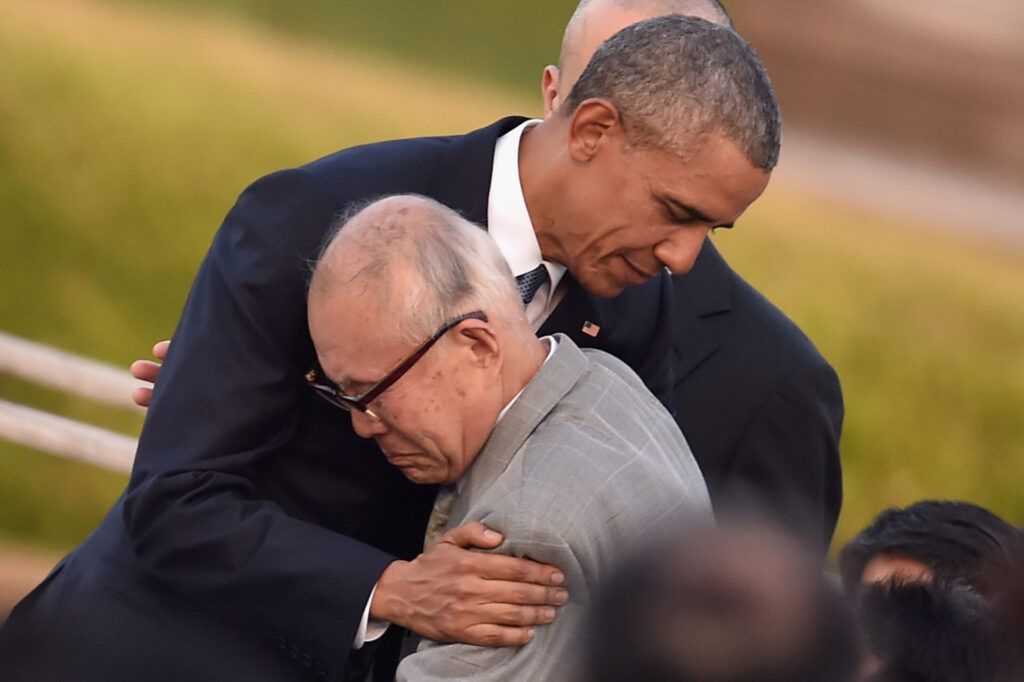 US President Barack Obama embraces an a-bomb victim at the Hiroshima Peace Memorial Park on May 27, 2016 in Hiroshima, Japan. It was the first time a US president made an official visit to Hiroshima, the site where the atomic bomb was dropped on August 6, 1945. (Photo by Atsushi Tomura/Getty Images)
English | Español
The solemn anniversaries of the bombings of Hiroshima and Nagasaki come and go each year, with world leaders delivering poignant and heartfelt messages about what happened and expressing their general support for nuclear disarmament. Many of these leaders then move on to what they deem to be more pressing matters.
But these annual commemorations do not resolve the issue at hand: As we mark the 80th anniversary of those bombings and the end of the worst conflict in human history, the world finds itself at an inflection point. All the misunderstandings, political and military posturing, hard won diplomatic agreements, and lessons learned that moved us away from nuclear catastrophe are being ignored or forgotten. Every nuclear challenge facing us is getting worse and, in many cases, growing more complex. There are dozens of pragmatic steps leaders can take starting today to reverse the trend, but political will and a sense of urgency are in short supply.
Perhaps the problem is that, for many, nuclear risks seem largely conceptual these days, decades removed from the once-omnipresent fear of nuclear war. To better understand what is at stake, world leaders should stop talking about Hiroshima and Nagasaki and actually go there. The leaders of nuclear armed states, in particular, should make the journey. Once you visit the cenotaphs and museums in either city and talk with the remaining victims of the bombings, it becomes impossible to ever again separate the theory of nuclear war from its appalling reality.
Leaders from the United States—the country that dropped the atomic bombs on Japan and the only country to have used nuclear weapons in conflict—have now repeatedly visited. Other world leaders lack any good excuse for further delay.
Following President Obama’s 2009 “Prague Speech,” in which he pledged that the United States would take concrete steps toward a world without nuclear weapons, Japanese officials began inviting him to visit Hiroshima and Nagasaki almost immediately. Deciding how to respond to those invitations was a delicate process. No sitting US president had ever visited (though former President Jimmy Carter did in 1984 and received some criticism for it).
The Obama administration chose a slow, deliberative approach, with US ambassadors to Japan John Roos and Caroline Kennedy first joining the memorial ceremonies. Under Secretary of State for Arms Control and International Security Rose Gottemoeller then visited Hiroshima in April 2014, returning in 2015 for the memorial ceremonies in both Hiroshima and Nagasaki. About a year later, Secretary of State John Kerry attended the G7 meeting hosted by then-Foreign Minister and future Prime Minister Fumio Kishida in Hiroshima, visiting the cenotaph while there. These visits and trips informed the White House conversations on the matter, with President Obama finally traveling to Hiroshima on May 27, 2016. His speech was and is certainly worth reading. While some criticism followed the visit, it served and still serves as an important example of how to acknowledge the difficult past and move ahead into the future with purpose and resolve. Most critics seemed to miss the fact that six months later, Prime Minister Abe traveled to Pearl Harbor, a visit with meaningful symmetry.
Although President Obama did not effect the kind of nuclear risk reduction he envisioned in Prague, he understood, like President John F. Kennedy, that “peace is a process, the sum of many acts.” One of those acts was simply taking the time to see things with his own eyes—to speak directly with people affected by the decision to use the ultimate weapon of war.
That act and the steps that led to it were important not just as symbols; they had a practical effect. People like me, who staffed Gottemoeller on her trips, also got to see these places first-hand. I came away with better understanding of the potentially catastrophic humanitarian consequences of nuclear war and have been a better expert and diplomat for it.
Having visited both Hiroshima and Nagasaki twice, the effects of nuclear use are, for me, not an abstract concept in a book, or a political bumper sticker useful for pushing policies; those effects are tangible and terrifying. I remember everything about my first trip to the Hiroshima Peace Museum. After moving through the initial rooms—seeing the table map of the city at the time overlaid with blast rings, a mock-up of Little Boy—our group arrived in the sections focused on the human effects of the blast. I saw photographs of women with the patterns on their clothing burned into their skin and, indelible for me, the outline of a human shadow burned directly onto the stone surface of a building façade. I still see that shadow in my mind’s eye. When our group moved to a room with the belongings of school children and Sadako Sasaki’s paper cranes, my breath caught in my chest and I felt tears welling up. As the lone woman and youngest member of the US delegation, I fought to hold them back, not wanting the others to see me breaking. I then saw my colleagues, many of them fathers, with tears in their eyes. It was a truly educational moment. No amount of diplomatic training or familiarity with the horrible complexity of World War II could separate human emotion from the expert.
My last visit to Nagasaki came just after the conclusion of a US-Japan Extended Deterrence Dialogue in nearby Sasebo. It was December of 2023, and I appreciated the opportunity to experience things without all the crowds and distinguished guests. I walked through the museum in quiet contemplation, again seeing a shadow—this time of a plant—forever burned onto a wooden surface. It could be seen as beautiful, if you didn’t know the provenance. I then saw a clock frozen at 11:02—a reminder of the end of time for tens of thousands of men, women, and children. It made me think of the Doomsday Clock, something I unknowingly would later come to manage. It also made me think that everyone who has a hand in shaping our nuclear future should see that frozen clock—see all of the other mementos of the Hiroshima and Nagasaki bombings.
This kind of personal experience would not be a panacea, but it might help leaders and experts to see beyond abstract arguments and their own long-held views about nuclear weapons.
The often sterile, detached nature of modern deterrence conversations becomes untenable once you have seen what’s left behind in the wake of death wrought on an unimaginable scale. At the same time, the casual dismissal of the role deterrence has played global stability becomes untenable, when you see what nuclear armed states are capable of doing to one another and the world.
World leaders must accept and manage that admittedly dichotomous reality. It should drive them to do more, try harder, demand action, and never forget the fate the world has escaped for eight decades. After visiting Hiroshima or Nagasaki, their efforts will undoubtedly be underpinned by an unwavering belief that nuclear weapons should never be used again.
Together, we make the world safer.
The Bulletin elevates expert voices above the noise. But as an independent nonprofit organization, our operations depend on the support of readers like you. Help us continue to deliver quality journalism that holds leaders accountable. Your support of our work at any level is important. In return, we promise our coverage will be understandable, influential, vigilant, solution-oriented, and fair-minded. Together we can make a difference.
Keywords: 80th anniversary, Hiroshima and Nagasaki, Obama, Obama in Hiroshima, Prague Speech
Topics: Analysis, Hiroshima & Nagasaki, Nuclear Risk, Nuclear Weapons

Alexandra Bell
Alexandra Bell is the president and CEO of the Bulletin of the Atomic Scientists. A noted policy expert and former diplomat, she oversees ... Read More

This project is part of a collaboration between the Bulletin of the Atomic Scientists and the Stanley Foundation.
ALSO IN THIS COLLECTION






If we would have invaded the Japan homeland ,deaths would have been millions , not 200,000!! Did you lose people during the war , I never met my grandfather because of Japan attack on the US. He was killed ! Iam so glad they dropped them and stoped the American lives . Do you know the invasion fleet was way bigger than D day , and we would have lost hundreds of thousand troops and the last island we took , this was the first time the Navy lost more lives than the landing force , they were flying into… Read more »
I agree. The Atomic Museum has a photographic record of the horrors of the first use of an atomic bomb on a city. That and my visit to Dachau convinced me of the absolute horror of war.
“It is well that war is so terrible, otherwise we should grow too fond of it”. General Robert E. Lee
I thoroughly enjoyed reading your memory of visiting these sites. I visited Hiroshima in 2019 and was brought to tears as well. Having read Hershey’s book again before the visit really helped make it that much more personal, but I was also impressed in how the Japanese told the story without sticking their finger in the United States’ eye, which they easily could’ve done. The account was very factual and very raw. Thank you so much for sharing and I agree that people need to visit these sites to understand, firsthand, the terror of nuclear weapons and how destabilizing they… Read more »