Reflections on Hiroshima and Nagasaki 80 years on
By Siegfried S. Hecker | August 6, 2025
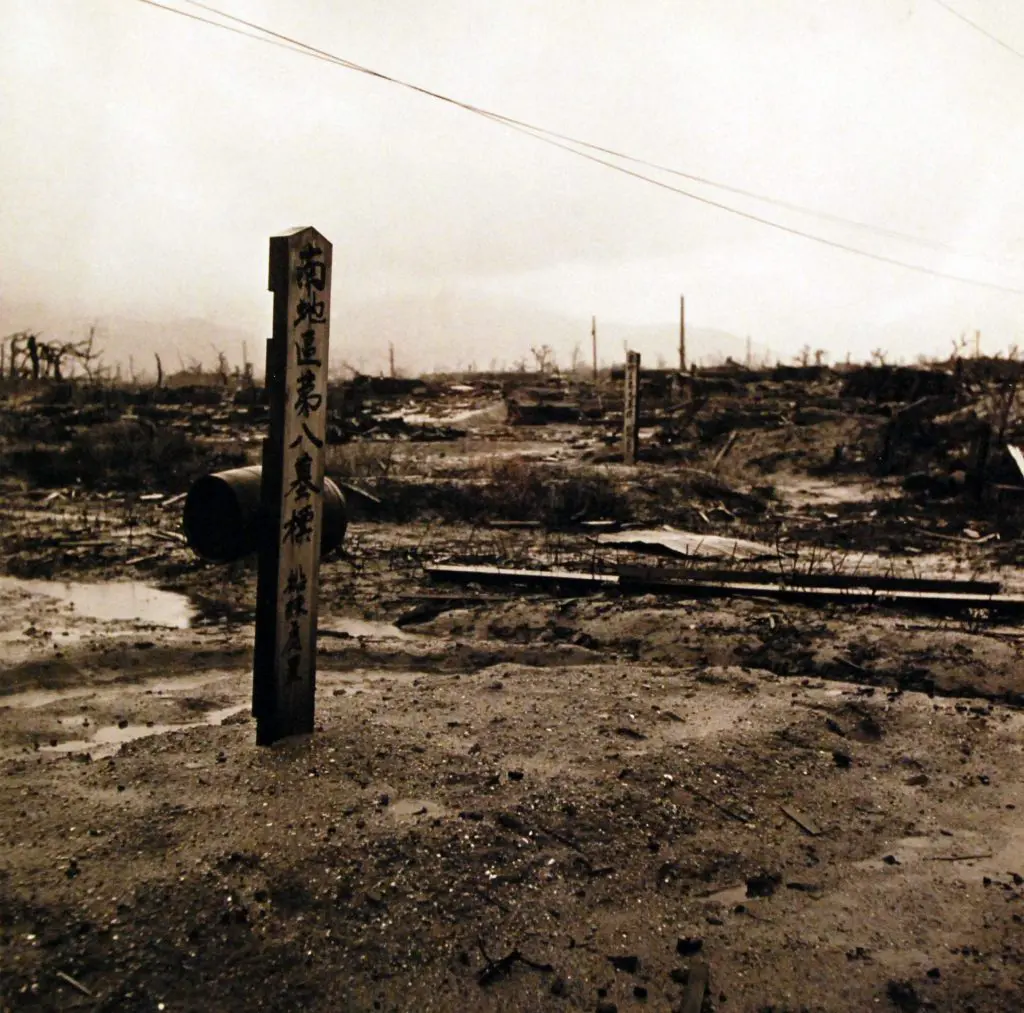 Mass grave markers in Hiroshima, photographed by Lieutenant Wayne Miller in September 1945. (US Navy / National Archives)
Thirty years ago, as director of the Los Alamos National Laboratory, I wrote an essay on the 50th anniversary of the bombings of Hiroshima and Nagasaki. In that piece (which can be found here), I had questions about the decision to use the atomic bomb that I couldn’t answer: Was it necessary? Was it right? It just wasn’t possible, three decades later, to put myself in President Truman’s shoes as he made those fateful decisions.
Instead, I answered two other questions: Did we learn from the bombings, and where do we go from here?
I concluded that we had learned, but we must keep the horrid images of the destruction in Hiroshima and Nagasaki in front of us as a stark reminder, so we continue to address current-day nuclear dangers, making it possible for people to look back on the 100th anniversary of the bombings and say the Manhattan Project turned out all right. Now, 80 years on, I am concerned we are on the wrong path—instead of continued learning about the dangers of nuclear war, we are unlearning the most important lessons.
During the first 50 years of nuclear weapons—despite J. Robert Oppenheimer’s concern about an atomic apocalypse, shown so dramatically in the final scene of Christopher Nolan’s film Oppenheimer—we are all still here. Although we had close calls—the Cuban Missile Crisis, a variety of nuclear weapons accidents, and serious health and environmental concerns resulting from the US–Soviet arms race—a global nuclear order had evolved. It consisted of a combination of norms, agreements, treaties, institutions, and practices.

Briefly stated, during that evolving order, nuclear weapons were not again used in war; there was only limited proliferation of nuclear weapons; no nuclear terrorism occurred; and the public saw significant benefits from peaceful nuclear technologies such as nuclear electricity and nuclear medicine. By 1991, the Doomsday Clock was set at 17 minutes to midnight to reflect a much-reduced nuclear threat, which had changed in character, from nuclear weapons in the hands of the Soviet government to nuclear weapons, materials, and experts getting out of the hands of the Russian government and other states of the former Soviet Union.
That global nuclear order would not have been possible without cooperation between the two nuclear superpowers, the Soviet Union and the United States, even while they were engaged in intense Cold War competition. Likewise restraint was necessary, through arms control agreements and other measures intended to accompany mutual deterrence and make war less likely. Cooperation was particularly crucial to ensure the safety and security of the Soviet Union’s tens of thousands of nuclear weapons and million-plus kilograms of fissile material as the country broke up, creating political, economic, and societal trauma. But cooperation was also necessary among the rest of the world’s nations to support the global nuclear nonproliferation regime, prevent nuclear terrorism, and expand the peaceful uses of nuclear technologies.
A fast-forward to 2025 brings us into a much more dangerous world—the Doomsday Clock is set at 89 seconds, the closest it has ever been to midnight. After more than a decade of close cooperation with the United States, Russia began to chart its own course, bristling under what Russian President Vladimir Putin called in a 2007 Munich Security Conference speech[1] America’s “hyper exceptionalism.” President Xi Jinping decided to abandon China’s decades-long policy of minimal nuclear deterrence, embarking on a significant buildup of his country’s nuclear forces. India and Pakistan entered the nuclear weapons club with a flurry of nuclear tests in 1998, increasing the stakes of conflict in South Asia. North Korea developed a nuclear arsenal that threatened not only South Korea and Japan, but also the United States. After the Trump administration withdrew from a nuclear deal in 2018, Iran reduced the breakout time required to produce bomb-grade uranium to weeks, prompting Israel, supported by the United States, to strike its nuclear facilities this June.[2]
Russia and the United States systematically abandoned nuclear arms restraints. Frustrations with what they considered a lack of progress toward disarmament, in 2017 a sufficient number of states signed the Treaty on the Prohibition of Nuclear Weapons, which entered into force in 2021, driving an even deeper wedge between the nuclear-weapons and non-nuclear-weapons states.
The most serious fracture in the decades-long global nuclear order came when Russia invaded Ukraine in February 2022. Much of the concern about that conflict focused on President Putin and his government threatening to use nuclear weapons in Ukraine or Europe. But the cracks in the nuclear order went much deeper.[3] Russia broke the security guarantee it signed in the 1994 Budapest Memorandum, which had convinced Ukraine to return to Russia the Soviet-era nuclear weapons it inherited. The security guarantee and numerous other international agreements, treaties, and organizations were essential components of the nonproliferation regime.
As part of the nuclear order, Russia had over the years become an important member of global organizations that worked to prevent nuclear terrorism. Russia had also traveled a long and positive road to recovery in the peaceful uses of nuclear energy after the 1986 Chernobyl reactor disaster. It greatly improved its regulatory system, cooperating with the US Nuclear Regulatory Commission and with other members of the nuclear industry. Russia agreed to down-blend 500 metric tons of highly-enriched uranium from its military complex for nuclear reactor fuel in the United States—a splendid example of swords-to-plowshares cooperation. In the process, it also established itself as an essential part of the global nuclear fuel supply chain, possessing some 40 percent of the world’s uranium enrichment capacity. Russia was poised to become a major exporter of nuclear power plants. It was a respected member of most international nuclear organizations, including the International Atomic Energy Agency (IAEA).
With the invasion of Ukraine, all is now either gone or under stress. When Russia invaded Ukraine, its soldiers pilfered material from the contaminated exclusion zones of the destroyed Chernobyl reactor in what constituted a case of state-sponsored nuclear terrorism. Even more egregious was Russia’s shelling of the Zaporizhzhia Nuclear Power Plant in Ukraine, followed by its efforts to force Ukrainian reactor operators to work at gunpoint.
Rebuilding the necessary global nuclear order, which we must, is one of today’s defining global challenges. We will need China to step up while we wait for Russia to hopefully return to behaving like a respected nuclear power.
Perhaps an even more serious threat to the global nuclear order are the wounds the current US administration has inflicted on our country. It is destroying our system of alliances and friendships around the world. It is adopting many of the Heritage Foundation’s Project 2025 recommendations to shape a different future for our national scientific and technical enterprise—recommendations that are dramatically at odds with what made America great.
At the end of World War II, the scientific and technical foundations for America’s success were based on the recommendations of Vannevar Bush, director of the Office of Scientific Research and Development, in his 1945 report to President Truman, “Science, the Endless Frontier.”[4] That report advocated building on the Manhattan Project’s demonstration of how the government, universities, and scientific communities can work together to achieve critical national goals and, in turn, help build America’s economic and military might.
What made the United States the envy of the world and the favorite destination for many of the world’s most gifted people was a combination of robust democracy and the use of soft power side-by-side with military might. But after nearly 80 years of a rules-based, liberal international order in which America and the Western world flourished, the current administration has tilted toward illiberal semi-democracy, with trade war-creating tariff increases and the unraveling of alliances, at a time when challenges from Russia and China underscore this country’s need for allies and friends.
America’s global role in leading the world toward peace and prosperity must be underpinned by leadership in science and technology. Bush’s blueprint for US science policy called for robust federal investment in basic research, largely at universities and through nonpartisan mechanisms. Science was viewed as a public good essential to the nation’s economic, security, and health enterprises. His vision led to the creation of the National Science Foundation (NSF) and influenced the establishment of the Atomic Energy Commission (AEC) and defense organizations that championed the importance of dual-use technologies to benefit not only the military but the broader economy. Science was viewed as independent, curiosity-driven, and essential to a strong, educated democracy, with the government as an enabler and protector of free scientific inquiry.
These are no less necessary as pillars of future America greatness than they have been for 80 years.
The Project 2025 blueprint would create a paradigm shift. It calls for political oversight, particularly to curb perceived liberal dominance in science. Scientific institutions must be ideologically accountable, and government should not fund science that conflicts with so-called conservative principles. Federal institutions are viewed as biased by deep state actors and slated for major reductions. The project’s view of American universities couldn’t be more different from Bush’s vision. They are described as ideologically captured institutions, an enemy of the state. Rather than promoting robust funding of scientific research, federal funding would come only with ideological scrutiny.
During the 2024 presidential campaign, Trump tried to distance himself from the Project 2025 blueprint. But the actions of his administration to date appear frighteningly aligned with it. Key scientific agencies—the NSF, NASA Science, the National Oceanic and Atmospheric Administration, the National Institutes of Health, and the Centers for Disease Control and Prevention—are slated for cuts of 40 percent and more. Likewise, scientific institutions and universities are increasingly exposed to conservative ideological litmus tests.
Why is an independent American research enterprise important to preserving a global nuclear order? It’s because our nation’s leadership in the nuclear sphere, be it for military or civilian purposes, depends critically on our global leadership in science and technology. The Project 2025 blueprint would move us dramatically backwards and out of a leadership position.
As we commemorate the 80th anniversary of the Manhattan Project, we must keep in mind that it not only produced the first atomic bombs but also fundamentally restructured the relationship between science, government, and the military in the post-war world. It ushered in university-government partnerships and catalyzed postwar civilian technologies. It was the real-world proof that “Big Science” funded by the government can serve the nation. The Big Science model was institutionalized after the war with the establishment of multidisciplinary institutions like the Los Alamos, Lawrence Livermore and Sandia national labs, along with a suite of civilian-focused Atomic Energy Commission laboratories. It was as much the critical assembly of talent—largely from Europe, which many of the world’s greatest scientists fled to escape Hitler’s and Mussolini’s reigns of terror—that led to the Manhattan Project’s success as the critical assembly of nuclear material.[5] It was the coming of age of American physics, demonstrating that large-scale, interdisciplinary, government-funded research could yield transformative national outcomes.[6] It gave scientists not only influence but also new ethical responsibilities[7] and resulted in the establishment of The Bulletin of the Atomic Scientists and the Federation of American Scientists.
Indeed, the outlook for the nuclear world today is much more troubled than when I looked back at the 50-year commemoration of the Hiroshima and Nagasaki bombings. We are in danger of forgetting the horrors of that destruction. We have unlearned the most important lessons about the need for cooperation and for mutual restraint. Russia presents the most immediate challenge to the global nuclear order, because its unjustified, brutal war in Ukraine has torn the order’s fabric. But the paradigm shift we are currently seeing in the United States and other major powers— toward renewed nationalism, emphasizing a more emphatically sovereigntist tilt than before the advent of globalization and a rules-based international order—may present the greater long-term challenge. This is especially so in America, where we are tearing down the pillars of our success—governmental, nonpartisan support of science and universities—that have served us well since 1945. These changes will impede our ability to rebuild the global nuclear order and prevent a nuclear apocalypse.
Notes
[1] http://en.kremlin.ru/events/president/transcripts/24034
[2] https://thebulletin.org/2025/07/time-for-iran-to-make-a-no-enrichment-nuclear-deal/
[3] https://thebulletin.org/2022/04/siegfried-hecker-putin-has-destroyed-the-world-nuclear-order-how-should-the-democracies-respond/#post-heading
[4] Bush, Vannevar. Science, the Endless Frontier: A Report to the President. Washington, D.C.: Office of Scientific Research and Development, 1945.
[5] Hoddeson, L. et al. Critical Assembly: A Technical History of Los Alamos During the Oppenheimer Years, 1943–1945, Cambridge University Press, Cambridge, United Kingdom, 1993..
[6] Kevles, Daniel J. The Physicists: The History of a Scientific Community in Modern America. Harvard University Press, 1978.
[7] Rhodes, Richard. The Making of the Atomic Bomb. Simon&Schuster, United States, 1986.
Together, we make the world safer.
The Bulletin elevates expert voices above the noise. But as an independent nonprofit organization, our operations depend on the support of readers like you. Help us continue to deliver quality journalism that holds leaders accountable. Your support of our work at any level is important. In return, we promise our coverage will be understandable, influential, vigilant, solution-oriented, and fair-minded. Together we can make a difference.

Siegfried S. Hecker
Member, Board of Sponsors Siegfried Hecker is a professor of practice at the Middlebury Institute of International Studies at Monterey and ... Read More

This project is part of a collaboration between the Bulletin of the Atomic Scientists and the Stanley Foundation.
ALSO IN THIS COLLECTION










Leave a Reply