It’s past time to start protecting US nuclear power reactors from drones
By Henry Sokolski | Analysis | September 3, 2025
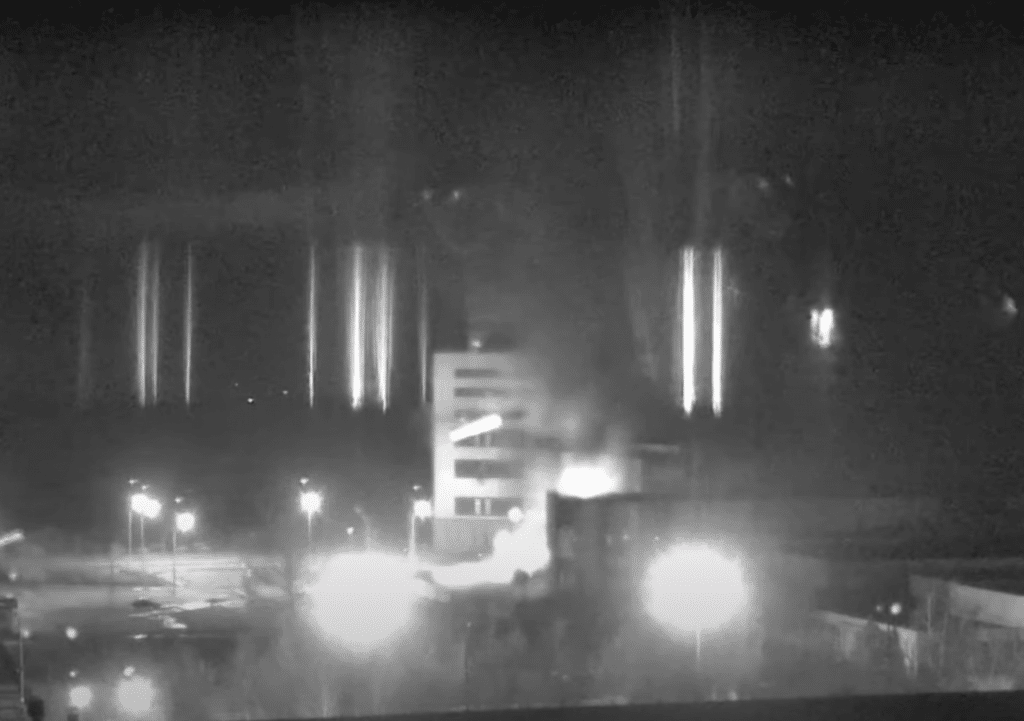 Screenshot of a video of the Russian attack on the Zaporizhzhia nuclear power plant
Earlier this year, in a one-page memo recommending one nuclear policy the new administration should adopt, I proposed that President Trump follow through on his 2021 executive order, which focused on the vulnerability of US critical infrastructure to drone strikes. This included our electrical supply system and nuclear power plants.
Since then, four drones have been sighted operating near the Prairie Island Nuclear Plant in Minnesota. This sighting came on the heels of some 26-odd drone overflights of US reactors in 2024.
Fortunately, the House Armed Services Committee has been keeping score. In its draft National Defense Authorization Act for FY 2026, the committee proposed that the Energy Secretary finally be given authority to defend Energy Department-operated nuclear facilities. Under the proposed legislation, the Energy Department can disable, damage, or destroy any unmanned aircraft system that overflies its nuclear facilities. This bill is expected to be debated on the floor the week of September 8th. Meanwhile, the Senate will have to consider which of the hundreds of amendments it will adopt in its legislation. With any luck, it will adopt the House provisions regarding drones.
This authority is overdue. In December, drones overflew a number of US power reactors as well as US military bases. Governors of New Jersey and Louisiana pleaded that President Biden take action. What followed, in both the Biden and Trump administrations, were bizarre word salads of dismissals. One claim was that the drones (some of which were the size of small airplanes) were flown by “hobbyists.” Another was that they were research planes authorized by the Federal Aviation Administration.
None of this was terribly convincing. In two separate 60 Minutes programs, a variety of senior military officials, including the former Commander of NORTHCOM, expressed concern and were blunt. They had no idea what these things were or where they were coming from, and they were worried: The military lacked the authority to shoot the drones down or any reliable means to detect and disable them.
The House Armed Services Committee legislation will correct this. Focusing on Energy Department-operated nuclear plants that the Committee has legislative jurisdiction over is a start.
What’s missing from this legislation is coverage for the nearly 100 other civilian nuclear plants that provide Americans with 19 percent of their electricity. What’s needed now is to get the committees with jurisdiction over these plants—the House and Senate committees focused on energy and homeland security—to grant similar authority to protect these facilities.
Then comes the hard part: figuring out how to do this. Hardening and actively defending these plants against drone attacks would help. In May, the National Academy of Sciences asked my center to testify on its research regarding the military vulnerabilities of nuclear plants. One recommendation my center provided was to protect our critical civil infrastructure—e.g., America’s electrical supply system, fossil fuel piping systems, and communication systems—with a publicly announced initiative that would clarify who should be in charge.
But such a wide-ranging program might be a bit much to bite off in one chunk. Instead, our government might start with a nuclear security initiative (a “NSI”) that would get ahead of the president’s order to build hundreds of new reactors here and abroad to assure they don’t become attractive military targets.
At a minimum, new and existing nuclear plants need to be defended against the kinds of attacks that Ukrainians have already suffered and the assaults China, North Korea, and Russia have threatened against their neighbors’ plants. The lead organization for this effort should be the Energy Department’s National Nuclear Security Administration, which already spends over $2 billion each year on nuclear nonproliferation and cooperative threat reduction programs. Some portion of this effort should be dedicated to increasing the security of American nuclear plants here and overseas.
Meanwhile, the Pentagon needs to clarify how it might employ air and missile defenses to protect commercial nuclear facilities within the United States. They also should explain how they will defend reactors they intend to build on their military bases (including those built overseas).
A separate question is who should pay for this protection. The nuclear industry needs to start accounting for these costs. So far, they’ve avoided openly discussing the Achilles heels of their plants in war. This is odd. Even the Chinese have lifted the veil on the military vulnerabilities of their nuclear plants; the People’s Liberation Army concedes that they’ve conducted studies.
The usual response to such inquiries is a non-response: These matters are too sensitive to discuss. Unfortunately, civil nuclear plants are public utilities. As such, the public must know how reliable these utilities might be and what, if anything, they will be asked to do in the case of an emergency.
In the old days, they called this civil defense. Today, it’s critical infrastructure protection—something our government needs to start talking about openly, starting with protection against drone overflights of nuclear plants.
Together, we make the world safer.
The Bulletin elevates expert voices above the noise. But as an independent nonprofit organization, our operations depend on the support of readers like you. Help us continue to deliver quality journalism that holds leaders accountable. Your support of our work at any level is important. In return, we promise our coverage will be understandable, influential, vigilant, solution-oriented, and fair-minded. Together we can make a difference.

Henry Sokolski
Henry Sokolski is the executive director of the Nonproliferation Policy Education Center in Arlington, Virginia, and author of China, Russia and the Coming Cool War (2024). He ... Read More













Three days ago, I purchased a used book entitled “Brittle Power” by Amory and Hunter Lovins, published in 1982 (486 pages). Their conclusion — build many small dispersed renewable sources of energy — is especially true now because of the drone issue. The drones are an ever increasingly cheaper way for individuals to attack huge power stations, nuclear or not. How will we protect nuclear power plants, or their upcoming smaller versions (SMRs), from attack by swarms of drones?
Drone hits (even by relatively large drones) are pinpricks to the thick reinforced concrete of the containement buildings of nuclear reactors. Ancillary installations can be repaired relatively easily. The successful Russian attack to the Zaporizhzhia nuclear power plant was actually to the cooling towers and most likely done by Ukraine. Missile attacks with a large warhead are another story but, in that case, it most likely means total war.