New START’s death is around the corner. Please, someone, tell the President
By Steven Pifer | Analysis | December 5, 2025
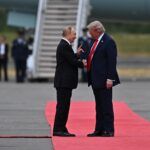
 Russian President Vladimir Putin meets with US President Donald Trump on August 15, 2025 in Anchorage, Alaska. (Photo: Sergei Bobylev / RIA Novosti, via Kremlin.ru)
The 2010 New Strategic Arms Reduction Treaty (New START) is on the path to a quiet death in two months. The treaty’s demise will end the last agreement constraining US and Russian nuclear weapons.
Russian President Vladimir Putin has proposed extending observance of New START’s numerical limits beyond the treaty’s expiration, but Moscow has given Washington reasons to ignore that offer. If President Donald Trump is interested in “denuclearization,” as he says he is, he could seek to improve on Putin’s proposal.
Common ground. New START entered into force in 2011. When its numerical limits took full effect in 2018, the United States and Russia had reduced their strategic offensive arms to levels not seen since the 1960s. On the eve of the treaty’s expiration in 2021, Washington and Moscow agreed to exercise the provision extending the treaty until February 5, 2026.
In September, Putin proposed the two countries agree to mutually observe New START’s three numerical limits—700 deployed strategic ballistic missiles and nuclear-capable heavy bombers, 800 deployed or non-deployed strategic ballistic missile launchers and nuclear-capable heavy bombers, and 1,550 warheads on deployed strategic delivery systems—for one additional year, that is, until February 2027. Then, in November, a Russian foreign ministry official suggested that Moscow was willing to voluntarily extend the limits for even longer.
On balance, extending observation of New START’s numerical limits has merit, particularly if it were to buy time for US and Russian officials to hammer out a successor. However, in recent weeks, Russian officials have done much to make their extension offer unattractive to Washington.
Verification problem. Russian officials have said that they are prepared to extend observation of New START’s three numerical limits. But they do not seek to continue the treaty’s verification measures. In early 2023, Putin announced that Russia would suspend its participation in New START, though officials made clear that Russia would continue to observe the numerical limits.
That poses a problem.
Each side likely can use its national technical means of verification, such as surveillance satellites, to monitor the other’s compliance with the two New START numerical limits covering launchers and deployed missiles and bombers. However, monitoring the third limit on deployed strategic warheads would prove difficult without the notifications and on-site inspections provided by the treaty. The Russians have ruled those out.
This is problematic because there is growing uncertainty over the number of warheads that the other side has deployed on its intercontinental ballistic missiles and submarine-launched ballistic missiles. Most US and Russian strategic ballistic missiles can carry multiple independently targetable re-entry vehicles and, depending on the ballistic missile type, are deployed with anywhere between one and 10 nuclear warheads each.
There is little mood in Washington to take Moscow at its word when it comes to arms control. Russia violated the 1987 Intermediate-range Nuclear Forces Treaty by testing and deploying a cruise missile of prohibited range. Arguably, Putin’s decision to “suspend” participation in New START can also be seen as a violation since the treaty makes no provision for unilateral suspension. A State Department report to Congress in January expressed concern that the Russians “may have exceeded” the limit on deployed strategic warheads.
More weapons. In October, Putin highlighted Russian tests of two new weapons systems: the Burevestnik nuclear-armed, nuclear-powered cruise missile and the Poseidon nuclear-armed, nuclear-powered undersea drone. While clearly strategic offensive weapons, the two systems are not captured by the definitions of strategic offensive arms in New START. The treaty provided for a mechanism to discuss new kinds of strategic arms and whether or how to address them, but Russia effectively has suspended that mechanism.
The appearance: Putin wants to maintain limits on existing US and Russian strategic arms all while Moscow continues to freely deploy new strategic weapons not subject to New START’s limits.
A one-year extension of New START’s numerical constraints could create space for discussion of strategic issues and of a possible New START follow-on, but the Russians do not seem much interested in that. In January 2024, Foreign Minister Sergey Lavrov tied the resumption of the strategic stability dialogue to broader security issues, including US support for Ukraine. And just weeks ago, the Russian ambassador to the United States reiterated that resumption of that dialogue depended on “positive changes in Washington’s policy towards Russia.”
These questions may explain why Putin’s offer has been met with virtual silence.
Saving strategic arms control. In recent months, President Trump has expressed interest in denuclearization, presumably by which he means limits on and reductions in nuclear weapons. In July, he said he did not want New START to expire. But when Putin spoke about extending New START, Trump did not react until asked about it by a reporter 13 days later. His off-the-cuff reaction—“sounds like a good idea to me”—left one to wonder if Trump previously had heard of it.
Curiously, in early November, Trump suggested he was working with Russia and China to denuclearize, though he offered no details, and neither country confirmed Trump’s assertion. The Russians maintain that they have received no formal response to Putin’s offer.
If Trump is serious about denuclearization, he could seek to improve on Putin’s proposal. The president could suggest that the United States and Russia agree to some verification steps to build confidence that both were observing all three New START numerical limits. Trump also could link his agreement to extending the numerical limits to the Russian agreement to begin talks about limits on new nuclear arms, including the Burevestnik and Poseidon weapon systems.
These ideas would improve on the Russian offer. They could raise confidence in the sides’ observance of the New START numerical limits. Perhaps more importantly, they could establish a venue in which US and Russian officials discuss future steps to curb a nuclear arms race that is already gathering steam and moves further away from strategic arms control.
The ball lies in Trump’s court. Does he want to explore whether something is possible in future limits on nuclear arms? Or was his reference to denuclearization just another idea thrown out with no real plan or intention for serious pursuit? He has two months to decide.
Together, we make the world safer.
The Bulletin elevates expert voices above the noise. But as an independent nonprofit organization, our operations depend on the support of readers like you. Help us continue to deliver quality journalism that holds leaders accountable. Your support of our work at any level is important. In return, we promise our coverage will be understandable, influential, vigilant, solution-oriented, and fair-minded. Together we can make a difference.
Keywords: Donald Trump, ICBMs, MIRV, New START, Russia, SLBM, United States, Vladimir Putin, strategic bombers, strategic nuclear weapons
Topics: Nuclear Weapons

Steven Pifer
Steven Pifer is an affiliate of Stanford's Center for International Security and Cooperation, a nonresident senior fellow with the Brookings ... Read More









We need to offer Putin that there will never be nuclear weapons in Ukraine, because NATO and Russia will agree not to station nuclear weapons anywhere in Europe – from Ireland to the Urals. And Ukraine will remain a member of the Nonproliferation Treaty. See my articles on this at the Bulletin. Any aspirants for the Nobel Peace Prize listening?