Nuclear arms control and disarmament after New START
By Daryl G. Kimball | Analysis | February 6, 2026
Editor’s note: This is part of an “experts comment” series on the expiration of New START.
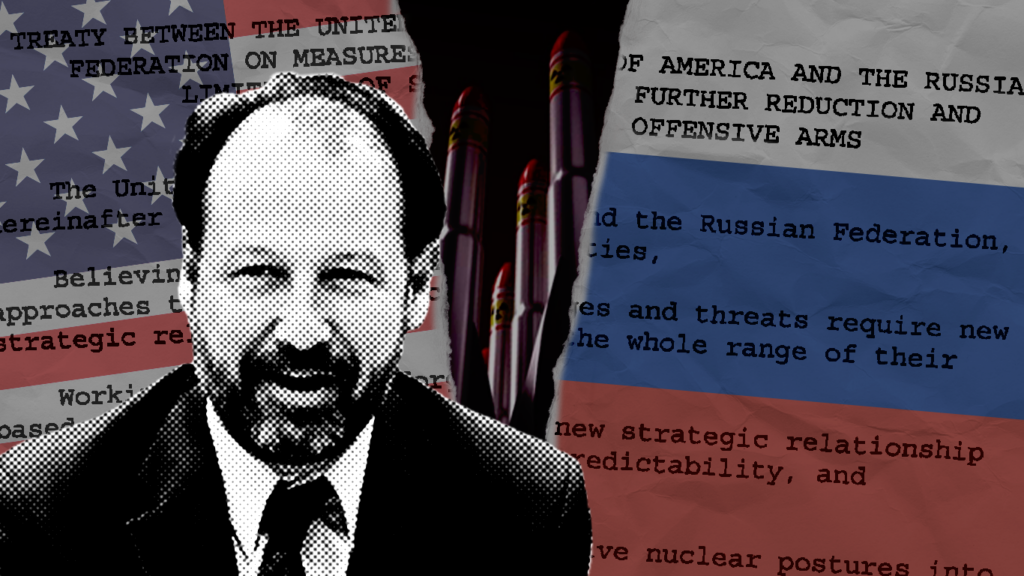
The expiration of the New Strategic Arms Reduction Treaty (New START) this week means that the United States and Russia are now unconstrained and could soon begin increasing their strategic deployed arsenal by uploading additional warheads on existing missiles and bombers—for the first time in more than 35 years. The end of New START could also open a new phase of dangerous nuclear competition—one that involves all the major nuclear-armed states.
Deploying more nuclear weapons will not make anyone safer. The United States already has a massive, devastating, and largely invulnerable nuclear force that is more than sufficient to deter nuclear attack. In 2013, the Pentagon’s Report of Nuclear Weapons Employment Strategy determined that the United States could reduce its deployed strategic nuclear weapons by up to one-third below New START levels and still deter possible attacks from any adversary. That basic conclusion still holds today, despite the expansion of China’s arsenal ever since.
Deploying additional US nuclear weapons would not fundamentally change the deterrence calculus of Chinese President Xi Jinping or Russian President Vladimir Putin. On the contrary, increases in Russian and US strategic forces would further destabilize the mutual balance of terror, pushing China to accelerate its program to expand its strategic nuclear retaliatory force.
How we got here. The deterioration of the arms control regime is the result of years of high-level inattention and the current US administration’s wrecking-ball approach to long-standing international norms and agreements that the United States helped.
Since New START entered into force in 2011, Moscow and Washington have misfired on their on-again, off-again discussions on further nuclear reductions as their relations have soured. Since the beginning of his second term, President Donald Trump has talked bigly about starting denuclearization talks with Russia and China, but he has failed to follow through on his promise. Worse yet, Trump has threatened to resume nuclear testing in response to allegations that Russia and China have conducted clandestine nuclear tests.
When asked in July about the expiration of New START, Trump said, “We are starting to work on that … That is a big problem for the world, when you take off nuclear restrictions.”
In September, the Kremlin made a modest proposal: continue to observe the central limits of New START after its expiration to provide time for talks on a successor deal. Then, in October, Trump told a reporter that Putin’s proposal “Sounds like a good idea to me.”
For months, the White House was nonresponsive. Then, on Thursday, after the treaty formally expired, Trump rejected that option, posting on social media that “Rather than extend New START … we should have our nuclear experts work on a new, improved, and modernized Treaty that can last long into the future.”
Being serious (again) about arms control. Trump’s comments that he wants to pursue talks are welcome, and his past statements suggest he grasps some of the basic realities—nuclear weapons are too plentiful, too expensive, and too dangerous to use. But he doesn’t yet have a coherent strategy.
For instance, Trump continues to say that he wants to involve China in a nuclear deal. Still, there is no indication that he or his team has proposed risk reduction or arms control talks with China since returning to office. Senior Chinese officials publicly and privately claim China may be willing to engage in a bilateral (but not trilateral) dialogue on strategic risk reduction. (In November 2023, both countries held one round of bilateral talks.)
Making progress on an “improved” nuclear deal with Russia will take time, preparation, and tough negotiations. To improve the chances of success now that New START has ended, Trump and Putin should continue to respect the treaty’s central limits. They should also refrain from talking about—let alone taking actions—that would increase the size of their respective deployed arsenals and immediately launch serious and sustained nuclear bilateral negotiations on a new framework deal.
If Trump and Putin can agree to maintain mutual restraints on their strategic nuclear arsenals and resume bilateral nuclear talks, they would be in a stronger position to call upon China, France, and the United Kingdom to respond by freezing their strategic launchers at their current number.
Right now, Russia and the United States each have fewer than 800 total strategic launchers; China has an estimated 550, including unfilled strategic missile silos; and France and the United Kingdom have a combined total of about 96. A freeze on strategic nuclear launchers at these levels would not adversely affect any one country’s ability to deter nuclear attack.
These joint restraint measures would create a more positive environment for US-Russian and US-Chinese talks on strategic nuclear reductions, new restrictions on intermediate-range missiles and tactical nuclear weapons, limits on strategic missile defenses, and other nuclear risk reduction measures, including joint steps to mitigate the risks of AI integration in nuclear command and control.
A resumption of US nuclear testing would blow a hole in any such efforts. If the Trump administration, which has failed to support the 1996 Comprehensive Nuclear Test Ban Treaty, has credible evidence that Russia or China is conducting clandestine nuclear test explosions, the obvious solution would be to take up the issue at the treaty’s governing body and pursue technical talks with China and Russia.
To get to that point, middle power countries must, as they have in the past, band together to push the nuclear-armed great powers to respect the norms and their obligations not to test nuclear explosive devices, engage in arms races, or threaten or use nuclear weapons.
The non-nuclear weapon state majority can start at the upcoming review conference of the Nuclear Non-Proliferation Treaty in April and May by demanding—loudly—that the United States, Russia, and China respect the global nuclear test moratorium and act now on their commitments to “pursue negotiations in good faith on effective measures relating to cessation of the nuclear arms race at an early date and to nuclear disarmament.”
Longer term, non-nuclear middle powers will also need to help build new processes to overcome the inequities and sclerosis of the current nuclear order. For example, a group of the willing could advance a new initiative to convene a series of high-level nuclear disarmament summits involving a group of 20 to 30 leaders from nuclear- and non-nuclear-weapon states. If designed properly, such an approach could help guard against the further erosion of essential guardrails against nuclear anarchy, foster new proposals and voluntary actions to reduce nuclear risks, and renew progress toward the elimination of nuclear weapons.
As has always been the case, sustained, coordinated, and sufficiently-resourced civil society campaigning to halt and reverse the new arms race will again be critical to channel the public’s general concern about nuclear weapons to demand more effective US policy action to cap, reduce, and eliminate arsenals.
Together, we make the world safer.
The Bulletin elevates expert voices above the noise. But as an independent nonprofit organization, our operations depend on the support of readers like you. Help us continue to deliver quality journalism that holds leaders accountable. Your support of our work at any level is important. In return, we promise our coverage will be understandable, influential, vigilant, solution-oriented, and fair-minded. Together we can make a difference.
Keywords: China, Donald Trump, New START, New START expires, Russia, United States, Vladimir Putin, arms control, underground nuclear tests
Topics: Nuclear Weapons

Daryl G. Kimball
Daryl G. Kimball has studied and written about nuclear weapons policy issues for more than three decades as an analyst with Physicians for Social ... Read More











Leave a Reply