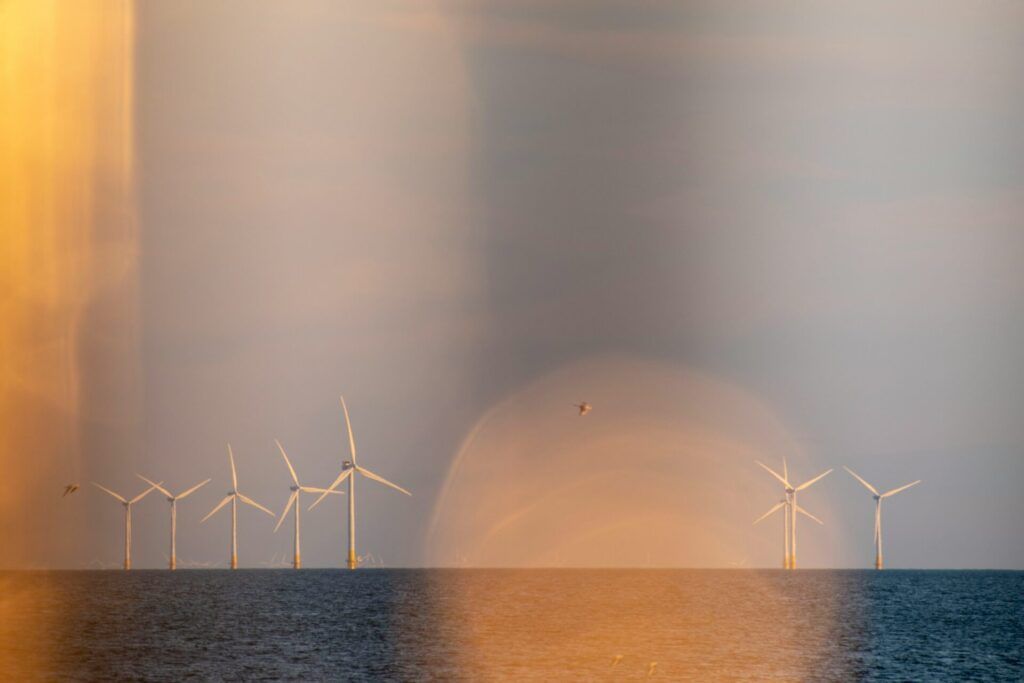
 The administration’s actions have saddled ratepayers in the region with sharply higher fuel costs for the gas and oil needed to produce power that wind farms could have replaced with zero fuel costs. (Photo by Ian Simpson on Unsplash)
Recent federal policy shifts affecting New England’s offshore wind projects are proving costly for the region’s electricity consumers. Those costs are adding up in multiple ways, and some will raise power costs for years into the future, in addition to the more diffuse but real costs stemming from global climate change as a result of continued reliance on fossil fuels.
Federal permitting delays and recent stop-work orders under the Trump administration have slowed construction of several offshore wind projects while essentially freezing further investment in many others. These tactics prevented the delivery of significant amounts of wind energy to the New England grid this winter from two major projects, Vineyard Wind and Revolution Wind. They have also kept construction from beginning at several other fully permitted sites and frozen permitting and investment in at least seven other lease areas off the New England coast alone. The administration’s actions have saddled ratepayers in the region with sharply higher fuel costs for the gas and oil needed to produce power that wind farms could have replaced with zero fuel costs; exposed them to ongoing volatility in prices for those fossil fuels; required millions in ongoing payments for a liquefied natural gas import facility that might not have been necessary with more wind power; and significantly limited the addition of new power supplies that could have supported greater economic growth.
The winter storm that buffeted the region in late January is the latest example of how spiking gas prices can impact consumers’ electricity bills. Data from ISO-New England, which runs the wholesale power distribution network in a six-state system, show that the energy market value (essentially the cost for electricity that will be paid by customers) soared to a record $2.7 billion for the month, 80 percent higher than January 2025 and triple the total from January 2024. These costs topped past highs set during the 2014 polar vortex and Russia’s invasion of Ukraine in 2022. It was due largely to a sharp rise in the price of natural gas, which is used regionally both to generate electricity and provide home heating. Now the ongoing war with Iran is pushing fossil fuels prices higher, with the full impact on consumers still unfolding.
Offshore wind generation can significantly blunt the impact of such price spikes because the resource is fuel free. It can directly replace the need for expensive gas- or oil-fired power, and it can also reduce overall demand for gas across the supply-constrained New England gas system, thereby reducing prices. In Virginia, Dominion Energy estimates that the offshore wind project it is building—the 2,600-megawatt Coastal Virginia Offshore Wind facility—will save customers $300 million annually during its first 10 years of operation. Those savings will come from reducing the amount of gas-fired generation the utility needs to meet local electricity demand.
Similarly, the two projects off the New England coast that are now just weeks away from delivering full power—Vineyard Wind (812 megawatts) and Revolution Wind (704 megawatts)—will cut costs for utility customers across the region. Institute for Energy Economics and Financial Analysis (IEEFA) research indicates that these projects are likely to operate with a 50 percent capacity factor from November through April, including the harshest winter months, when both regional demand and gas prices tend to rise significantly. (Capacity factor measures the amount of power a plant produces compared to the maximum it could produce.) Using this estimate for the Revolution and Vineyard projects shows that they should produce just over 18,000 megawatt-hours of electricity daily across those six months.
That production would have been extremely helpful this January and February. Vineyard Wind had already been sending some power into the New England grid; IEEFA accounted for that power, using data available from the Federal Energy Regulatory Commission. Still, the full capacity from Revolution and the remaining Vineyard output, which would likely have been finished months earlier without the delays caused by the Trump administration, could have boosted regional wind generation by almost 14,000 megawatt-hours during these cold months. This would have pushed total wind output to almost 10 percent of daily regional demand—and cut the need for a comparable amount of generation from either gas or fuel oil, saving consumers millions of dollars.
Many of New England’s gas-fired power plants can burn both gas and fuel oil to generate electricity, which gives the system flexibility during periods of extreme cold when gas is needed for home heating and prices are high. Indeed, during the January storm, oil-fired generation topped gas for five straight days starting on January 24, when the event began.
According to ISO-NE data, the average cost for gas for producing power during January was $24.25 per million British thermal units. That translates to roughly $170 just to produce 1 megawatt-hour of electricity for a plant with average efficiency. In other words, that additional wind generation could have cut costs by an estimated $2.3 million a day.
A ~$71 million saving in monthly costs may not seem significant, but that represents just a sliver of New England’s potential offshore wind capacity. Three other large offshore projects are fully permitted but not yet under construction, largely because of the administration’s consistent opposition to the sector, and there are other large wind leases nearby.
The three permitted projects include two New England Wind sites backed by Avangrid, the developer of Vineyard Wind, and the South Coast Wind project planned by EDPR and Engie, two European energy companies. Together, these three projects, each of which initially was supposed to be commercially operational by 2030, have a planned capacity of more than 3,300 megawatts. That would boost New England’s offshore wind generating capacity to 4,854 megawatts, which would have a transformative impact.
Together, that capacity would be capable of generating 58,248 megawatt-hours of electricity daily—meaning wind would be capable of generating 20 percent of the region’s daily demand. Looking specifically at January 2026, wind could have produced 21.3 percent of the region’s electricity and sharply cut power costs across the region, both by backing out gas or fuel oil generation and by lowering demand for gas, which likely would have reduced the fuel’s price and lowered the cost of the remaining gas-fired generation.
Additional offshore wind would also likely cut a major hidden cost: the need for the liquified natural gas import terminal at the Everett Marine Terminal, just north of Boston, and an associated gas-fired power plant. As a kind of insurance policy against regional energy shortages, the grid operator ISO-NE paid $777 million to keep these facilities open for just two years, from June 1, 2022, through May 31, 2024—costs that were passed on to ratepayers. In 2024, a new agreement with several utilities was approved, keeping the liquified natural gas facility open until 2030, with those costs also being paid for by regional consumers.
These offshore wind projects are essentially ready to build. Power purchase agreements would still need to be finalized, but those could be completed relatively quickly, and more clean power would be getting delivered in just a couple of years, providing essential energy security for not just New England, but the whole of the Atlantic coast. Yet the Trump administration actively stands in the way, using the power of the federal government to essentially stop all wind development. Meanwhile, alternatives—such as trying to site, finance, and build new gas pipelines to increase regional supplies—would take many years and would do little to protect consumers from seasonal fossil-fuel price spikes or geopolitical events.
Together, we make the world safer.
The Bulletin elevates expert voices above the noise. But as an independent nonprofit organization, our operations depend on the support of readers like you. Help us continue to deliver quality journalism that holds leaders accountable. Your support of our work at any level is important. In return, we promise our coverage will be understandable, influential, vigilant, solution-oriented, and fair-minded. Together we can make a difference.
Keywords: Trump administration, alternative energy, clean energy transition, offshore wind, power, wind energy
Topics: Climate Change

Dennis Wamsted
Dennis Wamsted focuses on the ongoing transition away from fossil fuels to green generation resources, focusing particularly on the electric power ... Read More

Seth Feaster
Seth Feaster is an Energy Data Analyst whose work focuses on the coal industry and the U.S. power sector. Before joining IEEFA, he created visual ... Read More















This totally illogical “anti-wind power” policy is based solely on the personal whim of President Trump and works to defeat his stated goal of “energy security” for America. As always, if we “follow the money” we find the primary beneficiaries of this policy are the fossil fuel-extraction industry’s multi-national, oil and gas companies. Rather than stimulating the inevitable future of renewable energy sources, the President wants to keep the nation dependent on costly, planet warming 19th Century technologies. This administration has gone so far as to mandate extended operation of several aging, coal-fired power plants, which were scheduled by their… Read more »