Our Mission
The Bulletin of the Atomic Scientists equips the public, policymakers, and scientists with the information needed to reduce man-made threats to our existence.
At our core, the Bulletin publishes a free-access website and a bimonthly subscription magazine. But we are much more. The Bulletin's website, iconic Doomsday Clock, and regular events equip the public, policymakers, and scientists with the information needed to reduce man-made threats to our existence. The Bulletin focuses on three main areas: nuclear risk, climate change, and disruptive technologies, including advances in bioresearch and artificial intelligence. What connects these topics is a driving belief that because humans created them, we can control them.

The Bulletin is an independent, nonprofit 501(c)(3) organization. We gather the most informed and influential voices tracking man-made threats and bring innovative thinking to a global audience. We apply intellectual rigor to the conversation and do not shrink from alarming truths.

From the former President & CEO
Rachel Bronson
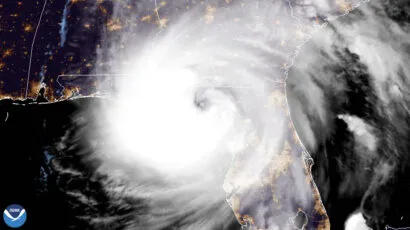
The year 2024 was another rough one for humanity and our planet. The nuclear threat remained far too high, and tragic fires, floods and hurricanes continued to ravage communities and landscapes alike. The threat of a new global pandemic simmered below the headlines, and advancements in artificial intelligence that promise both harms and benefits, continued to occur much faster than our ability to regulate them.
From the Editor-in-Chief
John Mecklin
The Bulletin had another record readership year in 2024, growing by about eight percent over the previous year and reaching almost seven million views. Along with a strong response to the Doomsday Clock announcement, this growth in readership was driven by an extraordinary range of quality articles scattered across the subjects we cover. The most-read article in 2024 was nuclear historian Alex Wellerstein's classic "Counting the dead at Hiroshima and Nagasaki," which garnered 385,000 views last year. It has received more than 1,000,000 views since it was first published in 2020.

A year in review
Nuclear Risk
Welcome to the antechamber of the next nuclear crisis
This past year, there has not been a single week without a reminder of the danger posed by nuclear weapons. Nuclear noise and signaling were evident; officials made implicit or explicit references to nuclear weapons and their possible use–seeming, for some observers, to call almost everything a nuclear threat. But the biggest change this year in international security is, arguably, the instability now at the doors of nuclear powers, and the looming possibility of a nuclear crisis.





Climate Change
Potential progress on climate change
2024 was the hottest year on record, with global mean surface air temperatures more than 1.5 degrees Celsius warmer than the pre-industrial average. Global greenhouse gas emissions are also projected to reach an all-time high of 41.6 billion metric tons, a billion more than last year, as a result of continued fossil fuel emissions and deforestation. These are depressing, if not unexpected, milestones.
What stands out most is our coverage of solutions-from promising nature-based adaptation and mitigation efforts to dangerous, techno-optimist interventions in the Earth's climate.





Disruptive Technologies
Another year, another 366 days of tech
(with a healthy dose of AI)
While there was no shortage of interesting developments in a variety of emerging technologies, artificial intelligence seems to have taken over many of 2024's headlines. Its prevalence in news coverage featured both its, sometimes, overblown capabilities and its suitability for important decision-making, including the analysis of health test results and surveillance databases. Beyond AI, many noteworthy events this past year spawned stories on the tech industry's influence on politics, journalism, misinformation and disinformation in the digital ecosystem, and the expansion of surveillance around the world.




Biosecurity
Experts encourage vigilance
The next pandemic could be lurking just around the corner. In Africa, a deadly version of mpox circulating in Democratic Republic of the Congo threatened to spark a wider outbreak. Not only that, but a mysterious disease killing children in that country remained unreported to global health authorities for over a month. In the United States, avian influenza appeared in cattle herds, putting workers at risk of exposure to a virus that could be just a few mutations away from becoming a real human threat. Meanwhile, the incoming Trump administration appeared poised to place in charge of US public health agencies an activist who has spent years sowing doubt about vaccines, an effective means of sidestepping the pathogens constantly lurking about humanity's doorstep.
A through line in much of the Bulletin's biosecurity coverage of 2024 was a focus on infectious diseases–the toll they can exact (did one fell the mighty Roman empire?), the role climate change is playing in their spread, and even the non-natural routes by which they may jump into humans.




Magazine
Growing a global audience
For over 75 years, the Bulletin of the Atomic Scientists magazine has published leading experts on nuclear risk, climate change, and disruptive technologies, including from luminaries such as Jennifer Doudna, Albert Einstein, Mikhail Gorbachev, and John F. Kennedy.
A highlight of the year was the September issue of the magazine focused on the 2024 elections, "How to Protect the Elections and Democracy in a Critical Political Year"
In the preface to the issue, Editor-in-Chief John Mecklin, and Executive Editor Dan Drollette, recall efforts in 2020 by supporters of then-President Donald Trump, and two years later of Brazilian President Jair Bolsonaro, of trying to overturn election losses. Thankfully both efforts failed, but those efforts are part of a broader trend around the world of populist political campaigns to attempt to move away from democracy and toward authoritarian or autocratic rule.
0
The number of libraries the magazine can be found in around the world0%
Increase in individual subscriptions in the past 5 yearsBecause representative governance is critical to the reduction of major global risks, the September issue of the Bulletin of the Atomic Scientists explored ways that free elections and democracy in general might be preserved and protected.
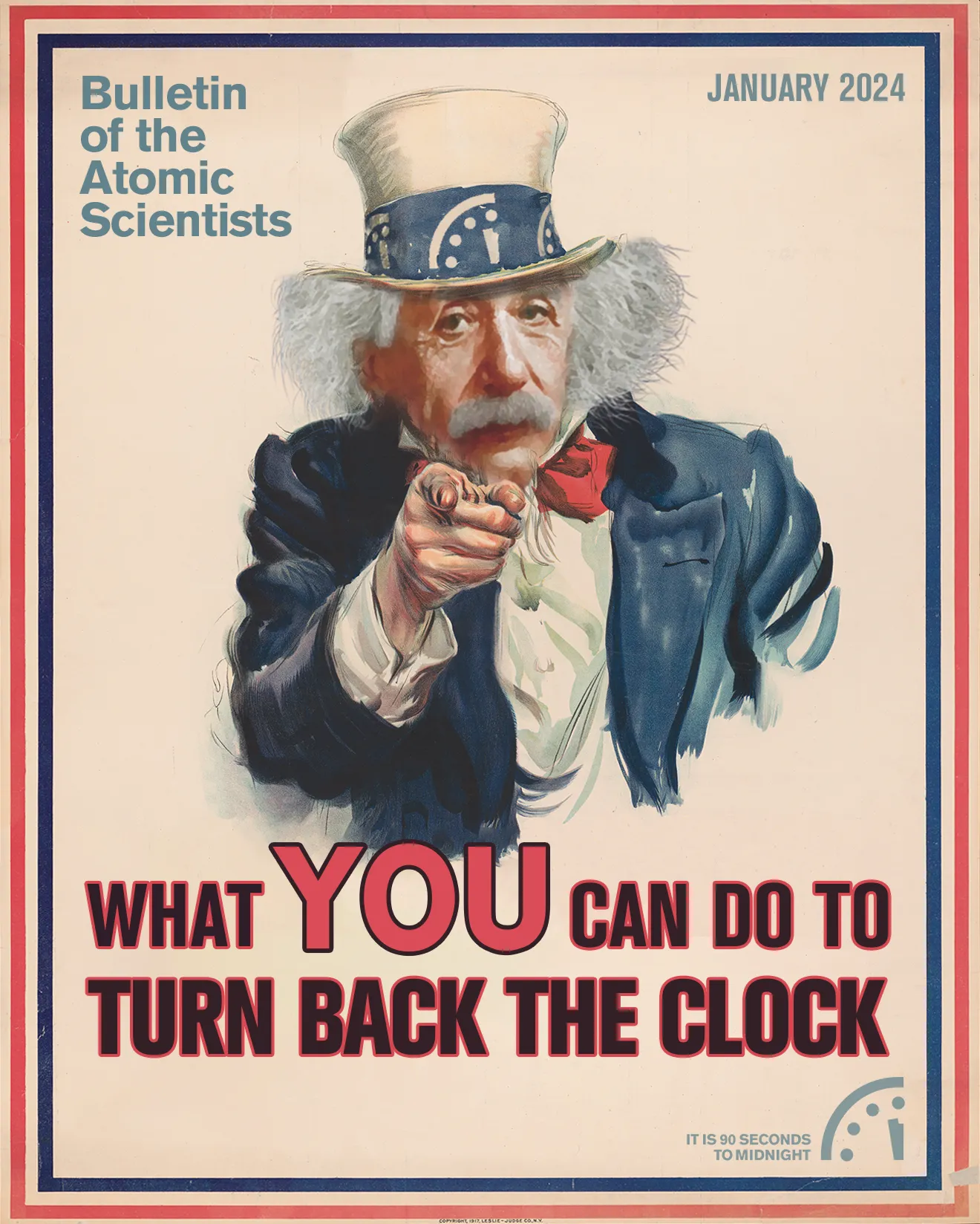
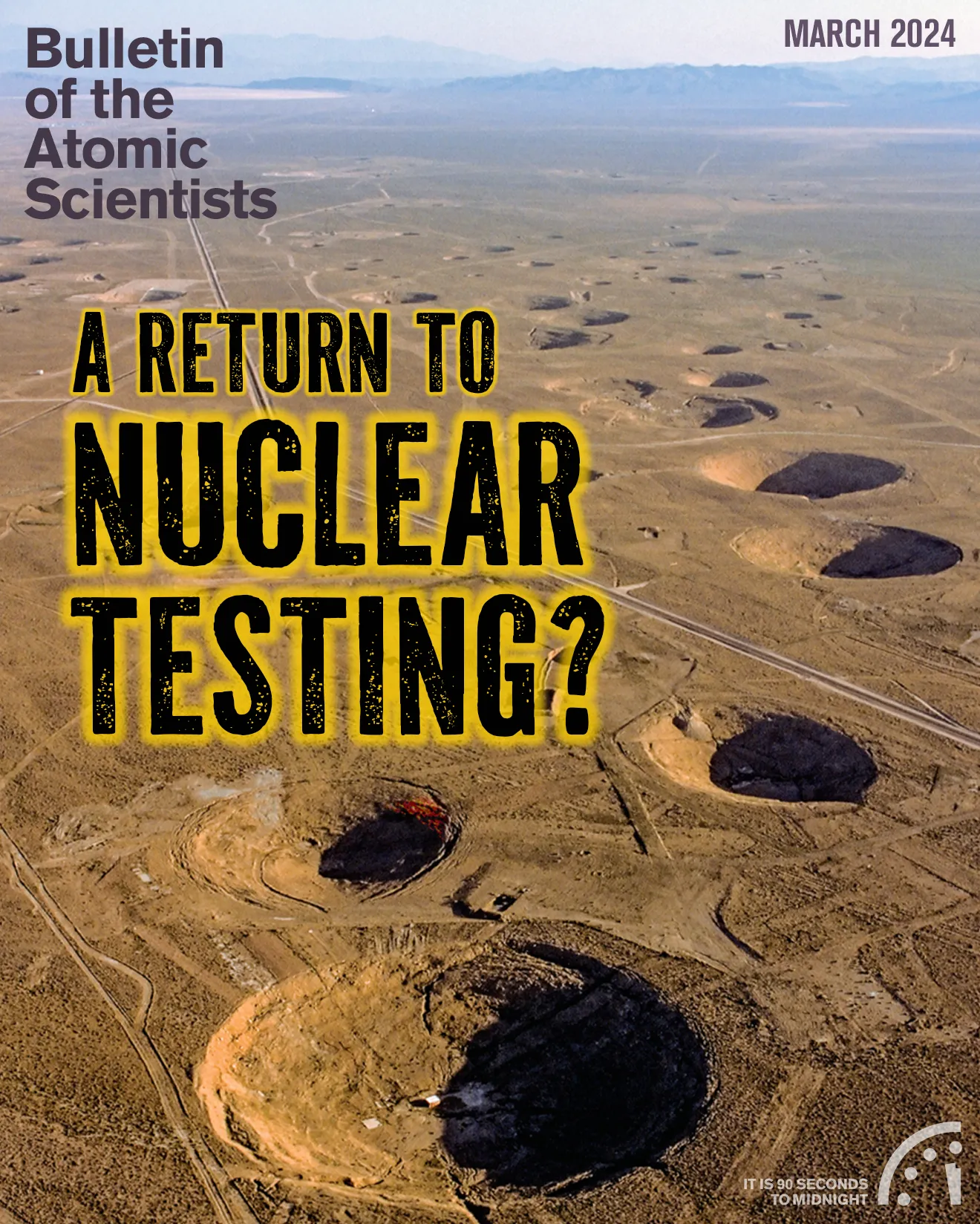
In 2024, the bi-monthly issues of the magazine also tackled the issues surrounding melting glaciers, demagogues, climate crises, fusion bombs, breadfruit trees, and the Greta Thunberg of AI. Each of these subjects was at the center of articles published in the Bulletin of the Atomic Scientists' bimonthly magazine in 2024, and each of those articles was among our best magazine articles of the year.
January 2024
March 2024

May 2024

July 2024

September 2024

November 2024

2024 Rieser Award Recipient
Collin Van Son
The Bulletin was delighted to announce Collin Van Son as the 2024 Leonard M. Rieser Award recipient for his November piece, "Dispatch from a nuclear petting zoo."
"In his powerful piece, Collin Van Son offers a deft and often wry account of his tour of Offutt Air Force Base in Eastern Nebraska, home of the US Strategic Command," Bulletin Editor-in-Chief John Mecklin said. "Stratcom is the entity responsible for maintaining and, if necessary, employing the US nuclear arsenal, and Van Son's exploration of the lexicon used there includes light-hearted observations that have quirky undertones; three nuclear-capable aircraft, for example, are called 'the petting zoo' because visitors are encouraged to physically touch them. But his essay is, at its core, deeply serious, focusing on the words, images, and metaphors that, he writes, 'speak to a deep-seated belief that nuclear weapons are natural and controllable, and therefore acceptable.' Van Son explains why that belief needs fundamental re-examination-by voters, leaders, and nuclear experts-in precisely the type of well-argued and distinctive prose that the Rieser Award is meant to honor."
Learn more about Leonard M. Riesner and the Bulletin's Voices of Tomorrow Program.
Doomsday Clock Announcement
Global engagement
amplifying the Clock Statement
The Bulletin's Digital Team engages dozens of issue-oriented groups each year, with pre-announcement briefings and visual assets for their own social media postings. Each year there are featured postings on social media and organization websites like the Elders, Norway ICAN, Abolition 2000, Physicians for Social Responsibility, Friends Committee on National Legislation, Outrider, PSR - Greater Boston, PSR Washington, Council for a Livable World, European Leadership Network, and more.
0
Day of earned-media stories of the announcement0
First week streaming of the announcement0
First week following the announcement pageviewsEach year, the Doomsday Clock Announcement is featured in the largest news outlets in the world and the accompanying statement is viewed over a million times, forcing a conversation about catastrophic risk, and options for reducing those risks. Below is very small sampling of global features.

Conversations Before Midnight
Convened a week after the US elections, Conversations Before Midnight, the Bulletin's most important fundraising event of the year, allowed attendees to come together as a community and discuss what the results mean for our collective future.
In addition to hearing remarks from featured speaker David Ignatius, the Bulletin honored outgoing President and CEO Rachel Bronson and recognized her 10 years of service to the Bulletin.
The conversations continued off the main stage with an audience of about 250 curious-minded attendees, many of whom are civic and scientific leaders, including those who set the Doomsday Clock.
The highly successful evening raised $225,000 in support of the Bulletin's mission.

Featuring a conversation with Washington Post columnist and best-selling novelist, David Ignatius.
2024 Conversation Before Midnight Sponsors
Platinum Sponsors
Paul Francis & Lee Francis
David Kuhlman & Martha Esch
Joan & James Shapiro Foundation
Gold Sponsors
The Crown Family
Lotis Blue Consulting
Northern Trust
William & Eleanor Revelle
Lynne & David B Weinberg
Silver Sponsors
Alvin H. Baum Family Fund
Susan & Stephen Baird
Kennette Benedict & Robert Michael
John Bremen & Laura Frohlich
The Bronson & Matthews Families
DeBlasio Family Foundation
Robert LoPrete & David Germaine
Steve Ramsey & Ann Jones
Richard & Ellen Sandor Family Foundation
Bronze Sponsors
Diamond Family Foundation
M Harris & Co.
Stephanie and William Woodson
In Memoriam
Remembering significant contributions to science and global security
Howard Hiatt

Howard Hiatt, Bulletin Board of Sponsors member
Passing away at the age of 98 years old, Hiatt spent much of his career working to advance global health initiatives, mentor the next generation of scientists and physicians, help underserved communities, and raise awareness about the consequences of nuclear weapons.
"Howard's legacy is a testament to the longstanding commitment that the world's science leaders have in identifying existential threats and their responsibilities in helping us minimize them," said Bulletin President and CEO Rachel Bronson. "His roles on the Board of Sponsors helped advance the Bulletin's work and draw attention to many of the issues he and we hold dear, namely protecting humanity from dangers of our own making. We are profoundly grateful for his contributions to science and his support of our mission."
Rod Ewing

Philanthropy–supporting the importance of uplifting
the voices of science to effect policy
Andreas Persbo is a recognized nuclear expert. He currently serves as the director of Open Nuclear Network (ONN), a program of PAX sapiens, a network of family-driven foundations focused on existential risks including nuclear proliferation, US-China relations, and pandemic prevention. Previously he served as a founding member of the United Kingdom-Norway Initiative on Verified Warhead Dismantlement and as the executive director of London's Verification Research, Training, and Information Centre.
Persbo credits the Bulletin with helping to shape and propel his career trajectory. He recently sat with the Bulletin for an interview to discuss its role in uplifting the voices of emerging experts and serving as a pillar of the community combating existential risk.

With gratitude
For our generous donors
The Bulletin of the Atomic Scientists is thankful for our community of donors who believe science should serve humanity, not threaten it. For more than seven decades, this dedicated network of donors has sustained the Bulletin.
We extend our deepest gratitude to the board leaders, individuals, and institutions who made contributions between July 1, 2023 and June 30, 2024.
Financial Overview
Management discussion and analysis
We design our financial reporting to provide donors and the public with a transparent overview of our finances. This Management Discussion and Analysis (MD&A) aims to help readers of our financial statements make reasonable inferences about the Bulletin's progress in accomplishing our mission in a manner that is financially responsible. We recognize the trust our supporters place in our management of their contributions, and sound fiscal policies and procedures are a top priority for the Bulletin.
As in prior years, our independent auditors, Miller Cooper LLP, gave the Bulletin an "unmodified" opinion, the highest assurance level. This narrative expands on that statement and supplements the financial statements below. The complete audited financial statements for 2024 are available by request, and the Bulletin's annual "990" informational tax filing, which utilizes these audited numbers, is available on various public reporting websites.
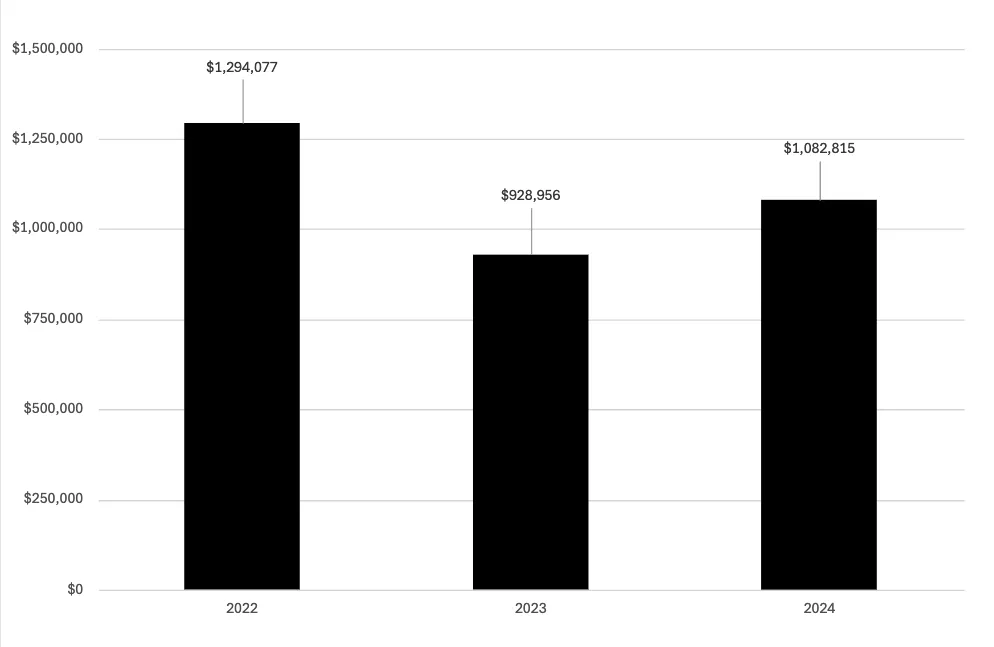
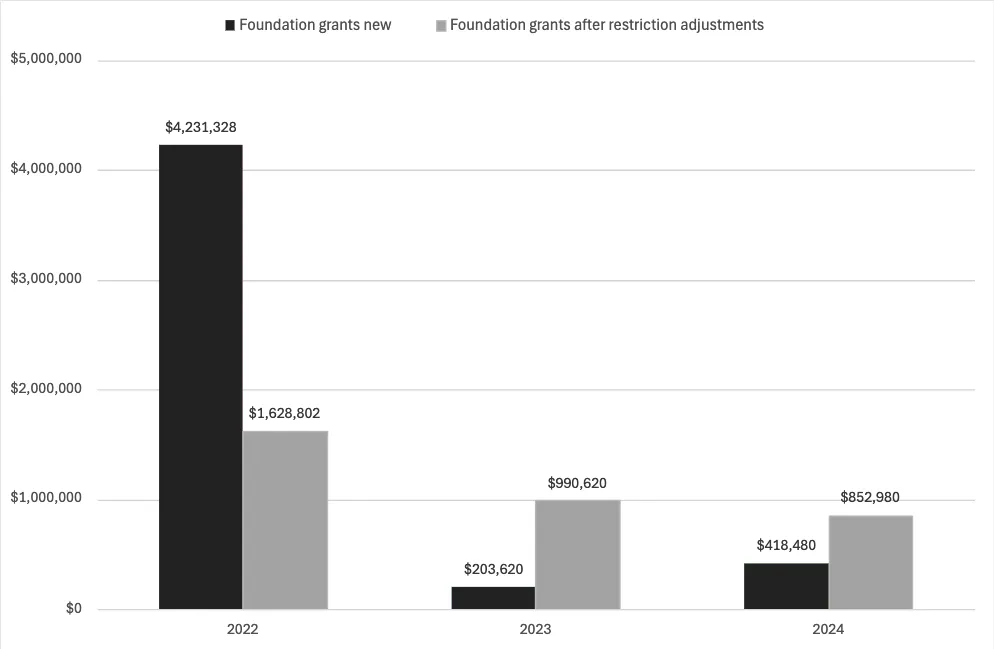
Individual and foundation contributions continued to serve as core support for the Bulletin's mission-critical work in 2024. We present examples of this throughout this annual report. I am pleased to share that those contributions provided nearly $2.7 million to support our work. The charts labeled "New Individual Gifts and Corporate Support" and "Foundation Support," show a comparative analysis of contributions over the past two years. With recent changes in a major funder's priorities, we will need to replace this support, and renew past multi-year support for our bio work in order to continue the impact and outreach we have demonstrated over previous years.
Revenue in 2022 reflects significant contributions supporting our work on bio-risk and more general capacity building. These contributions were intended to be utilized over several years to enable growth in these crucial areas. They provide a foundation for the Bulletin to build upon in the years ahead to seek additional support. A corresponding increase in expenditures for specific initiatives accompanied these increased revenues and offset their net effect. These multi-year grants and commitments are reported as revenue in the fiscal year when pledged as required by Generally Accepted Accounting Principles (GAAP). They will need to be replaced in the near future.
The upfront recognition required by GAAP occurs even when funds may not be received or used until the later years of the grant's disbursement. These requirements continue to make the annual presentation challenging as their operational use spans multiple years. Note that the deferral of such revenue for future operations occurs before our financial reports calculate net revenue for the year. Our ability to secure multi-year support is a strong endorsement of our efforts, notwithstanding the required accounting treatment, as multi-year commitments provide external validation of our strategy, governance, and impact.
In addition to temporarily restricting contributions for future periods and initiatives, the Bulletin uses surpluses of unrestricted net assets to support future operations when results end positively. The Bulletin ended 2024 with an operating surplus that was added to our unrestricted net assets at the end of the year and is allocated for use in 2025. Contributing to this surplus were continued strong returns on investments, resulting from interest rates remaining at higher levels. While these rates are expected to drop in 2025, the Bulletin has utilized a balanced strategy by purchasing fixed-rate treasuries to ensure continued income streams this year and beyond.
Readers will notice that the Bulletin maintained a strong Statement of Financial Position or balance sheet in 2024. Most assets are investments reserved for future use due to multi-year grants received upfront and board-approved operating and strategic reserves. The Bulletin invests in a conservative portfolio of assets spread among numerous classes of investments. Such amounts are released from restriction into normal operations to meet requirements. As in the past, the Bulletin has no long-term debt and maintains minimal short-term liabilities, which rarely exceed thirty days.
If you have any questions about this report or need additional financial information, please do not hesitate to contact the Bulletin at [email protected].
Thank you for your generous and sustained support. We could only do this with you.
Sincerely,
Rachel Bronson, PhD
Former President and CEO
Revenue
Operating Revenue
Please tap and scroll left on the table below to view the full dataset on smaller screen sizes such as mobile.
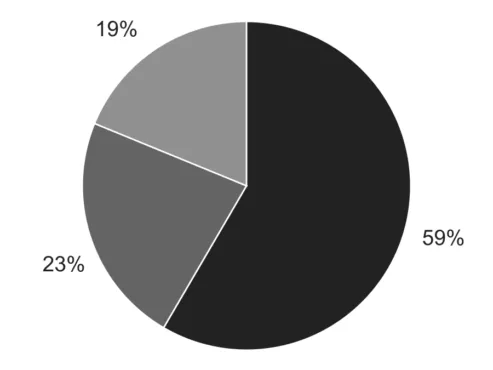
| Donor support | $1,066,900 | 59% |
| Foundation grants | $418,480 | 23% |
| Magazine & Other | $339,534 | 19% |
| Total *after restriction adjustments | $1,824,914 |
Expenses
Operating Expenses
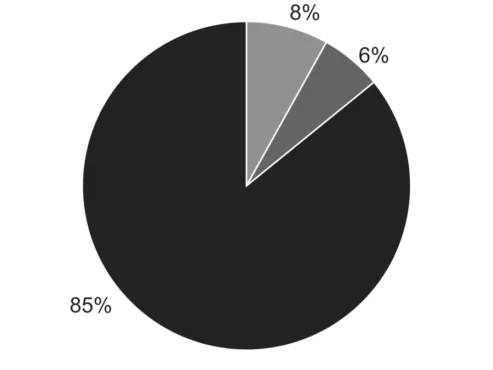
Please tap and scroll left on the table below to view the full dataset on smaller screen sizes such as mobile.
| Program | $3,132,484 | 85% |
| Fundraising | $309,478 | 8% |
| Management and general | $226,850 | 6% |
| Total | $3,668,812 |
Gifts
New Individual Gifts and Corporate Support
FY 2022-2024
All amounts in US Dollars
Foundation Support
FY 2022-2024
All amounts in US Dollars
Activities
| STATEMENT OF ACTIVITIES | |
| FOR THE YEAR ENDED JUNE 30, 2024 | |
| REVENUE AND OTHER SUPPORT | |
| Revenue and support without restriction: | |
| Magazine | 220,055 |
| Individual gifts and corporate support | 1,066,900 |
| Foundation grants | 418,480 |
| Other revenue | 119,479 |
| In-kind support* | 781,269 |
| $2,606,183 | |
| Prior revenue released from restriction: | $847,371 |
| TOTAL REVENUE AND OTHER SUPPORT | $3,453,554 |
| OPERATING EXPENSES BY FUNCTION | |
| Publication and website program | 2,489,650 |
| Fundraising | 309,478 |
| Management and general | 88,415 |
| In-kind support* | 781,269 |
| TOTAL OPERATING EXPENSES | $3,668,812 |
| NET CHANGE IN ASSETS - UNRESTRICTED** | $(215,258) |
| *In-Kind support is categorized as follows: | |
| Writers contributions | 642,834 |
| Professional Services | 138,435 |
| Total in-kind support | $781,269 |
| ** Net change in assets is utilized as follows: | |
| Audited net change in unrestreicted net assets | (215,258) |
| Internally deferred revenue from prior fiscal years | 348,484 |
| Depreciation | 16,918 |
| Unreleased investment gains | (27,081) |
| Net operating surplus carryforward | $123,063 |
Position
| STATEMENT OF FINANCIAL POSITION | |
|---|---|
| FOR THE YEAR ENDED JUNE 30, 2024 | |
| ASSETS | |
| Current Assets: | |
| Cash and investments | 2,251,335 |
| Accounts receivable, net of allowance | 42,500 |
| Pledges receivable | 200,415 |
| ERTC Receivable | 92,344 |
| Prepaid expenses | 28,382 |
| $2,614,976 | |
| Noncurrent Assets: | |
| Property and equipment, net | 15,927 |
| Website improvements, net | 33,675 |
| $49,602 | |
| TOTAL ASSETS | $2,664,578 |
| LIABILITIES AND NET ASSETS | |
| Liabilities: | |
| Accounts payable and accrued expenses | 75,934 |
| Deferred subscription revenue | 21,201 |
| $97,135 | |
| Net Assets: | |
| Without donor restrictions | 1,767,028 |
| With donor restrictions | 800,415 |
| $2,567,443 | |
| TOTAL LIABILITIES AND NET ASSETS | $2,664,578 |
| CHANGE IN UNRESTRICTED NET ASSETS | |
| Net assets, beginning of the year | 3,179,657 |
| Change in net assets - without restrictions | |
| Net assets restricted in current year | 450,415 |
| Net assets released from prior restrictions | (847,371) |
| Net assets, end of the year | $2,782,701 |