No, the United States does not need a costly national cancer study near nuclear reactors
By Adam Stein, PJ Seel | Analysis | January 2, 2026
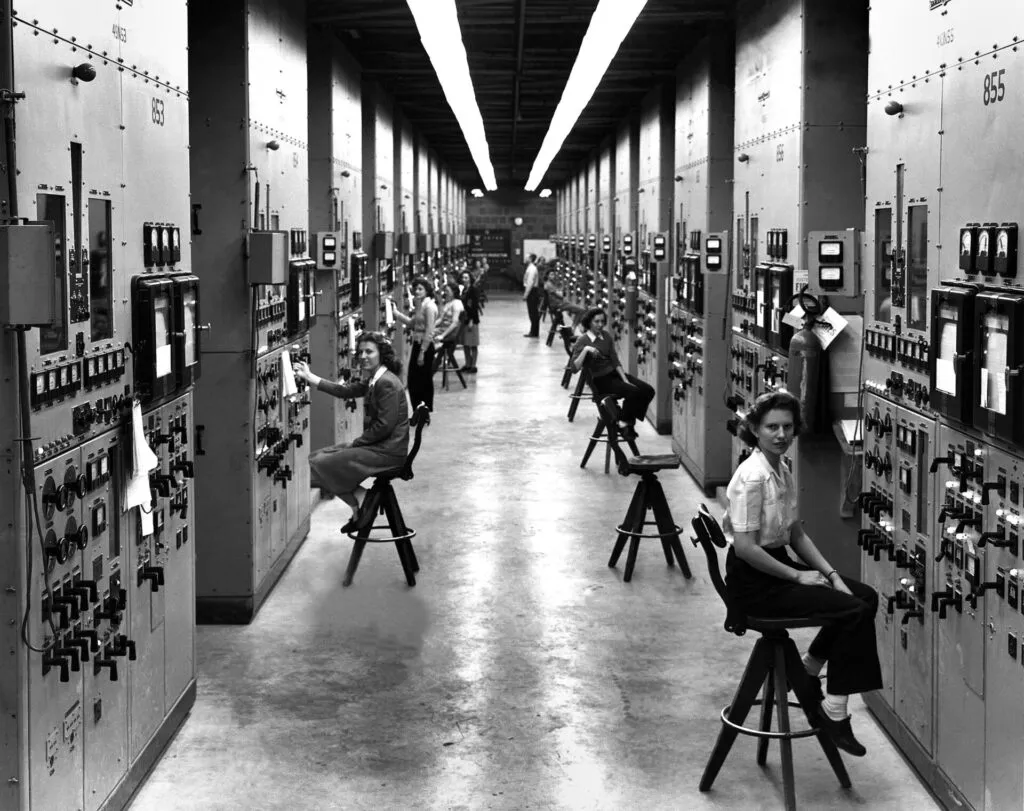 The Energy Department‘s Million Person Study is the most extensive epidemiological study of US nuclear workers and atomic veterans exposed to low-dose radiation throughout the last century, including the Calutron female operators who refined uranium ore into fissile material at the Y-12 plant at Oak Ridge, Tennessee during World War II. The study provides several orders of magnitude greater statistical power than any community-based population study ever will. (Photo credit: Ed Westcott / US Army / Manhattan Engineering District)
With the return of nuclear energy to the public square and serious efforts among policymakers to commercialize a new generation of reactors in the United States and Europe, familiar claims about the risks of nuclear reactors have returned as well. In a recent Bulletin article, Joseph Mangano and Robert Alvarez call for a new national cancer study focused on communities near nuclear power plants before any further expansion of nuclear power is undertaken in the United States. The authors are long-time opponents of nuclear energy and repeat claims based upon decades-old studies and outdated science that not only ignore an enormous body of better and more recent data but also defy contemporary scientific understandings of the health risks associated with low doses of ionizing radiation.
However, the scientific consensus on this question is clear: The United States does not need a national cancer study near nuclear reactors.
Routine reactor emissions, both activated material (made radioactive by neutron bombardment) and fission by-products, pose no meaningful health risk. Even if some vanishingly small effect existed, it would be statistically indistinguishable from the background cancer rate and would be lost in the noise of lifestyle, environmental, and biological risk factors.
How do we know this? Because large sample studies have tracked the health of millions of workers exposed to routine ionizing radiation and found no definite link to increased risk of cancer at low effective doses—defined as below 0.1 Sievert, the international unit commonly used to estimate the health effects of radiation exposure.

Worker vs. public exposure. Workers at nuclear power plants, national laboratories, medical facilities, and other sites where they might be exposed to above-background doses of radiation are closely monitored by employers and occupational health authorities in the United States. Many such workers wear dosimeters that measure real-time radiation exposure. Their clothing is tested for radiation contamination. Air filters in ventilation systems are monitored for radiation contamination as well.
All that testing and monitoring provides an enormous trove of data from which to examine the radiological doses that workers are routinely exposed to and the long-term health consequences of those exposures. That data is far more robust and reliable than the decades-old population-based studies of communities near nuclear facilities that keep being used in articles that oppose nuclear energy, including Mangano and Alvarez’s.
The Energy Department’s Million Person Study, for instance, has collected and is tracking the most extensive cohort of US nuclear workers and atomic veterans exposed to low-dose radiation throughout the last century, using modern dosimetry in contemporary analysis and improving historical calculations. The study, whose findings have been published in peer-reviewed scientific journals, provides several orders of magnitude greater statistical power than any community-based population study ever will, resulting in far more reliable data that tracks actual radiation exposure of nuclear workers in the United States.
Routine occupational doses will always be greater than or equal to those received by the surrounding public. Yet, according to Idaho National Laboratory, even most of the closely monitored US nuclear workers receive no measurable annual dose, and those who do receive a dose average equal to only 2 percent of the occupational limit. By the simple physical reality that the public stands at a greater distance, beyond the physical barriers of nuclear facilities, and is exposed to radioactive materials that first undergo environmental dilution, its members cannot receive more radiation than the nuclear workers do. If atomic workers, who are the most exposed group, show no measurable increased risk of cancer from routine operations, the public cannot either.
Distinguishing the contribution of a radiation exposure dose measured in hundredths of a millisievert from the many other contributors to cancer is simply not possible. In 2006, the average American received about 6.2 millisieverts per year from natural background and medical imaging. Living near a nuclear power plant typically adds less than 0.01 millisievert per year—two orders of magnitude lower and comparable to the radiation exposure one receives from a few hours of air travel. Any measurable health effects from these average very low radiation exposure doses from nuclear power plants are further confounded by risk factors such as smoking, radon, air pollution, pesticides, diet, and workplace exposures, each individually contributing to a far larger extent to cancer incidence than routine reactor emissions possibly would.
Decades of monitoring of routine radiological exposures to nuclear workers have failed to find any statistically significant association with cancer incidence or mortality for the simple reason that radiation is a relatively weak carcinogen, particularly when compared to many common lifestyle and environmental hazards. Large occupational cohorts like the international epidemiological study of nuclear workers (INWORKS), funded by the International Agency for Research on Cancer, illustrate this point. Most of the dataset lies in the very low dose range, that is, below 20 milligrays. (Gray is a unit measuring the dose physically absorbed by tissues, which depends on the type of radiation. In general, for external radiation (non-ingested), 1 Gray can be assumed to be 1 Sievert.)
In the very low absorbed dose range, the variation in cancer incidence is so large that any effect is not statistically significant, and a statistical relationship can be established only at the cost of making conservative assumptions. Most often, this involves assuming a linear dose-response relationship from the outset and treating stratification on factors like age, sex, and employment duration as sufficient to control confounding (despite lacking individual data on smoking, diet, or other lifestyle factors) and without formal analyses of how strongly unmeasured confounders might influence the results. INWORKS is fundamentally refining current radiation protection assumptions rather than testing whether they are correct in the first place.
The current model for identifying possible causal relations between low-dose radiation exposure and increased risk of cancer consists of drawing the best straight line that connects zero to the high-dose region, in which the relationship becomes statistically significant. But this linear no-threshold (LNT) model is inappropriate for use in regulatory decisions because the data is not sufficient to establish a strong relationship in the low dose region. The system of international radiological protection uses collective dose as an indicative measure in protection, and it is specifically discouraged for risk projection, especially for any single individual.
Despite claims to the contrary in another recent Bulletin article, there is no scientific consensus on the validity of the LNT model in the low-dose region. The consensus, if there is one, is that there is substantial uncertainty of the type and magnitude of an effect, if an effect exists in the low-dose region, and therefore a hypothesis of a linear model is equally difficult to reject and accept outright. Yet, the rejection of the LNT model, as ordered by the Trump administration, would necessitate adopting another model in its place. But there is no other model available that can provide more clarity to explain the highly variable data in the very low dose region, for the essential reason that establishing a causal relationship at such low probability would require a dataset from a very large cohort having received similar radiation exposure. An alternative approach could consist of setting a reasonable and science-based regulatory threshold for lower doses for which effects begin to show statistical significance in some studies, and safety concerns are low enough to not warrant concern or action below such value.
New analytical tools are also being developed that will better make use of the existing data. For instance, a recent study (which has not been published in a peer-reviewed journal yet) that conducted a causal machine-learning analysis (a new discipline that consists of identifying, modeling, and quantifying causal relationships) of the Japanese atomic-bomb survivor cohort tracked for over 70 years found clear dose-related effects at higher doses. But that same study could not find any causal signal for radiation dose below about 50 millisieverts, which is eight times higher than the average annual radiological dose experienced by an American individual and 5,000 times higher than the additional exposure due to routine operations from nuclear power plants that a resident of the surrounding community is exposed to on average. This study is significant for its approach because it uses reproducible, transparent methods that attempt to assess the causal relationship between low doses and cancer risk as if running a randomized study with the data. Such tools are being considered to reanalyze the data of the Million Person Study on low-dose radiation exposure of US nuclear workers and atomic veterans.
Chasing statistical ghosts. Instead of considering these robust, contemporary studies, featuring better dosimetry, larger samples, and proper controls, Mangano and Alvarez rely upon a handful of studies from the 1960s and 70s known to suffer from a variety of flaws that plagued the radiological health field in the decades after World War II. These early studies typically used small sample sizes and failed to adequately control for other risk factors like smoking, socioeconomic status, or air pollution.
Many such studies have tested dozens of cancer types, subgroups, and regions, making it more likely to find (false) positive associations that would appear merely by chance. Moreover, publication bias ensured that studies reporting negative or non-existent findings were less likely to be published in the peer-reviewed literature, skewing the perception of risk by magnifying the instances in which a positive finding, however random, had been found.
The 1974 Washington State Health Department study of Hanford workers that the authors cite prominently is a good example of the limitations of early studies. This study lacked effective individual dosimetry data, relying instead upon crude occupational classifications to estimate radiation exposure. As was so often the case at the time, it failed to control for confounding factors such as smoking, socioeconomic status, prior medical history, and workplace exposures to non-radioactive chemicals. As a result, the study found elevated mortality rates among Hanford workers that later studies did not corroborate. This was likely compounded because “missing annual external dosimetry records were more common for workers employed in the early years of Hanford’s operation.”
The most rigorous follow-up analysis of the Hanford study, published in 1989, found no positive dose-response relationship for all cancers combined or for leukemia. The updated analysis concluded that Hanford workers had “death rates substantially below those of the general US population.” These results are to some degree confounded by the “healthy worker effect,” a frequent phenomenon in occupational health in which the working population is often healthier by many measures than the general population because they are self-selected for their job by their age, activity, and social status. Still, this far more robust analysis concluded that there was “no evidence of a positive correlation of radiation exposure and mortality from all cancers combined.”
The controversy surrounding Thomas Mancuso’s earlier research at Hanford provides another example. A comprehensive peer review of Mancuso and colleagues’ report published in 1979 found serious methodological problems, concluding that adjusting the sample for age and calendar year of death reduced the association with radiation dose.
Early studies also often fell victim to the “finder principle,” which posits that if you look hard enough, you are bound to find something.
Selectively choosing small populations for intensive scrutiny, whether through epidemiological surveys or medical screening, inevitably turns up maladies that would have gone otherwise unnoticed had health authorities or researchers not been looking for them. Had authorities at the time screened populations in other regions, not proximate to nuclear facilities, with the same intensity, they likely would have found similarly overlooked maladies. This is why control groups matter.
Consider the experience after Chernobyl in 1986. Radioactive iodine release caused statistically significant increases in thyroid cancer among highly exposed young populations. However, for all other populations, most lifetime doses were near natural background variation, and adverse health effects were not expected. Both the United Nations Scientific Committee on the Effects of Atomic Radiation (UNSCEAR) and the World Health Organization (WHO) documented that enhanced medical surveillance campaigns uncovered many benign nodules and small cancers, even in control groups, that would never have been detected otherwise. Given the low average dose across the population, these findings were just the regular incidence of thyroid cancers made evident because they were screened for.
While a 1996 study, later reused by the WHO in 2005, said there was a chance for 4,000 radiation-induced cancer deaths, the Chernobyl Forum (nearly all applicable UN agencies, including the WHO), stated in 2006 that “It is impossible to assess reliably, with any precision, numbers of fatal cancers caused by radiation exposure due to Chernobyl accident. Further, radiation-induced cancers are at present indistinguishable from those due to other causes.”[1] That same limitation is even more pronounced and insurmountable for very small doses near operating nuclear power plants.
The act of looking harder produced an apparent increased risk where none existed. Due to this and the low overall exposure, UNSCEAR specifically suggested that individuals “need not live in fear of serious health consequences.”
Richard Clapp’s 1987 Lancet study of leukemia near the Pilgrim nuclear plant in Massachusetts has never been tied to radiation emissions despite several subsequent attempts by state and federal health officials. If routine nuclear plant emissions of radioactive materials were causing measurable increases in cases of cancer, one would expect to see similar patterns near other plants with similar or higher emissions. If the accidental release from Chernobyl, the largest in history, was difficult to detect in the surrounding population, the almost negligible iodine routine release from regular plant operations is nearly statistically impossible to measure.
Focus on Massachusetts still occurs today. A just-released study from Harvard University claims that those living adjacent to nuclear power plants have higher rates of cancer, without any actual data tying cancer to plant emissions, or considering the much higher exposures from natural and medical sources. Cancer epidemiology is truly challenging with so many risk factors, but studies that attempt to correlate without fully utilizing the best modern statistical tools will only generate sensation instead of safety.
Resources would be better used by just increasing cancer screening in the entire US population.
Proportion, not perception. Mangano and Alvarez marshal all that outdated methodology and unsound data in the service of demanding a massive national study to investigate whether nuclear plant operations might be contributing to increased cancer incidence in surrounding communities. The principle appears simple: Newer, well-designed studies with improved methodology provide more reliable information.
Further, the authors claimed that a National Academy of Sciences plan to do so was prematurely abandoned due to budget constraints. And technically, this is true. The Academy and Nuclear Regulatory Commission’s initial phase 1 study attempted to be a small replication of the 1990 cancer study around nuclear plants, and per their own admission, the phase 2 study was canceled since the initial results supported the conclusion that no statistically valid results could be generated. Such a study would further confuse the issue, because it would be as likely to show a false-positive as a real effect, with no way to be confident which it was. This conclusion reflects not so much fiscal constraints as the underlying epidemiological reality of low-dose exposure. The reason that any statistically meaningful result would require millions of subjects, multiple decades of surveillance, and at least millions of dollars is that the health consequences of low-dose exposure to ionizing radiation, if they exist at all, are vanishingly small.
The National Academies’ earlier methods document for radiological risk assessment states that sample sizes needed for doses below 20 millisieverts are “prohibitively large.” This is because this effective dose level is several orders of magnitude larger than regular public exposure from power plants (0.001 to 0.01 millisievert). To get usable data and reach sufficient statistical significance, one would need an exposed population, depending on the dose, of between 500,000 and 32 million people, tracked for decades. (Our recent paper on the Nuclear Regulatory Commission’s quantitative health objectives goes into further detail on this.)
Despite these challenges, and to satisfy Mangano and Alvarez’s demand, the United Kingdom completed a study of cancer rates near nuclear power plants just this year. The study confirmed an earlier study and found no increases in cancer rates among children in communities closer to nuclear installations, even with types of cancer that are more sensitive to ionizing radiation.
A 2022 consensus report from the National Academies identified controlled laboratory-based biological studies as the only appropriate course to resolve low-dose uncertainty, not studies of populations near nuclear facilities. This report doubled down from the Academy-Commission study, making clear that reducing uncertainty in low-dose risk estimates would require a multi-decade program costing roughly $1.6 billion. But even then, there would still be an uncertain likelihood of producing reliable results.
Fifty years of studying millions of nuclear workers and residents near plants have demonstrated that routine nuclear plant operations pose no detectable health risk to the public. By contrast, a study by the Environmental Protection Agency and the National Academy of Sciences estimated that up to 22,000 people died from radon-induced lung cancer annually, with a quarter of cases being among non-smoking individuals.
At a comparable cost to what Mangano and Alvarez propose for a national cancer study, we could mitigate radon exposure in 100,000 homes per year. Focusing on the highest exposure areas, this could save hundreds of lives every year as opposed to zero from a statistically useless study. That’s what proportionate risk management means.
There are many better ways to spend money that could actually save lives, including building more nuclear reactors to reduce emissions of fine particles and other airborne pollutants. Unfortunately, Mangano and Alvarez’s proposal creates new barriers to nuclear energy expansion by stoking baseless fears of low-dose radiation exposure. A United Nations Development Program Secretary summed up a common theme to the Chernobyl Forum: “The bottom-line message … is that poverty, not radiation, is the real danger.” Promoting the well-being of communities with nuclear power will do more for people’s lives than any study could hope to help with chasing small statistical risks. If science cannot, as the UN notes, reliably estimate cancer fatalities from the world’s worst accident that had prompt fatalities, then it won’t find them in the exposure range below 0.01 millisievert that the average member of the public receives from the US operating fleet.
Radiation safety is too important to be wasted on studies that cannot deliver answers. Science should chase questions that can be realistically answered and offer solutions to reduce risks that can actually save lives.
Notes
[1] The World Health Organization Health Expert Group for the UN Chernobyl Forum published a report in 2005 that suggested 4,000 additional deaths could occur from radiation exposure. These values were pulled from a report a decade earlier, in 1996, by Cardis and co-workers. The mortality forecast they found was based on pre-accident knowledge and dosimetry data at the time of the accident, and used a simple model that assumed high dose rates without dose-rate factors. Nearly 40 years after the accident, the early projections have not been shown. Instead, the WHO, UNSCEAR, and other international bodies have concluded that it is impossible to attribute even these large radiation exposures to increases in cancer rates.
Together, we make the world safer.
The Bulletin elevates expert voices above the noise. But as an independent nonprofit organization, our operations depend on the support of readers like you. Help us continue to deliver quality journalism that holds leaders accountable. Your support of our work at any level is important. In return, we promise our coverage will be understandable, influential, vigilant, solution-oriented, and fair-minded. Together we can make a difference.
Keywords: DOE, Energy Department, Million Person Study, National Academy of Sciences, Nuclear Regulatory Commission, Three Mile Island, US nuclear power plants, cancer risk, linear no-threshold model, low dose radiation, low level radiation risk, nuclear reactors, nuclear safety, occupational dose, public health, radiation-induced cancers
Topics: Nuclear Energy

Adam Stein
Adam Stein is the director of the Nuclear Energy Innovation program at the Breakthrough Institute. ... Read More













Leave a Reply